


The foundation is the unsung hero of any structure, silently bearing loads and ensuring stability. While there are multiple foundation systems available, the Mat or Raft Foundation has carved a niche for itself, especially in specific construction scenarios. This article delves deep into the nuances of this foundation type, elucidating its construction, benefits, and inherent challenges.
What is a Mat Foundation and Why is it Used?
A mat foundation is a thick, solid concrete slab that extends under the entire footprint of a building. It is reinforced with steel to make it strong enough to support the weight of the building and distribute the load evenly over the soil.
Mat foundations are often used in areas with weak soil or where there is a risk of flooding. This is because they can spread the weight of the building over a large area, which reduces the amount of pressure placed on the soil. Mat foundations are also a good choice for buildings with large footprints, such as warehouses or apartment complexes.
KeyComponents of Mat or Raft Foundations
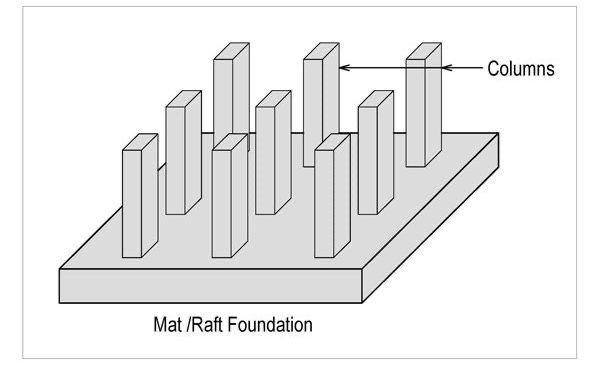
Mat or raft foundations are a type of shallow foundation that is used to support the weight of a building on weak soil. They are made up of three key components:
- Concrete slab: The concrete slab is the main component of a mat foundation. It is a thick, solid slab that extends under the entire footprint of the building. The concrete slab is reinforced with steel bars or mesh to make it strong enough to support the weight of the building.
- Reinforcements: The reinforcements are steel bars or mesh that are embedded in the concrete slab. They help to distribute the weight of the building evenly over the slab and prevent it from cracking.
- Stiffening beams: Stiffening beams are often incorporated into the concrete slab to counteract bending and deflection. They are made of steel or concrete and are placed at regular intervals across the slab.

Benefits of Mat or Raft Foundations
Mat or raft foundations are a type of shallow foundation that is used to support the weight of a building on weak soil. They offer several benefits, including:
- Uniform load distribution: Mat foundations spread the load of the building over a large area, which reduces the stress on the underlying soil and helps to prevent differential settlement.
- Versatility: Mat foundations are versatile and can be used in a variety of soil conditions, including those with low bearing capacity. They are also a good choice for buildings with heavy loads, such as apartment complexes or warehouses.
- Minimal groundwork: Mat foundations require less excavation than other types of foundations, which can save time and money.
- Resilience: Mat foundations are resilient and can withstand potential soil movement or other adverse conditions. With proper reinforcement, they can provide a stable foundation for even the most challenging structures.
Potential Limitations of Mat Foundations
Mat foundations are a type of shallow foundation that is used to support the weight of a building on weak soil. However, they do have some potential limitations, including:
- Cost: Mat foundations can be more expensive than other types of foundations due to the amount of concrete and reinforcement that is required.
- Site preparation: Mat foundations require thorough ground leveling and preparation. This can be a time-consuming and expensive process.
- Moisture vulnerability: Mat foundations are close to the ground surface, so they can be susceptible to water ingress if not properly waterproofed.
Considerations for Optimal Mat or Raft Foundation Construction

Mat or raft foundations are a type of shallow foundation that is used to support the weight of a building on weak soil. They are versatile and effective foundation types, but there are a few key considerations that need to be taken into account for optimal construction.
- Soil analysis: A detailed soil investigation should be conducted to determine the bearing capacity of the soil and identify any potential challenges. This information will help to ensure that the foundation is designed to support the weight of the building and resist any potential movement of the soil.
- Architectural design: The building’s architectural design should also be taken into account when designing the foundation. The load points and potential stress areas of the building need to be factored into the foundation’s blueprint to ensure that it is strong enough to support the structure.
- Waterproofing measures: Mat or raft foundations are close to the ground, so it is important to incorporate effective waterproofing solutions to prevent moisture-related issues. This may include using a waterproof membrane or sealant, as well as grading the ground away from the foundation to prevent water from pooling.
Mat or Raft Foundations, with their capability to distribute loads uniformly, offer an effective solution for structures in areas with challenging soil conditions or where basements are intended. However, the key to their success lies in meticulous planning, design considerations, and expert execution. When constructed with precision, they can provide a robust, long-lasting foundation that ensures the stability and longevity of the superstructure it supports.








Leave a comment