

Once a quiet suburban town, Imus City, Cavite has evolved into one of the South’s most dynamic growth centers—an urban hub balancing accessibility, modernity, and community living. Strategically positioned just 21 kilometers south of Metro Manila, Imus serves as a vital gateway between the capital and the wider province of Cavite. Its location along key transport corridors like Aguinaldo Highway, Daang Hari, and the upcoming CALAX and LRT-1 Cavite Extension makes it one of the most connected and investment-ready cities in Southern Luzon.
Over the past decade, Imus has transformed from a bedroom community into a self-sustaining citywith thriving business districts, master-planned residential enclaves, and a fast-growing commercial scene. The momentum is unmistakable—families are relocating here for better quality of life, while investors are betting on long-term appreciation fueled by infrastructure and economic expansion.
While Cavite as a whole continues to evolve, Imus stands out as its beating heart—a city that captures the province’s shift toward urban sophistication and sustainable growth.
Overview of Imus City
Location & Accessibility
Imus City sits in the heart of Cavite province, forming a vital link between Metro Manila and the fast-developing Southern Luzon corridor. It’s located approximately 21 km south of Makati—making it one of the most accessible growth cities outside Metro Manila. Major thoroughfares drain through Imus, including the historic Aguinaldo Highway, the expanding Daang Hari–CALAX corridor, and other road links that significantly enhance mobility and drive real-estate demand.

City Profile
Land Area & Population
According to the latest data from the Philippine Statistics Authority (2020 Census), Imus covers approximately 171.66 square kilometres and is home to 496,794 residents.
Administrative Status
Imus is classified as a component city, part of Cavite’s 3rd District, and holds 97 barangays.
These data points position Imus as not just a suburb, but a significant regional centre in its own right.
Economic Character
Once known largely as a residential suburb, Imus City has transformed into a mixed-use hub combining living, working and commerce. The emergence of logistics complexes, business parks (for example, the Anabu Hills Industrial Estate), and commercial strips underscores this shift. For real-estate investors and home-buyers alike, this evolution signifies the convergence of infrastructure and economy—a combination that reliably boosts property values, rental demand and long-term growth prospects in the city.
Infrastructure and Connectivity
Infrastructure is the lifeblood of Imus City’s transformation—and the reason it continues to attract investors, homebuyers, and businesses moving south of Metro Manila. With multiple expressways, highways, and upcoming transport projects intersecting the city, Imus has become one of Cavite’s most strategically connected hubs.
Major Road Networks
Imus sits at the crossroads of several key transport arteries that link it directly to Metro Manila and nearby growth areas in Cavite and Laguna.
Aguinaldo Highway
The main north–south spine connecting Imus to Bacoor, Dasmariñas, and Metro Manila. This route remains vital for daily commuters and logistics transport.
Daang Hari Road
A gateway route leading straight to Alabang via the MCX (Muntinlupa–Cavite Expressway), cutting travel time to Muntinlupa and Las Piñas to as little as 25–30 minutes.
CALAX (Cavite–Laguna Expressway)
The game-changer in Cavite mobility, linking Imus and General Trias to the South Luzon Expressway (SLEX) and the emerging business zones in Laguna. Once fully operational, CALAX will drastically shorten travel between Cavite and major Metro Manila business centers.
LRT-1 Cavite Extension
Set to open its first phase by 2025, this 11.7-kilometer expansion will extend the existing LRT-1 line from Baclaran to Niog, Bacoor—just a few minutes from Imus City. This project will reduce travel time from Cavite to Pasay and Makati from over 90 minutes to around 40 minutesduring peak hours.
Upcoming Developments
Imus continues to benefit from the government’s “Build Better More” infrastructure agenda, with several new projects enhancing its connectivity and livability:
Imus Transport Terminal
A new integrated terminal being developed to streamline commuter routes to Metro Manila.
Cavite–Laguna–Batangas Spine Road
A major corridor under planning that will connect Imus to CALABARZON’s key cities.
Bypass Roads and Commercial Corridors
Ongoing expansions in Alapan, Medicion, and Anabu areas are opening new mixed-use developments and reducing congestion on Aguinaldo Highway.
Travel Times: Then vs. Now
Before these projects, traveling from Imus to Metro Manila’s key districts often took 90–120 minutesduring rush hours. With the combined effect of MCX, Daang Hari, CALAX, and the LRT-1 extension, travel times are being dramatically reduced:
Imus to Makati CBD
40–50 minutes (previously 1.5–2 hours)
Imus to BGC (Taguig)
45–55 minutes (previously 1.5 hours)
Imus to Alabang
25–30 minutes (previously up to 1 hour)
These improvements aren’t just enhancing convenience—they’re raising land values and rental yields, particularly in subdivisions and condo projects near major access points. Accessibility has evolved from a selling point into a decisive investment driver.
Real Estate Market Overview
Property Types
In Imus City you’ll find a broad spectrum of residential options—each catering to distinct buyer segments and investment strategies.
- Subdivisions and house-and-lot estates remain the backbone of the market. These appeal especially to young families seeking space and security.
- Townhouses are gaining traction as a value-driven alternative. For example, average listing prices for townhouses hover around ₱ 49,930 / sqm.
- Mid-rise condominiums are now entering the mix, as vertical development starts to complement horizontal growth. Emerging for both owner-occupiers (local professionals) and investors (rental market).
Average Prices (2025)
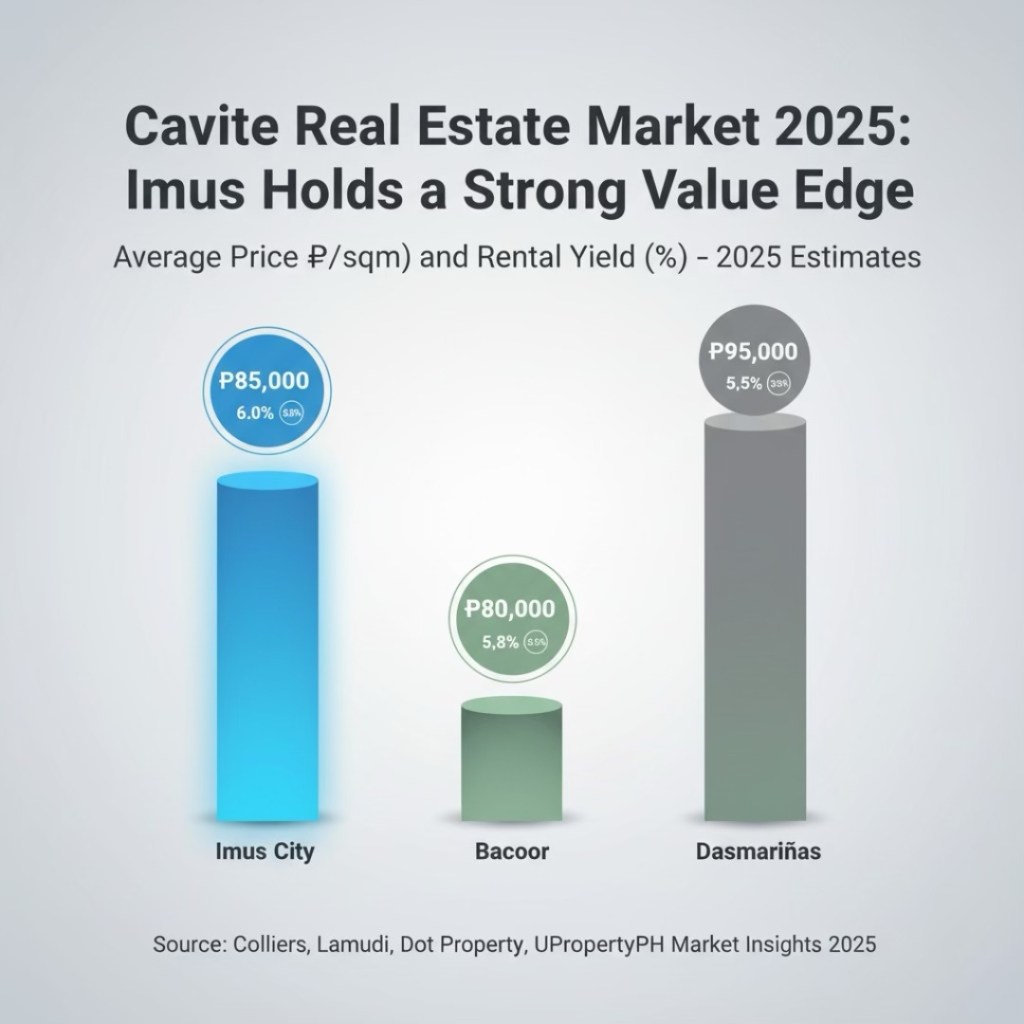
The latest available data indicate a strong upward trajectory in land, townhouse and house prices in Imus City:
- Residential lots near growth nodes in Imus have listing figures in the range of ₱ 49,000-₱ 59,000 per sqm.
- Houses show median list price per sqm at around ₱ 89,171 per sqm.
- For land alone, some listings show ₱ 35,000+ per sqm in less-premium zones.
These numbers reflect that Imus still offers a relative discount compared with other peri-Metro Manila cities—but the gap is narrowing quickly.
Market Trends
Several unmistakable trends are reshaping the Imus real-estate market:
A shift from horizontal to vertical developments
As land becomes scarcer and pricier near major arteries (Daang Hari, Aguinaldo Hwy), developers are delivering mid-rise and even mixed-use condominium products. The trend is backed by national research showing suburban markets embracing vertical living.
Increasing interest from OFWs and Metro Manila professionals
With the commuting distance improving via new infrastructure, Imus becomes attractive for city-based professionals seeking better value. Also, OFWs view the area as a strong capital-appreciation play.
Value appreciation driven by infrastructure
Property values in areas like Vermosa have seen dramatic increases—one estimate noted a rise from ~₱900/sqm in 2011 to ~₱21,600/sqm in 2024 for certain lots.
Rental market gaining momentum
With more young working families and professionals moving south, demand for rental townhouses and condos is growing. This adds a dimension of cash-flow for investors, not just capital gain.
Top Developers & Signature Projects
Imus City is attracting major players who are shaping the city’s real-estate identity:
Ayala Land / Avida Homes
With projects such as Verra Settings Vermosa, they bring brand, infrastructure-led development and resale potential.
Vista Land and Lifescapes Inc.
Known for subdivision ventures, especially in the family-friendly segments.
Alveo Land Corporation
With premium benchmarks (e.g., Caleia Vermosa) setting higher-end pricing floors in Imus.
These developers underscore the shift of Imus from a mere fringe area to a serious real-estate frontier.
Lifestyle and Livability
Imus City delivers the suburban calm many crave, without giving up the energy and convenience of modern city life. As Cavite’s historic capital turned growth center, it offers a balance that appeals to families, professionals, and investors alike — affordable living, strong infrastructure, and a governance framework built on safety and sustainability.

Residential Appeal: Suburban Calm Meets Urban Access
Life in Imus feels slower — in the best way. Tree-lined subdivisions, family-friendly parks, and master-planned communities dominate the landscape. Gated enclaves and modern townships offer a sense of order and security, while proximity to Daang Hari, CALAX, and the LRT-1 Cavite Extension keeps Metro Manila well within reach. Whether you’re a first-time homeowner or scaling up from a city condo, Imus gives you the space and lifestyle breathing room without disconnecting you from the metro’s pulse.
Education and Healthcare: Quality Within Reach
Imus is strategically surrounded by some of Cavite’s top educational and medical institutions. De La Salle Medical and Health Sciences Institute and De La Salle University Dasmariñas anchor the academic hub nearby, while top-rated schools like Imus Institute of Science and Technology provide strong local options.
Healthcare is equally accessible — with De La Salle University Medical Center, Imus Doctors Hospital, and Our Lady of Pillar Medical Center serving as major healthcare anchors in the area.
Leisure and Shopping: Everything Within 15 Minutes
Weekends in Imus are effortlessly convenient. Vista Mall Imus, Robinsons Place Imus, and The District Imus provide everything from daily essentials to upscale retail and dining. Emerging lifestyle strips and food parks across Aguinaldo Highway and Buhay na Tubig cater to the city’s growing young professional demographic. And with nearby Tagaytay just a short drive away, spontaneous weekend escapes are part of everyday living.
Community, Safety, and Livability Metrics
Imus ranks among the most liveable areas in Cavite thanks to its affordable cost of living and active local governance.
According to Numbeo (June 2025), the average meal at a local restaurant costs around ₱240, while a three-course dinner for two averages ₱900–₱1,000 — notably lower than comparable areas in Metro Manila.
The city government’s 2024 Citizen’s Charter reinforces its vision of “a secured and healthy citizenry, living in a smart, green and sustainable environment.” That civic focus translates to better-managed subdivisions, efficient barangay policing, and active environmental planning under Cavite’s Ecological Profile 2023, which highlights Imus’s integration of open green spaces and mixed-use urban design.
In simple terms: Imus delivers safety, affordability, and sustainability — the three pillars of modern suburban living. With a cost profile friendlier than Metro Manila, a proactive city government, and a lifestyle ecosystem that supports both family growth and investment value, Imus continues to rise as one of Southern Luzon’s most liveable cities.
Investment Potential
Capital Appreciation
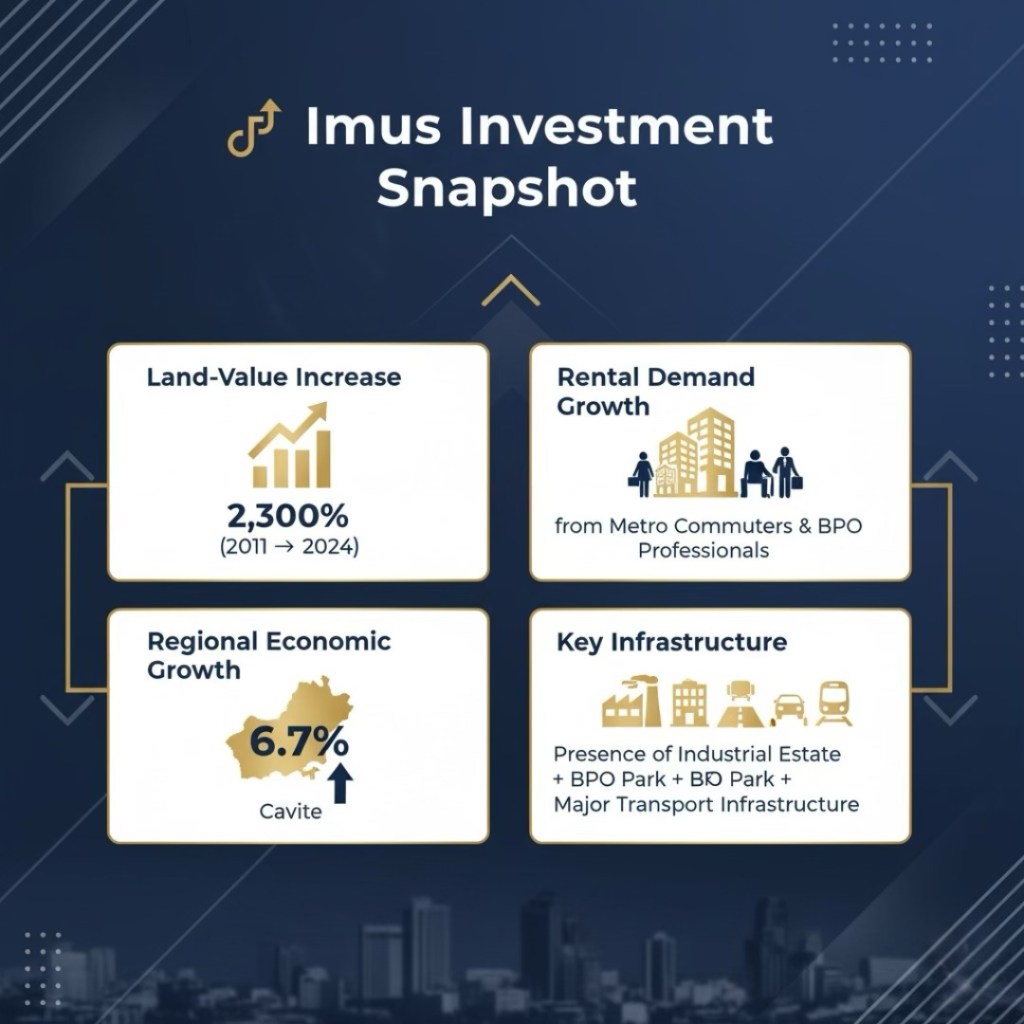
Imus City is undergoing a dramatic value shift. In key zones—such as Vermosa along Daang Hari Road—land prices surged from about ₱900 per sqm in 2011 to ₱21,600 per sqm by 2024, marking a staggering increase of over 2,300%. This is no isolated breakout: the city’s positioning within CALABARZON—one of the highest-growth regions in the Philippines—supports a broader narrative of upward trajectories. With improved connectivity, imminent transport infrastructure, and industrial/logistics hubs entering the market, expect appreciation to continue as Imus transitions from “emerging” to “established growth corridor.”
Rental Market
Affordability plus proximity equal opportunity—Imus is becoming a magnet for professionals working in Metro Manila who are seeking value. A 2025 analysis highlighted steady demand from Metro-based commuters and OFWs looking at townhouses and condos in the area. Moreover, as manufacturing and BPO employment grows locally, so does the need for rental housing near workplaces—meaning investors have options for both capital growth and regular cash flow.
Economic Growth
Imus is no longer just a bedroom city.
- The presence of large industrial estates like the 200-hectare Imus Informal Industrial Estate along Gen. Aguinaldo Highway underlines manufacturing activity and employment creation.
- The province of Cavite logged a growth rate of 6.7% (2025 data), driven by industry and services, underscoring the region’s economic momentum.
- The city actively draws BPO/IT operations and logistics locators via zones like the Cavite BPO Project in Anabu II-D, Imus.
In short: job growth = housing demand = investment upside.
Government Initiatives
The local government in Imus is visibly pro-investment. The city is classified as “economically dynamic,” hosts multiple industrial parks, and has streamlined processes for business investors. Moreover, focus areas such as the BPO park, the industrial estate, and infrastructure build-out signal long-term policy alignment with real estate growth. The message to investors: this isn’t pie-in-the-sky—it’s built into the city’s strategy.
Top Emerging Neighborhoods in Imus City
Explore four high-momentum areas within Imus—each offering a unique blend of lifestyle, investment potential, and development trajectory.
1. Anabu (Brgy. Anabu I & II)
Anabu has become Imus’s commercial and mixed-use powerhouse. Anchored by developments along Daang Hari and Vermosa Boulevard, this zone features suburban subdivisions, office-park clusters and retail hubs. For property investors and new homeowners alike, Anabu offers the twin advantages of accessibility (direct reach to MCX / CALAX) and future-proof value growth.
Key highlights:
- A growing number of subdivisions in Anabu II-D list along Daang Hari.
- The presence of large retail centres and amenities within the Anabu growth corridor accelerates lifestyle appeal.
Ideal for buyers focused on: infrastructure-driven growth, rapid appreciation potential, and emerging commercial-residential synergy.
2. Bayan Luma (Central Imus)
Bayan Luma is the established heart of Imus—ripe for those who value a mature neighbourhood, shorter commutes, and full-service living. With proximity to Imus Cathedral, established retail and transport, this area offers fewer unknowns and more stability.
Why it matters:
- Residents in the area enjoy access to older townhouse and house-and-lot inventory, often with more favourable entry pricing.
- Being centrally located reduces travel time, making it particularly attractive for working professionals and local families.
Best suited for: buyers seeking immediate move-in readiness, community-depth and lower development-risk.
3. Alapan & Buhay na Tubig (Emerging Housing Cluster Zone)
These barangays are gaining momentum as newer housing clusters push southwards—offering relatively fresh lots, modern subdivision designs and the potential for volume yield.
Key indicators:
- Buhay na Tubig’s barangay mapping shows active subdivision and residential zoning.
- Alapan (while less referenced in open data here) shares the same corridor logic—growth extends outward from infrastructure nodes.
Ideal for: those targeting early-entry price points, newer homes and mid-term investment horizons (3-7 years).
4. Medicion & Malagasang (Mixed-Use and Inclusive Development Corridor)
This corridor is moving beyond purely residential: it combines mid-rise affordable housing, new infrastructure, and urban-extension patterns.
Notable developments:
- The local government broke ground on a housing project in Malagasang 1-G: five mid-rise, 10-storey buildings covering 1.3 hectares.
- Subdivision listings in Malagasang II show listed pricing around ₱22,831 per sqm (Mary Cris Complex).
Who it’s for: investors targeting rental or mid-rise condos, buyers seeking future value uplift through newer infrastructure, and families looking for newer-build homes at competitive pricing.
📌 Quick Comparison Table
| Area | Primary Strength | Entry Price Tier |
|---|---|---|
| Anabu | Connectivity + mixed-use development | Mid-High |
| Bayan Luma | Mature neighbourhood, central access | Mid |
| Alapan & Buhay na Tubig | Emerging clusters, newer inventory | Entry-Mid |
| Medicion & Malagasang | Inclusive mid-rise & value-uplift corridor | Entry |
Why Invest in Imus City
Imus City stands at the crossroads of progress—strategically positioned, rapidly developing, and full of potential. For investors and homebuyers alike, this Cavite city offers a compelling mix of accessibility, affordability, and sustained growth.
1. Strategic Location Connecting South Luzon and Metro Manila
Imus enjoys a prime location that links the bustling Metro Manila to the rest of South Luzon. Major thoroughfares such as Daang Hari, Aguinaldo Highway, and the upcoming Cavite–Laguna Expressway (CALAX) make daily commutes and logistics highly efficient. Its accessibility attracts both professionals seeking suburban tranquility and businesses targeting the growing Cavite–Manila corridor.
2. Strong Infrastructure Pipeline Enhancing Connectivity
Infrastructure projects continue to fuel Imus’s upward trajectory. The LRT-1 Cavite Extension will soon connect Bacoor and Imus to Pasay and Makati, dramatically cutting travel time and boosting property values along its route. Complemented by CALAX and the Cavite–Tagaytay–Batangas Expressway (CTBEX), the city is evolving into a central transit hub in Southern Luzon.
3. Lower Property Prices Compared to Nearby Urban Centers
While Makati, Taguig, and Alabang have seen steep price escalations, Imus remains competitively priced—making it an ideal entry point for investors and first-time homebuyers. The lower cost of land and housing allows higher potential for capital appreciation as infrastructure developments and urban growth catch up.
4. Consistent Housing Demand from Young Families and OFWs
Imus continues to attract a steady influx of homebuyers—especially young families seeking suburban comfort and OFWs looking to invest their hard-earned income into stable, appreciating assets. The combination of family-friendly communities, reputable schools, and expanding job opportunities ensures consistent real estate demand.
5. Pro-Development Governance and Modernization Efforts
Imus City’s local government actively supports urban modernization through efficient zoning, sustainable land use, and digital governance initiatives. Ongoing projects in smart city systems, transport management, and economic zones demonstrate a strong, future-oriented leadership that inspires investor confidence.
Imus isn’t just growing—it’s transforming into one of Cavite’s most dynamic urban centers. Every investment here positions you at the forefront of a city built for long-term prosperity.
Who Should Consider Buying in Imus
Imus City appeals to a wide range of property seekers—each drawn by its balance of affordability, accessibility, and modern suburban comfort. Whether you’re buying your first home, building your investment portfolio, or planning your retirement, this thriving Cavite city offers a lifestyle that fits your goals.
1. First-Time Homebuyers Seeking Affordable Yet Strategic Locations
For young professionals or starting families, Imus offers the best of both worlds: accessible homes at attainable prices and proximity to Metro Manila’s key business districts. Many pre-selling and ready-for-occupancy properties provide flexible financing options, making homeownership more achievable without sacrificing location or quality of life.
2. OFWs Looking for Secure Long-Term Investments
Overseas Filipino Workers see Imus as a safe and practical choice for growing their real estate portfolio. Its continuous infrastructure improvements and expanding residential communities ensure stable value growth—ideal for those planning future returns or a permanent home upon retirement.
3. Property Investors Targeting Pre-Selling Projects for Value Appreciation
Imus is a hotbed for pre-selling developments from reputable local and national developers. With upcoming transport links like CALAX and the LRT-1 Cavite Extension, early investors can benefit from significant property appreciation once these projects reach completion. The city’s consistent demand for rentals also makes it a strong buy-and-hold market.
4. Families Wanting Suburban Peace Close to City Conveniences
Imus delivers the suburban lifestyle many families crave—quieter neighborhoods, cleaner air, and safe, gated communities—while remaining close to shopping malls, schools, hospitals, and business hubs in Alabang and Metro Manila. It’s a place where families can enjoy space and security without giving up urban comfort.
5. Retirees Seeking Manageable, Accessible Living
Retirees looking to downsize or enjoy a more relaxed pace will find Imus ideal. The city’s accessibility to quality healthcare, leisure centers, and provincial destinations like Tagaytay creates a comfortable and fulfilling retirement setting. Its manageable traffic, moderate cost of living, and welcoming community make daily life simpler and more enjoyable.
Related Articles
📘 [Cavite Real Estate Guide 2025]
Your comprehensive look at Cavite’s top investment corridors, infrastructure plans, and property market outlook. This guide serves as the ultimate resource for buyers, sellers, and investors tracking the province’s rapid urban transformation.
🏙️ [Bacoor Real Estate Spotlight]
Discover why Bacoor is leading Cavite’s rise as Metro Manila’s next southern extension. From its coastal townships and upcoming LRT-1 connection to its booming residential clusters, Bacoor is redefining modern suburban living.
🏡 [Tagaytay City Property Market Overview]
Get a detailed analysis of Tagaytay City—the educational and commercial hub of Cavite. Learn about its strong housing demand, thriving mixed-use districts, and why it’s a favorite among families and long-term investors.
These articles connect the dots across Cavite’s top growth cities—showing how each one contributes to the province’s status as the South’s premier real estate frontier.
Schedule a Viewing or Consultation
Imus isn’t just growing — it’s evolving into one of Cavite’s most strategic real estate hotspots. Whether you’re a first-time buyer, an OFW planning your next investment, or a family looking for a suburban home near Metro Manila, now is the perfect time to explore your options.
Thinking of investing in Imus?
Browse verified Imus property listings on UPropertyPH.com and find developments that match your goals — from affordable townhouses to premium subdivision homes.
📞 Schedule a Free Consultation
Talk to a licensed real estate broker who can guide you through the latest market data, project comparisons, and financing options.
Don’t wait for prices to rise. Secure your spot in Cavite’s next growth center — where accessibility, opportunity, and community converge.




 U-Property PH
Leave a comment