

When the process isn’t the problem—the encounter is.
Introduction — When a Simple Transaction Takes an Unexpected Turn
Paperwork in real estate should be predictable. Requirements are posted, guidelines are published, and the process—at least on paper—looks straightforward. You collect the documents, double-check every page, file them neatly in a folder, and walk into the government office expecting a routine submission. Nothing fancy. Nothing complicated. Just a clean transaction moving forward as it should.
But every broker, every buyer, every seller eventually learns the same uncomfortable lesson: the challenge isn’t always the system. Sometimes, it’s the encounter.
One moment, you’re submitting documents.
The next, you’re staring at an officer insisting on a requirement that doesn’t exist, doesn’t apply to your case, and cannot be produced even if you tried. It’s surreal—like stepping into a side quest you never signed up for.
That moment can derail timelines, rattle even the most prepared transactor, and force you to rethink your next steps.
This is one of those moments.
And it revealed something deeper about how real estate transactions unfold in the Philippines—far beyond listings, negotiations, or property tours. This is the part no one glamorizes but everyone must learn to navigate.
Part 1 — The Story: What Actually Happened
The Morning That Should Have Been Routine
I arrived early—well before the lines snaked around the lobby. If you’ve ever tried to process anything in a government office, you know the magic hour is right before opening. That quiet, optimistic window where you tell yourself today will go smoothly.
My documents were complete.
Organized.
Cross-checked the night before.
I’d done this type of transaction plenty of times. Nothing unusual. Nothing new. The plan was simple: submit the papers, get the receiving copy, and keep my client’s timeline right on track.
When my number flashed on the screen, I stepped up to the counter with the calm confidence that comes from preparation. The officer took the folder and started flipping through the pages with practiced efficiency.
Then he stopped.
Brows furrowed.
Leaned back in his chair.
And just like that, the air shifted.
The Unexpected Detour at the Counter
He pointed to one of the documents and said I needed an additional requirement—something I had never heard of, something nowhere on the checklist, something I knew wasn’t required for my category of filing.
He delivered it with absolute conviction.
Technical jargon.
References to memos and procedures that sounded authoritative but didn’t line up with actual policy.
I clarified politely.
He doubled down.
I explained the guidelines.
He escalated the terminology.
Every time I tried to anchor the conversation on documented rules, he pulled it somewhere else.
The more I listened, the clearer it became:
This wasn’t a misunderstanding.
This was a wall disguised as a requirement.
It didn’t matter if I was right.
It didn’t matter that the requirement wasn’t real.
It didn’t matter that the guidelines in front of me said otherwise.
I wasn’t going to win this at the counter.
The Decision to Step Back
Arguing would be pointless.
Escalating could make the situation worse.
And entertaining any “other options” was never on the table.
Arguing would be pointless.
Escalating could make the situation worse.
And entertaining any “other options” was never on the table.
The Second Visit — Same Documents, Different Outcome
The next day, I returned to the same office with the exact same documents. I lined up at a different window. A different officer greeted me, reviewed the papers carefully, compared each item to the posted checklist…
And approved everything on the spot.
No added requirement.
No confusion.
No delays.
Just the straightforward process I expected in the first place.
That contrast told me everything I needed to know.
Sometimes the challenge isn’t the system.
It’s who you encounter within it.

“Same documents. Same rules. Completely different experience.”
Part 2 — Analysis: What Was Really Happening?
Real estate transactions don’t happen in a vacuum. They pass through human hands, human interpretations, and human temperaments. And when an encounter becomes difficult without any documented reason, there’s almost always a deeper explanation.
Below are the realities many Filipinos experience quietly—but rarely talk about openly.
Inconsistent Interpretation of Rules
Government offices update guidelines, issue circulars, and publish new memos—but not everyone updates at the same time.
Some officers follow the newest guidelines.
Some follow older versions they memorized years ago.
Some rely on personal interpretation rather than policy.
This creates unpredictable outcomes:
- One window accepts your documents smoothly.
- Another asks for something not listed anywhere.
- A third processes the same paperwork completely differently.
Not out of malice.
Often just differences in training, experience, or internal memos received.
Discretion Applied Incorrectly
Frontline officers are given a degree of discretion to ensure compliance and completeness. Used properly, it protects the public.
Used too broadly, it becomes a barrier.
- Extra steps added “just to be safe”
- Requirements interpreted more strictly than intended
- Approvals withheld for reasons outside documented rules
It’s the downside of a system that leans heavily on individual judgment.
Personality-Based Processing
This is the most human part of the equation.
An officer may be:
- Efficient and helpful
- Overwhelmed and exhausted
- Cautious and strict
- Or simply having a difficult day
When processing depends on the person behind the window, consistency becomes impossible.
Same documents.
Same rules.
Different outcome—based entirely on personality dynamics.
Pressure Tactics and Subtle Red Flags
The most uncomfortable possibility—but one many Filipinos quietly recognize.
Sometimes an impossible requirement isn’t about compliance.
It’s about creating frustration.
Frustration that makes shortcuts look tempting.
Frustration that makes the wrong option look convenient.
Frustration that tests your patience and principles.
No accusations.
No assumptions.
Just acknowledging a pattern people see but rarely discuss.
Why These Gaps Exist
Understanding the root causes helps:
- Variations in training across branches
- Heavy workloads in busy offices
- Delayed distribution of updated memos
- High volume of transactions
- Reliance on discretion to manage document flow
These factors create an environment where even complete paperwork can hit friction.
Official Requirements vs. Commonly Misinterpreted Requirements
| Official Requirement | Commonly Misinterpreted / Added Requirement |
|---|---|
| Notarized Deed of Conveyance (e.g., Deed of Absolute Sale) | Requirement for extra copies beyond what is officially required (e.g., eight copies when not specified) |
| Original Owner’s Duplicate Copy of Title (TCT / CCT) | Request for “new title copy” or multiple “duplicate copies” even though one valid duplicate is sufficient |
| Certified True Copy (CTC) of Title from Registry of Deeds | Request for several CTCs when only the required number is needed |
| Latest Tax Declaration for land and improvements | Requesting tax declarations for many prior years when only the latest is required |
| Real Property Tax (RPT) Clearance indicating no unpaid taxes | Demanding tax clearances older than necessary or for all previous years even when not required |
| Payment/receipts for Capital Gains Tax (CGT) and Documentary Stamp Tax (DST) via Bureau of Internal Revenue forms (Form 1706, 2000) | Request for extra tax forms or or Audited Financial Statement |
| Certificate Authorizing Registration (CAR or eCAR) from BIR | Asking for a “special clearance” or additional BIR memo not stated in checklist |
| Transfer Tax Receipt from LGU Treasurer’s Office | Request for multiple transfer tax receipts or “preliminary assessment” not officially mandated |
| Submission of documents + payment of Registration Fees to Registry of Deeds (for issuance of new title) | Request for extra documentation such as “affidavit of no encumbrance” when not applicable |
| Update of Tax Declaration under new owner at Assessor’s Office | Requirement for “new tax maps” or “improvement valuations” when none needed |
Part 3 — The Guide: What To Do When This Happens to You
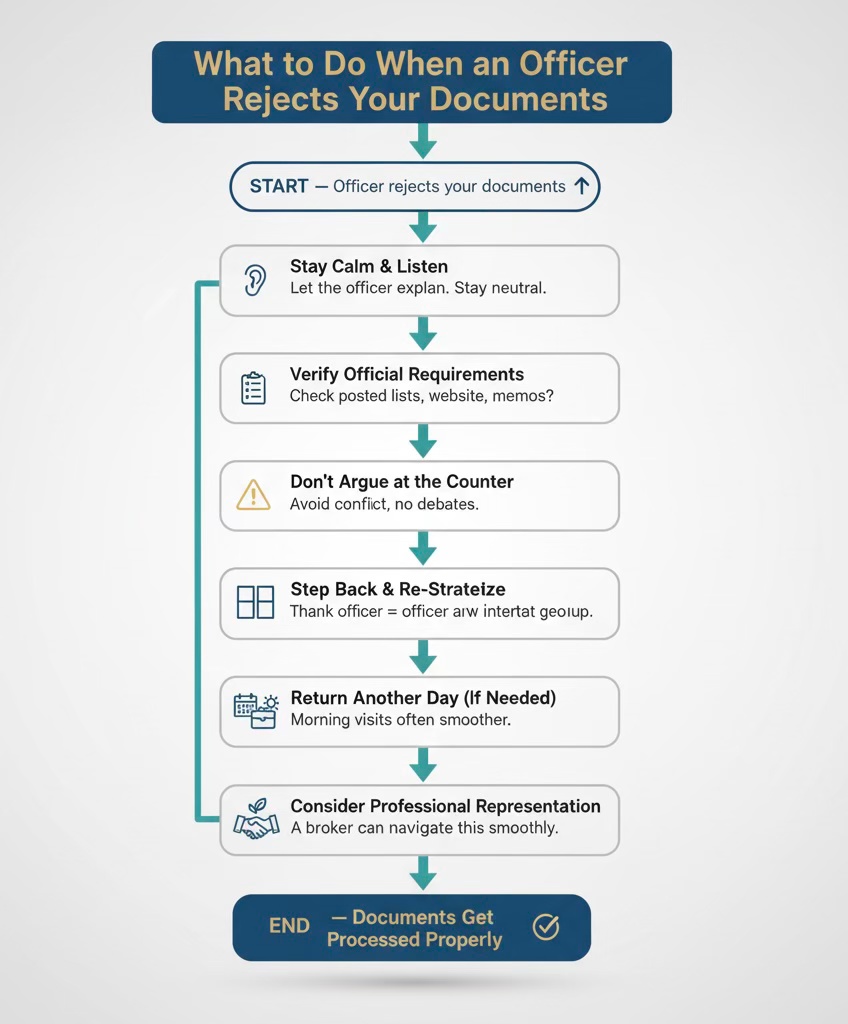
Government processing can feel intimidating, especially when you encounter something unexpected at the counter. But these situations can be managed calmly and intelligently—without shortcuts and without conflict.
Here’s what works.
Know the Official Requirements
Information is your best armor.
Verify requirements from:
- The official government website
- Posted checklists at the office
- Updated circulars or memos
- Professionals who recently completed similar transactions
When you know the correct guidelines, you instantly recognize red flags.
This protects you from misinformation—and unnecessary stress.
Don’t Argue at the Counter
Even when you’re right, arguing rarely leads to approval.
Debating a frontline officer often:
- Hardens their stance
- Extends the conversation
- Increases tension
- Reduces your chance of a positive outcome
Counter windows are processing points—not debate stages.
Stepping back is the smarter move.
Step Back and Re-Strategize
Walking away isn’t surrender.
It’s strategy with dignity.
It gives you space to:
- Clear your head
- Reconfirm the official requirements
- Avoid an emotional reaction
- Decide your next move without pressure
That pause often saves the entire transaction.
Try a Different Window or Return Another Day
This is the simplest—and most effective—solution.
A different officer may:
- Interpret rules correctly
- Review documents objectively
- Process everything smoothly
Same papers.
Same guidelines.
Better outcome.
It’s one of the most practical tactics experienced brokers rely on.
Stay Calm and Stay Ethical
Frustration can nudge people toward shortcuts.
But shortcuts come with long-term consequences:
- Legal risks
- Complications during resales
- Stress you don’t need
Integrity may feel slow—but it’s the only path that protects your peace, your client, and your transaction.
Consider Getting Professional Representation
Real estate brokers interact with government systems constantly.
We see the patterns.
We know the workflows.
We understand which requirements apply to which filings.
A seasoned professional knows:
- How to prepare airtight documentation
- When to escalate
- When to shift windows
- Which offices are stricter
- How to anticipate possible roadblocks
Representation isn’t just convenience.
It’s strategic protection of your time, your resources, and your sanity.
Why Sharing This Matters (For Buyers, Sellers, and First-Time Transactors)
Most people think real estate is just about property tours and signed contracts. But a huge part of the work happens in government halls—behind counters, inside cramped offices, during hours-long lines, and in conversations that can either move the process forward or halt it entirely.
Every Filipino who has ever transacted with the government knows these realities:
- Rules interpreted differently depending on the officer
- Long, unpredictable lines draining your time and patience
- Instructions that don’t match posted guidelines
- Subtle pressure to consider “other ways”
- The emotional weight of delays you did not cause
These challenges can rattle even the most prepared person.
By sharing this story, I want people to feel less alone—and more empowered.
You don’t need shortcuts.
You don’t need to argue.
You don’t need to panic.
You just need strategy, composure, and documented facts.
Because real estate requires more than negotiating skills.
It requires understanding the system—and navigating it ethically.
And once you learn how to move through these encounters, the fear disappears.
You’re no longer thrown off by the unexpected.
You walk in prepared, calm, and grounded.
Eventually, every detour straightens out.
Every obstacle becomes manageable.
Every challenge becomes a reminder that patience and integrity win—even inside the most unpredictable government window.
Key Takeaways You Can Use Immediately
- Always verify the official requirements before lining up.
- Don’t argue at the counter—strategy beats confrontation.
- Step back when something feels off.
- Try a different window; outcomes vary by officer.
- Keep all interactions ethical and documented.
- Consider professional representation to avoid unnecessary stress.
Navigating Government Processing Doesn’t Have to Be Stressful
If you want a clean, efficient, and fully guided experience for your real estate transaction, I can help you handle:
- Documentation preparation
- Government office submissions
- Timeline protection
- End-to-end transaction support
Send me a message or schedule a consultation—I’m here to make the process clear, honest, and manageable from start to finish.
📩 Message me anytime for assistance.






 U-Property PH
Leave a comment