

Some cities grow slowly. Dasmariñas accelerates.
With its powerful mix of universities, hospitals, expressway connections, and rising commercial activity, it has become one of Cavite’s most in-demand real estate markets—and a crucial node in the Cavite growth corridor.
If you want a property that balances Metro Manila accessibility, suburban comfort, and long-term capital appreciation, Dasmariñas deserves a place on your shortlist.
This guide breaks down everything: market prices, best neighborhoods, ROI analysis, lifestyle insights, and future infrastructure shaping values.
Why Dasmariñas Is Cavite’s Fastest-Rising Real Estate Hotspot
Energy, growth, and opportunity converge here.
Dasmariñas has quietly evolved from a residential suburb into Cavite’s education and healthcare capital, a crucial advantage no neighboring city matches at this scale.
Why demand keeps surging:
- Families relocating from Metro Manila seeking bigger homes
- Students and medical workers fueling rental demand
- OFWs buying long-term appreciation assets
- Developers expanding aggressively due to improving road infrastructure
- Cavite’s regional economy sustaining a 6.7% annual growth trend (NEDA Region IV-A)
The real estate market thrives when connectivity, employment, and population density meet—and Dasmariñas has all three in abundance.
City Overview: What Makes Dasmariñas Highly Strategic?
Geographic Advantage & Metro Manila Connectivity
Dasmariñas commands 90.13 km² of central Cavite, carrying over 700,000 residents—a striking 16% of the province’s entire population (PhilAtlas). In real estate terms, that density tells you one thing: this city isn’t a quiet bedroom community. It’s a rising urban core with gravitational pull.
Anchored along Aguinaldo Highway, Cavite’s main transport spine, Dasmariñas acts as the province’s central interchange, connecting major growth zones in every direction:
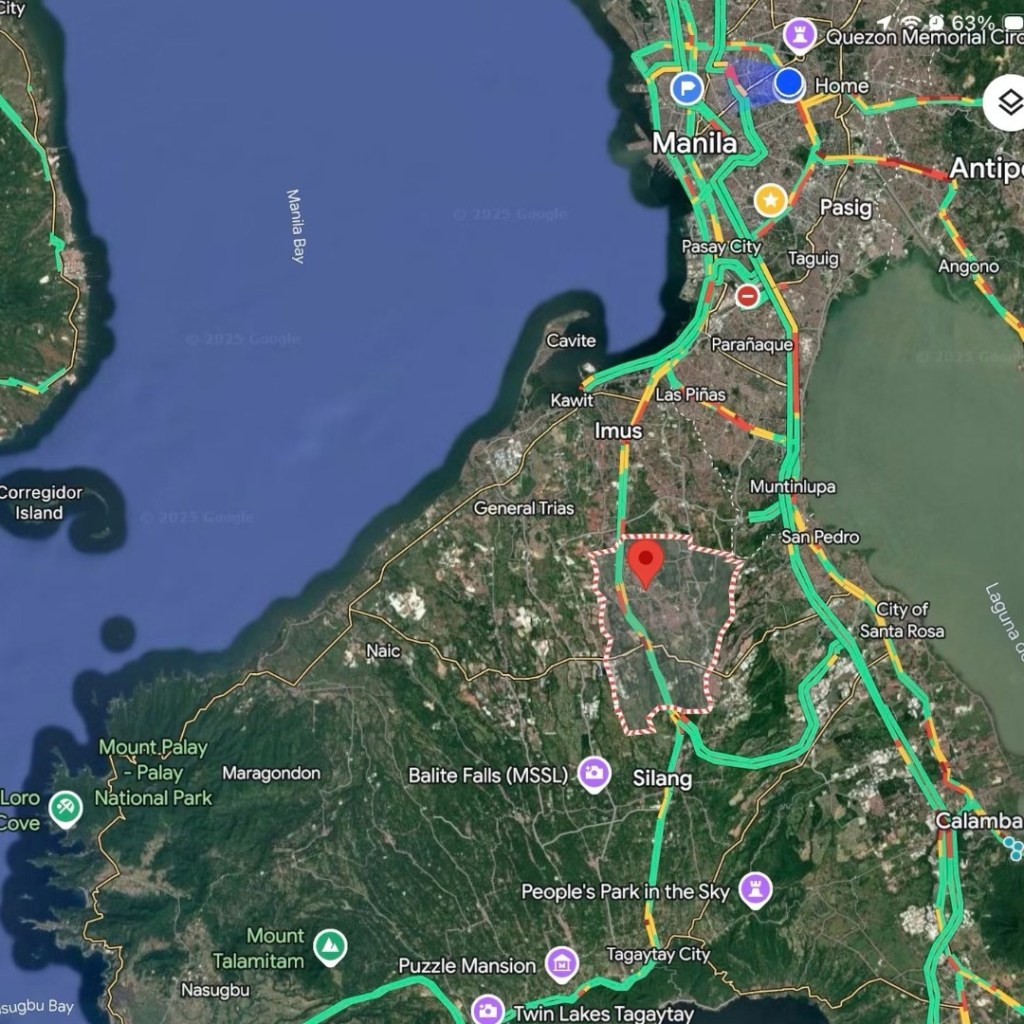
Map: Cavite with Dasmariñas at the center.
- Metro Manila via MCX → SLEX
- Silang and Tagaytay, the tourism and leisure belt
- General Trias, home to industrial and business parks
- Trece Martires, Cavite’s administrative capital
Movement happens through Dasmariñas—not around it—which naturally amplifies commercial activity and long-term property value.
Daily mobility is powered by a multi-layered transport system:
- Aguinaldo Highway – the city’s economic backbone
- CALAX – already reshaping Cavite–Laguna connectivity, with future exits expected to further cut travel time to Dasmariñas
- MCX, giving residents a streamlined link to Metro Manila
- Governor’s Drive, connecting industrial corridors and employment hubs
Each infrastructure upgrade compounds the city’s growth momentum.
In real estate, connectivity is currency—and Dasmariñas holds one of the strongest positions in Cavite.
Dasmariñas: Cavite’s Education & Healthcare Capital
If there’s one advantage that completely differentiates Dasmariñas from other Cavite cities, it’s this:
It is the province’s academic and medical powerhouse.
No city in Cavite packs as many top-tier universities and healthcare institutions into a single urban footprint.
Major Universities
- De La Salle University – Dasmariñas
- Emilio Aguinaldo College
- Philippine Christian University
- Cavite State University (satellite campus)
Major Hospitals
- De La Salle Medical and Health Sciences Institute
- Asia Medic Medical Center
- Congressional National Hospital
- Pagamutan ng Dasmariñas
This dual concentration of education + healthcare fuels two of the most resilient housing markets:
- Student rentals, driven by year-round enrollment cycles and predictable demand
- Medical housing, supported by doctors, nurses, interns, medical residents, and patient companions
Most Cavite cities rely on one economic driver. Dasmariñas thrives because it has both.
This is why investors consistently see stable occupancy, low vacancy risk, and repeat demand—a rare and powerful combination.
Population Growth & Urban Expansion
Dasmariñas records a population density of 7,801 persons per km² (PhilAtlas)—one of the highest in Cavite. This isn’t random; it’s the result of sustained migration and a healthy urban ecosystem that continually pulls people in.
High density is usually a warning sign in some markets, but in Dasmariñas, it reflects:
- consistent inward migration from Metro Manila and nearby cities
- robust residential demand, both for ownership and rentals
- expanding commercial and institutional hubs
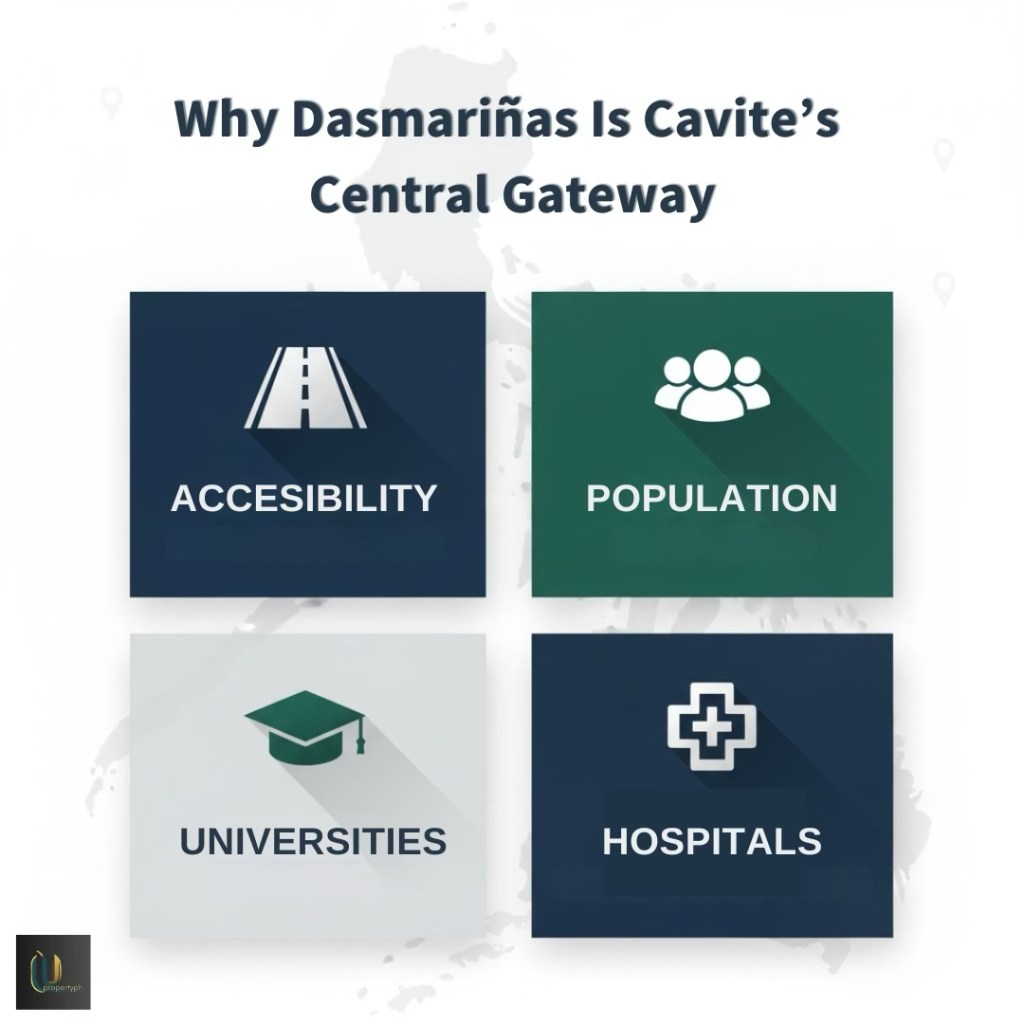
Infographic: “Why Dasmariñas Is Cavite’s Central Gateway”
Dense cities attract investors because real estate performance depends on one core metric: people.
Where people converge, property values rise.
Where they stay long-term, rental markets stabilize.
Where population growth continues, land becomes a finite and appreciating asset.
Real Estate Market Overview: Prices, Trends, and Demand (2025)
Dasmariñas Real Estate Price Snapshot (2025)
| Category | Price Range / Median Values (2025) | Notes / Market Insight |
|---|---|---|
| Subdivision Lot Prices | ₱40,162 per sqm (median listing price) | Prime barangays often exceed ₱45K–₱50K per sqm, especially near schools, hospitals, and major roads. |
| Condominium Prices | ₱3,722,684 median list price • ₱171,135 per sqm (median) | Values depend heavily on proximity to DLSU-D, DLSUMC, and commercial corridors. |
| House & Lot Prices | ₱83,421 per sqm (median) | Reflects mid-income and emerging upscale subdivisions; actual total prices typically range ₱4M–₱9M+. |
| Zonal Values (BIR – Burol Sample) | RR: ₱10,500/sqm • RC: ₱16,600/sqm | Zonal values remain conservative; market listings significantly exceed these figures. |
| Rental Rates (Monthly) | Studio (sample): ~₱18,000 • Townhouse/2BR: ₱20,000 | Actual listings vary by size, condition, and location. Rentals strongest near universities & hospitals. |
Note: The values above are based on recent listing medians online, combined with BIR zonal references. Listing prices are asking prices, not final sale prices, and may vary by barangay, developer, property age, or market condition. Use these figures as current market indicators, not official transaction averages. Always cross-check with local brokers and recent sales for more precise valuations.
Current Selling Prices
Dasmariñas continues to post one of the most competitive yet fast-appreciating price ranges in Cavite. Using a blend of LGU zoning references, BIR values, and verified public market data, the city’s 2025 pricing reveals a market that has matured but still offers room for strategic entry.
Average Market Prices (2025):
Subdivision lots: ₱25,000–₱45,000 per sqm
Prime corridors—especially near universities or major roads—regularly break the ₱50,000/sqm mark.
Townhouse units: ₱2.5M–₱5.5M
Strong demand from starter families and workforce professionals.
Mid-rise condos: ₱2M–₱4.2M
Competitive pricing versus Imus and Bacoor; excellent for student housing.
House-and-lot (mid-income): ₱4M–₱9M
A growing segment dominated by families relocating from Metro Manila.
Zonal Value Snapshot (BIR) — Barangay Burol Main
Residential Rear (RR)
₱10,500 per sqm
Residential Corner (RC)
₱16,600 per sqm
Zonal values in fast-growing cities like Dasmariñas tend to lag behind actual market prices, especially in prime barangays. This gap signals ongoing appreciation, not market overheating.
For investors, this is your early indicator of long-term upside.
Market Interpretation
- Prices remain more affordable than Bacoor and certain pockets of Imus
- Appreciation is consistent, not speculative
- Supply remains healthy, but key micro-markets (near hospitals/universities) are tightening
- Mid-income subdivisions offer some of the best land-value growth in Cavite’s central corridor
Dasmariñas sits in the sweet spot: still accessible, but rising fast enough to reward early movers.
Rental Market Behavior
Rental demand in Dasmariñas is not seasonal—it’s structural.
The city benefits from multiple, overlapping tenant pools that ensure year-round occupancy, not just peak-season activity.
Primary demand drivers include:
- Students from DLSU-D, EAC, PCU, CvSU satellite campuses
- Medical workers from the adjoining hospital district
- Families working in nearby commercial centers, industrial estates, and business parks
- Metro Manila commuters who prefer Cavite pricing but still work in NCR or Alabang
This mix creates one of Cavite’s most stable rental ecosystems.
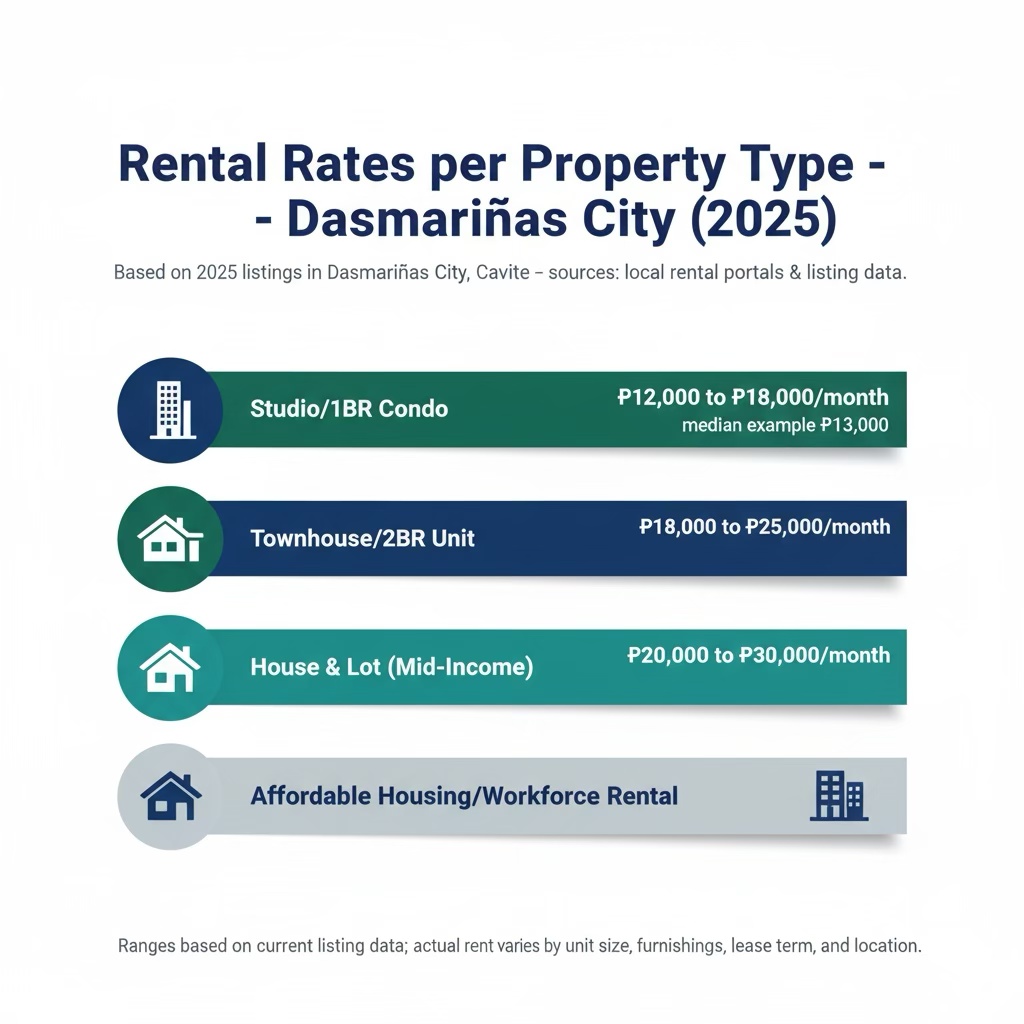
2025 Rental Rates for Various Property Types in Dasmariñas City, Cavite
Typical Monthly Rental Rates (2025)
- Studio/1BR near universities: ₱7,000–₱11,000
- 2BR units: ₱12,000–₱18,000
- Townhouses: ₱12,000–₱20,000
- Single-family homes: ₱18,000–₱30,000+ depending on subdivision and size
Short-Term Rentals: Proceed with Strategy
Short-term occupancy (STR) is significantly lower than leisure-driven markets like Tagaytay, which means STR investors must be surgical with location and product.
But long-term rentals?
A different story entirely.
Long-term leasing in Dasmariñas is:
- consistent
- predictable
- low-risk
- supported by evergreen demand (schools + hospitals + workforce)
Investors benefit from steady yields without the volatility of tourism-dependent cities.
Comparison With Nearby Cities
To understand where Dasmariñas stands, compare it with Cavite’s other top-performing markets:
| City | Primary Strength | Price Level | Best For |
|---|---|---|---|
| Dasmariñas | Universities, hospitals, central Cavite location | Medium | Investors, families, OFWs |
| Imus | Commercial density, access to MCX | Medium–High | Young families, professionals |
| Bacoor | Closest to Metro Manila; easy NCR commute | High | Metro Manila commuters |
| General Trias | Industrial zones, future commercial hubs | Medium | Investors, workforce rentals |
What makes Dasmariñas stand out?
It’s the rare Cavite city that checks all major value drivers simultaneously:
- Education (Cavite’s university capital)
- Healthcare (major hospital cluster)
- Retail (SM Dasmariñas + multiple commercial nodes)
- Transport (Aguinaldo Highway, CALAX access, MCX–SLEX linkage)
Most cities excel in one or two categories; Dasmariñas excels in all four.
For long-term investors, that’s the perfect equation for resilience and appreciation.
Top Residential Developments in Dasmariñas
Mid-Income Subdivisions & Master-Planned Communities
Dasmariñas built its real estate reputation on the strength of its mid-income subdivisions—communities that consistently appreciate because they sit near schools, hospitals, shopping hubs, and major roads.
These developments attract families upgrading from Metro Manila or nearby Cavite municipalities, looking for a safer, calmer, and more spacious jump in lifestyle—without sacrificing accessibility.
Key Mid-Income Communities
Garden Grove Village
Known for mature trees, wider roads, and strong end-user demand. Resale values here have historically risen faster than city averages.
Avida Settings Cavite (boundary-accessible)
A brand associated with quality deliverables, strong HOA management, and stable mid-income appreciation.
Lancaster New City (easily accessible via major roads)
While part of a larger township spanning multiple cities, its reach from Dasmariñas makes it a viable option for families wanting township-style living plus strong transport access.
Amaia Scapes Cavite (accessible)
Affordable to mid-income bracket with reliable developer reputation and strong community adoption.
Why these developments perform well
- Gated environments with controlled entry
- Proximity to schools and medical institutions
- Predictable family-oriented demand
- Competitive home sizes versus Metro Manila
- Strong resale and rental appeal
Bottom line:
Mid-income subdivisions in Dasmariñas are some of Cavite’s most stable long-term performers—ideal for families and long-term investors who prefer lower risk and predictable appreciation.
Condo Developments (The Rapidly Growing Vertical Market)
Vertical living in Dasmariñas is no longer a niche—it’s a rising category fueled by students, medical workers, young professionals, and employees working in nearby commercial and industrial corridors.
Condos benefit from the city’s “university + hospital + retail” ecosystem, which naturally supports strong occupancy.
Key Condo Developments
Green 2 Residences (SMDC)
Situated near key universities, this is the city’s flagship student-oriented development. Strong rental turnover.
The One Dasmariñas Place
Positioned along major transport corridors, making it ideal for commuters and medical staff.
Illumina Residences Dasmariñas (pipeline)
Projected to cater to the student and young professional market with modern amenities and higher-value positioning.
Why condos are gaining traction
- Smaller cuts match student and professional budgets
- Turnkey rentals for OFWs and passive investors
- High liquidity due to consistent tenant flow
- Vertical living complements Dasmariñas’ dense, urbanizing core
For investors:
Condos in Dasmariñas shine when positioned within walking distance of schools or hospitals—this reduces vacancy and boosts yield predictability.
Affordable Housing Communities
Dasmariñas is one of Cavite’s strongest strongholds for affordable and economic housing.
These communities absorb massive demand from:
- industrial park workers
- retail/commercial district employees
- local residents upgrading from informal/older housing
- OFWs securing their first property
- families priced out of Tagaytay, Imus, and Bacoor
Key Advantages
- Accessible financing schemes
- Faster turnover and high liquidity
- Strong demand for small homes in Paliparan, Burol, Sampaloc, and San Agustin
- Excellent appreciation potential in pre-CALAX zones, where road improvements typically trigger value jumps
Affordable housing is the backbone of Cavite’s real estate market—and Dasmariñas holds some of the highest year-round demand volumes in the region.
Upscale Villages & Premium Gated Communities
As Dasmariñas’ middle class and OFW population grows, so does demand for premium gated communities offering:
- larger cut lots
- stricter security
- controlled neighborhood design
- superior amenities
- proximity to malls, hospitals, and schools
These enclaves appeal to balikbayans, upwardly mobile families, and long-term homeowners who want more space, more privacy, and better lifestyle options.
Why premium communities outperform
- Limited inventory
- Strong end-user market
- Higher-quality infrastructure
- Better-maintained amenities
- Located near major commercial centers and transport corridors
Premium subdivisions typically show above-average price growth, especially in neighborhoods near the university belt, hospital district, and Aguinaldo Highway.
🔍 Summary Insight: What This Means for Buyers and Investors
- Families prefer mid-income subdivisions for stability and lifestyle.
- OFWs gravitate toward affordable housing and mid-income H&L in emerging corridors.
- Investors find the strongest rental demand in condos near schools and hospitals.
- Balikbayans and affluent households drive demand in premium gated enclaves.
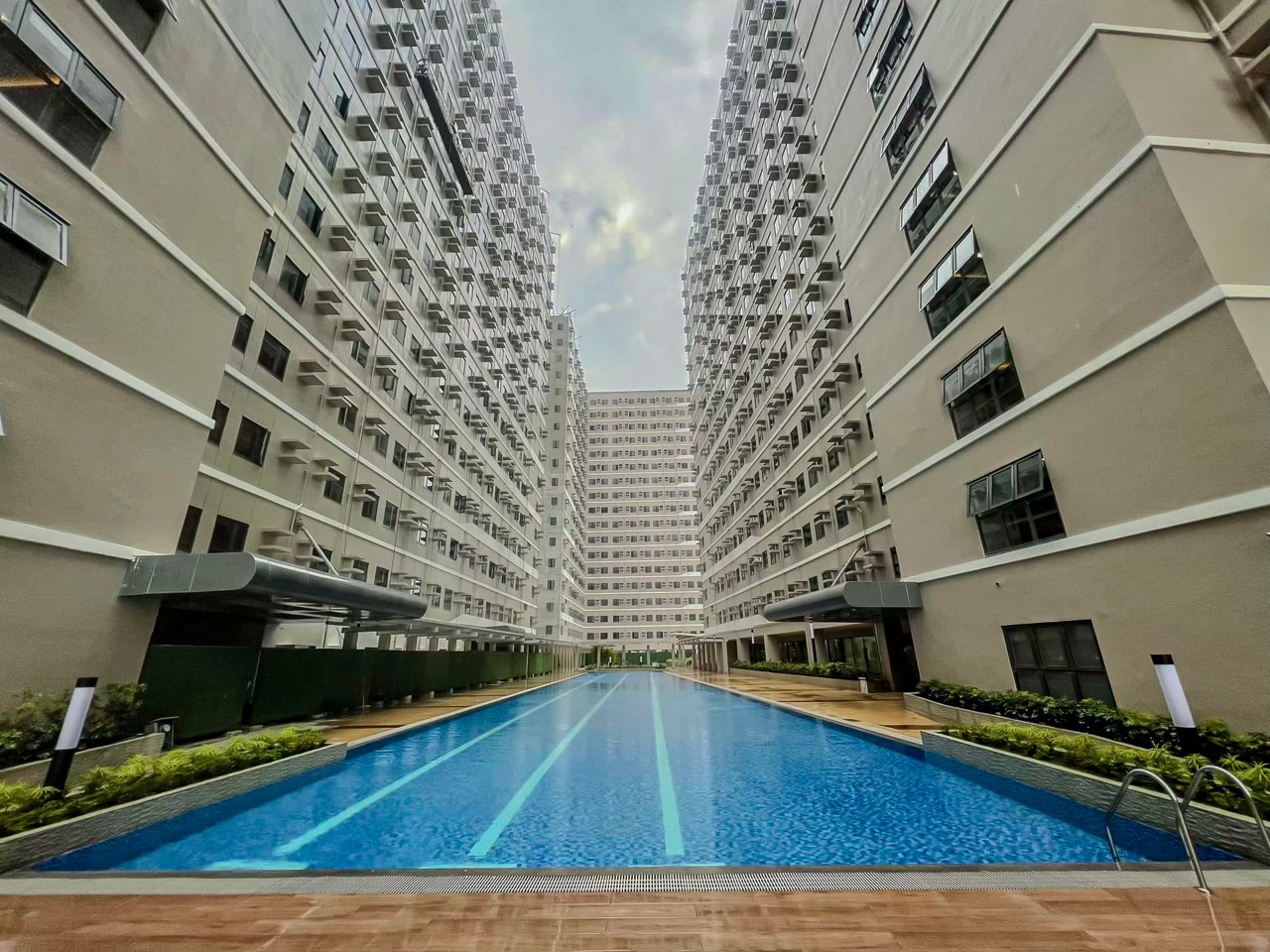
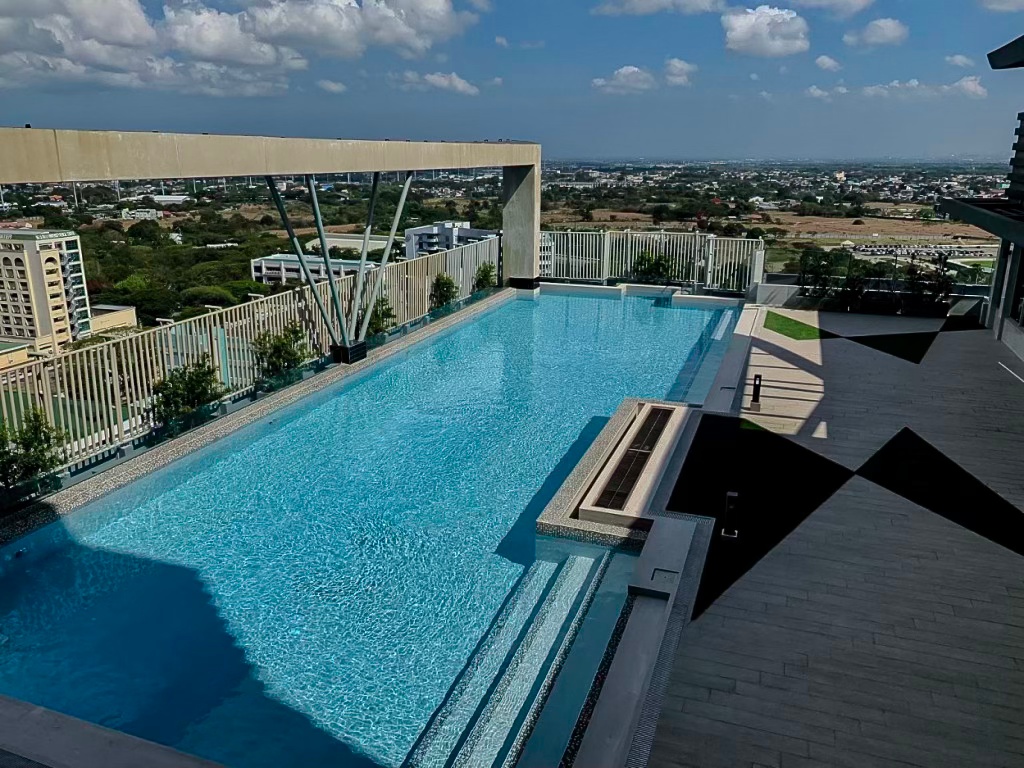
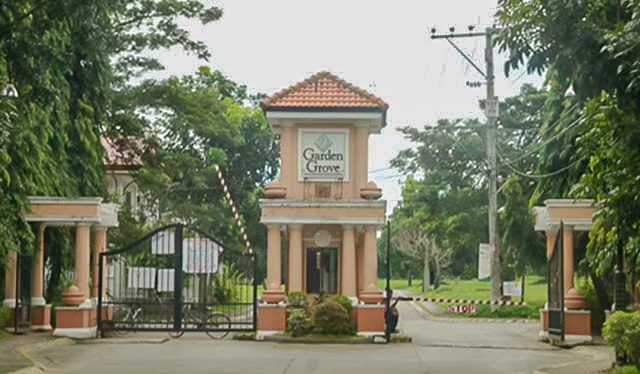
Dasmariñas works across buyer segments because its residential inventory is as diverse as its economic drivers—and that’s why the city remains one of Cavite’s most sustainable property markets.
Infrastructure & Connectivity: The Engine of Appreciation
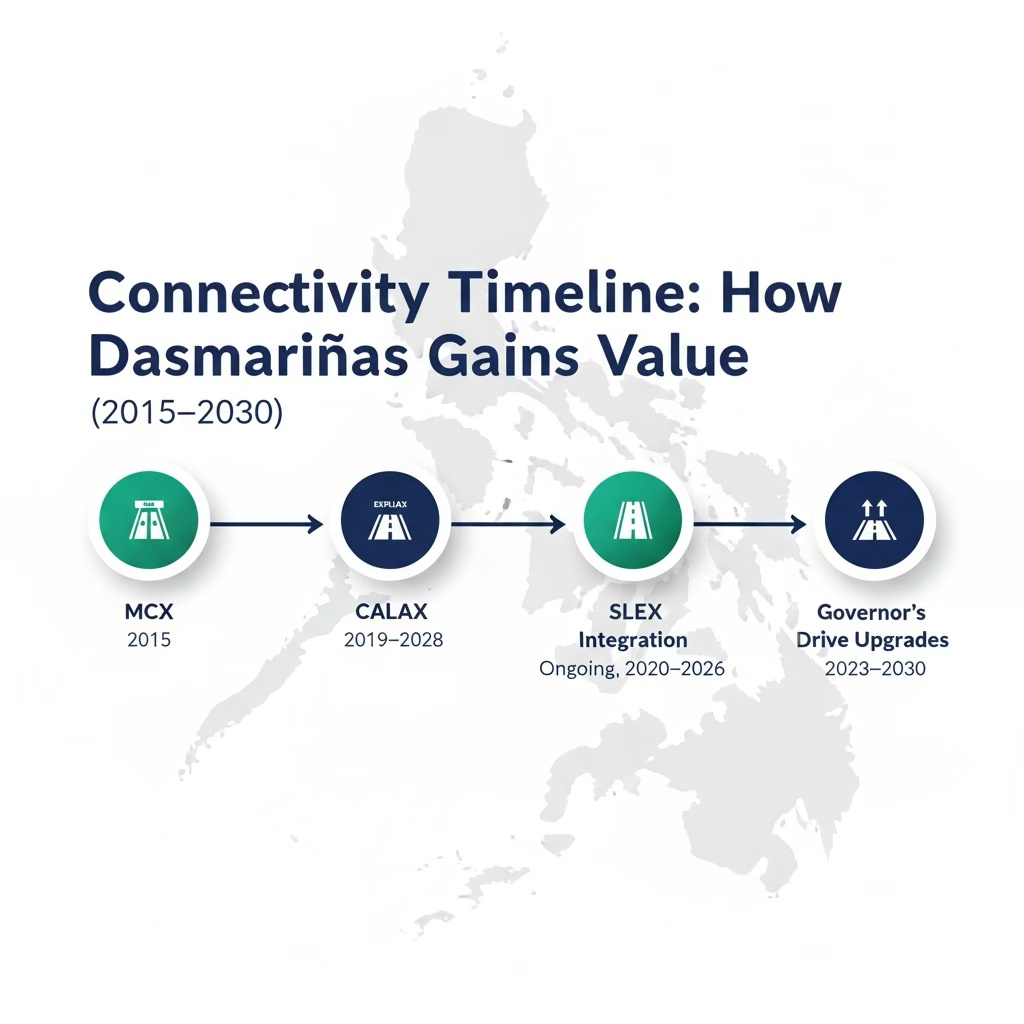
Timeline detailing the connectivity enhancements in Dasmariñas from 2015 to 2030.
Infrastructure is the ultimate value catalyst.
In Cavite, transport projects don’t just shorten travel time—they redraw property lines, shift demand, and create new micro-markets. Dasmariñas sits at the center of this movement, benefiting from every major corridor under construction or enhancement.
CALAX: The Infrastructure Game-Changer
The Cavite–Laguna Expressway (CALAX) continues to be the most transformative infrastructure project shaping central and southern Cavite. While the full alignment isn’t open yet, the Silang–East interchange already provides residents of Dasmariñas a smoother route toward:
- Silang (now significantly faster to access)
- Nuvali and Sta. Rosa — two of South Luzon’s biggest business, commercial, and lifestyle districts
- Laguna Technopark and CALABARZON industrial zones, strengthening employment mobility
Once future Dasmariñas-specific interchanges open, the city’s accessibility will shift from “strong” to “exceptional.”
CALAX effects on real estate:
- Land values along CALAX feeder roads historically rise faster than city averages
- Property demand expands outward as previously “secondary” barangays become highly accessible
- Investors benefit from early entry into pre-exit zones
- End-users enjoy shorter travel times to regional commercial districts
This expressway will reshape commuting patterns, widen the city’s catchment area, and pull new demand from workers who previously bypassed Dasmariñas.
Upcoming Transport & Mobility Projects
Beyond major highways, Dasmariñas is benefiting from a growing network of local mobility improvements. These smaller, localized enhancements often create micro-appreciation pocketsbefore the wider market catches on.
Planned and ongoing upgrades include:
- Modernized public transport terminals, helping streamline jeepney and bus operations
- Feeder roads connecting more barangays to CALAX, reducing dependency on Aguinaldo Highway
- Improved pedestrian walkways and bike infrastructure, supporting safer urban mobility
- Intersection redesign and signal improvements around the city center and major barangay clusters
Why these projects matter:
- Reduces chokepoints and redistributes traffic more evenly
- Strengthens intra-city mobility, making inner barangays more livable
- Elevates property desirability in previously secondary locations
- Creates new opportunities for commercial and mixed-use developments
- Supports the city’s transition from “suburban” to “fully urbanized”
As these upgrades unfold, almost every barangay—from Burol to Salitran, Paliparan, San Agustin, and Sampaloc—stands to benefit.
This is the type of layered mobility improvement that steadily pushes land values upward without the volatility of speculative markets.
CALAX: The Infrastructure Game-Changer
The Cavite–Laguna Expressway (CALAX) continues to be the most transformative infrastructure project shaping central and southern Cavite. While the full alignment isn’t open yet, the Silang–East interchange already provides residents of Dasmariñas a smoother route toward:
- Silang (now significantly faster to access)
- Nuvali and Sta. Rosa — two of South Luzon’s biggest business, commercial, and lifestyle districts
- Laguna Technopark and CALABARZON industrial zones, strengthening employment mobility
Once future Dasmariñas-specific interchanges open, the city’s accessibility will shift from “strong” to “exceptional.”
CALAX effects on real estate:
- Land values along CALAX feeder roads historically rise faster than city averages
- Property demand expands outward as previously “secondary” barangays become highly accessible
- Investors benefit from early entry into pre-exit zones
- End-users enjoy shorter travel times to regional commercial districts
This expressway will reshape commuting patterns, widen the city’s catchment area, and pull new demand from workers who previously bypassed Dasmariñas.
Aguinaldo Highway Enhancements
Aguinaldo Highway remains the lifeblood of Dasmariñas. Almost every major commercial center, retail strip, hospital, and transportation point branches out from it.
To support rapid population growth, the Department of Public Works and Highways (DPWH)continues to undertake essential upgrades, including:
- Multi-phase road widening to ease congestion
- Drainage system improvements to minimize flooding and protect property values
- Intersection and signalization upgrades to improve traffic flow
- Carriageway repairs for safer and smoother transit
These enhancements ensure that the city’s main artery keeps up with its economic expansion.
Real estate impact of Aguinaldo Highway improvements:
- Businesses gravitate to areas with improved traffic flow
- Residential communities near upgraded segments see higher rental absorption
- Accessibility boosts the desirability of surrounding barangays
- Investors benefit from developments with direct or near-direct access points
Better roads mean better mobility—and better mobility reinforces both commercial intensity and residential value.
Economic Drivers: Why Demand in Dasmariñas Stays High
The strength of a real estate market is rarely about buildings—it’s about the ecosystem that keeps people flowing in and out every single day.
Dasmariñas thrives because its economic drivers are broad, stable, and mutually reinforcing.
Education, healthcare, retail, BPO, industrial, and workforce sectors all converge here, creating a multi-layered demand base that few Cavite cities can match.
University Belt Strength

Emilio Aguinaldo College, a key educational institution in Dasmariñas, Cavite
Dasmariñas is widely recognized as Cavite’s premier university city, home to several of the province’s largest educational institutions. Collectively, they draw tens of thousands of students, faculty members, support staff, and service workers every year.
This academic concentration guarantees:
- year-round boarding demand, not just per-semester spikes
- high absorption for condos and townhouses, especially within 1–2 km of campus clusters
- repeat yield from student housing, driven by constantly renewing enrolment cycles
- parent-funded leasing, which tends to be stable and price-insensitive
- opportunities for bedspace, studio rentals, and compact 1BR units
Where demand is steady, rental yields remain resilient.
This is why properties near DLSU-D, EAC, and PCU consistently outperform the broader Cavite rental market.
For investors, this is one of the most predictable income streams in the entire province.
Healthcare Ecosystem
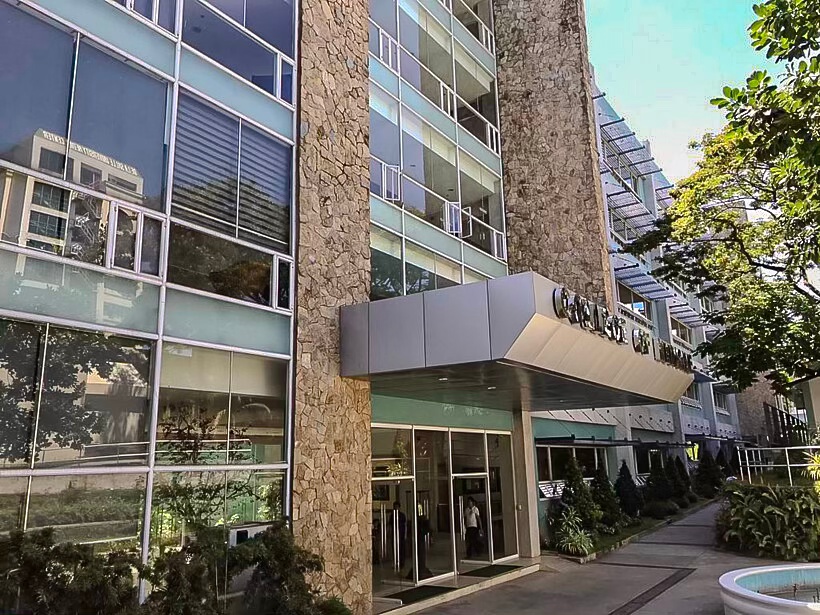
Entrance of a modern building in De La Salle Medical Dasmariñas
Dasmariñas also hosts one of Cavite’s strongest healthcare clusters, anchored by De La Salle Medical and Health Sciences Institute, along with a growing network of private hospitals and specialty centers.
These institutions create constant, year-round demand for:
- staff housing, especially for nurses, interns, and residency doctors
- temporary accommodation for rotating medical workers
- family lodging for patients from nearby towns
- long-term rentals for medical faculty and specialists
Unlike seasonal industries, healthcare demand doesn’t fluctuate—it expands.
This creates a stable, recession-resistant tenant pool, ideal for investors seeking steady monthly income without relying on tourism or corporate leasing cycles.
Simply put:
Where there is healthcare, there is housing demand. Dasmariñas has both in abundance.
Commercial Centers & BPO Employment
Retail and BPO hubs amplify the city’s livability and employment footprint. Dasmariñas serves as a commercial magnet for nearby towns, consistently drawing both residents and workers to its major centers, including:
- SM City Dasmariñas — one of the biggest malls in Cavite
- Robinsons Place Dasmariñas — key retail + services hub
- The District (boundary-accessible)
- Local BPO and IT offices, emerging along commercial corridors
These establishments generate:
- thousands of daily jobs
- heavy retail foot traffic
- strong demand for nearby rentals
- increased land values along commercial arteries
Workers want to live close to where they earn.
The stronger the commercial ecosystem, the more stable the surrounding residential market—and Dasmariñas captures this dynamic perfectly.
Industrial Zones Nearby
Dasmariñas also benefits from its proximity to major industrial zones located in:
General Trias
Gateway Business Park, Suntech iPark
Carmona
Carmona Industrial Complex
Imus
industrial and logistics clusters
Silang and Dasmariñas borders
emerging light manufacturing zones
Thousands of workers—from technicians and engineers to supervisors and support staff—prefer to reside within 15–20 minutes of their workplaces. Many find Dasmariñas ideal due to its:
- better housing stock
- access to utilities and transport
- availability of affordable-to-mid-income rentals
- safer, more established subdivisions
This creates a strong baseline for:
- affordable housing
- townhouse rentals
- small-to-mid-sized family homes
Industrial zones anchor long-term workforce population—one of the most reliable demand drivers for year-round occupancy.
🔍 Why This Ecosystem Makes Dasmariñas Exceptionally Resilient
Most cities depend heavily on a single economic driver—tourism, retail, industrial jobs, or BPO.
Dasmariñas thrives because its demand sources are diversified, making it naturally resistant to market downturns.
Education + Healthcare + Retail + Industry + BPO = stable, multi-segment rental and housing demand.
This layered ecosystem is the reason:
- vacancy rates remain low
- yields are steady
- property values trend upward
- demand remains consistent regardless of economic season
In real estate, resilience is gold.
Dasmariñas has it in abundance.
Investment Analysis: ROI, Yields & High-Demand Micro-Markets
Smart investors don’t chase hype—they study patterns.
In Dasmariñas, the patterns are clear: land values climb steadily, rental demand is multi-layered, and micro-markets perform differently depending on tenant type and accessibility.
This combination creates a rarely volatile, consistently rewarding investment environment.
Lot Value Appreciation
Over the last decade, the strongest appreciation in Dasmariñas has consistently clustered around areas with institutional anchors—places where people naturally converge, work, study, shop, heal, or commute.
The most robust 10-year growth trends appear in locations near:
- Major universities (DLSU-D, PCU, EAC)
- Hospital district (DLSUMC and medical institutions)
- Aguinaldo Highway (retail + transport synergy)
- Governor’s Drive (industrial and commercial linkages)
- Future CALAX connection points (early-stage value growth)
Historical Value Trends
- Average 5–7% annual appreciation, even during slower economic cycles
- Higher-than-average jumps in barangays near new roads, retail nodes, or transport upgrades
- Premium pockets regularly outperform city-wide averages due to scarcity and high demand
Dasmariñas performs best where mobility, institutions, and population density meet—creating sustained upward pressure on land values.
For long-term investors, this is the hallmark of a fundamentally strong, demand-driven market—not a speculative one.
Rental Yield Forecasts (2025–2030)
The rental market in Dasmariñas is supported by an unusually diverse tenant pool, which keeps occupancy high and volatility low.
Projected Gross Yields by Asset Type
Condo (student/medical staff): 5–7%
Reliable due to constant enrollment cycles and hospital staffing.
Townhouses: 6–8%
Favored by young families and professionals working in nearby commercial centers.
Subdivision homes: 4–6%
Strong end-user demand and stable long-term leasing.
Affordable housing: 6–9%
High occupancy driven by industrial and service-sector workforce.
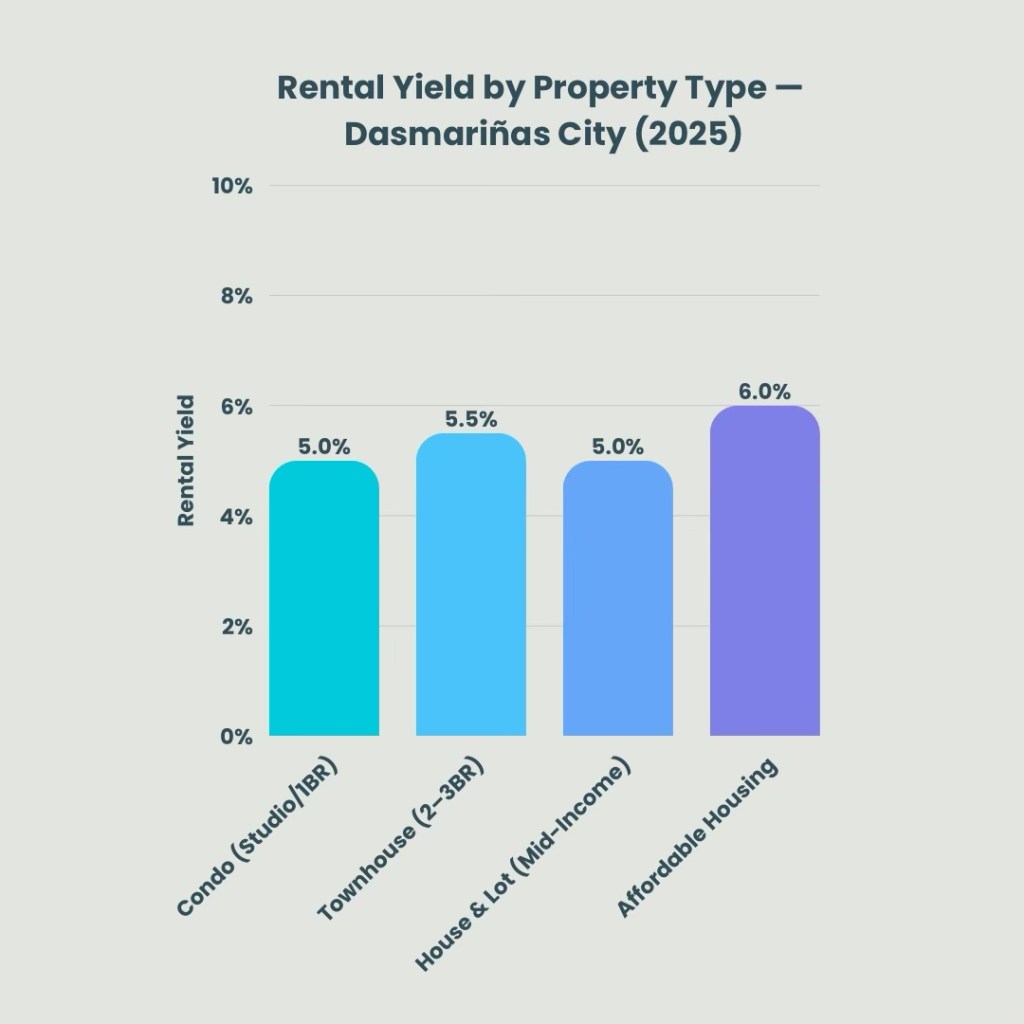
Why yields stay stable
- Continuous inflow of students and medical personnel
- Workforce migration from Metro Manila and nearby towns
- Strong end-user market with minimal vacancy volatility
- Large population base guaranteeing recurring demand
Even during economic downturns, Dasmariñas has shown consistent rental resilience—a major advantage compared to tourism-dependent markets.
Best Micro-Markets for Investors
Dasmariñas is not a single market—it’s a collection of micro-markets, each with its own tenant profile, rental pattern, and appreciation trajectory.
Understanding these distinctions is key to optimizing your investment.
Burol (1–3)
A top-performing zone for mid-income and medical-driven rentals.
- Near major hospitals and clinics
- Strong mid-income residential base
- Close to Congressional Avenue, a key connector road
Ideal for: townhouses, subdivided units, mid-rise condo rentals
Salitran (1–3)
One of the city’s most dynamic and fast-maturing districts.
- Strategic access to Aguinaldo Highway
- High student and young-professional density
- Increasing commercial activity and transport nodes
Ideal for: compact condos, 1BR units, townhouses
Paliparan (1–3)
A population powerhouse with reliable, year-round workforce demand.
- Large mid-to-lower-income tenant base
- Affordable housing hotspot
- Strong rental absorption from workers in nearby industrial parks
Ideal for: affordable housing units, townhouses, boarding-type rentals
San Agustin & Sampaloc
Dasmariñas’ academic and residential synergy zones.
- Proximity to multiple universities
- High student population density
- Strong retail activity and transport access
Ideal for: studio units, small 1BR condos, dorm-style rentals, micro-apartments
Why These Micro-Markets Matter
Each micro-market serves a different demographic with distinct rental behaviors:
- Students = small units, walkability, near-school
- Medical workers = long-term stability, near hospitals
- Families = townhouse/subdivision, secure environments
- Industrial workforce = affordable housing, transport access
This diversity gives investors a strategic advantage:
you can choose the tenant type—and the income model—that best fits your goals.
Risk Factors & What to Watch Out For
No market is without risks, and professional investors know what to evaluate before diving in.
Key Risks
- Traffic congestion, especially along Aguinaldo Highway during peak hours
- Student-housing oversupply, but only in poorly located developments
- Flood-prone pockets, which vary significantly per barangay (site visits are essential)
- Condo HOA and management issues, which can affect long-term yields
- Construction delays or poor build quality from weaker developers
How to Manage These Risks
- Prioritize properties within 1 km of institutional anchors
- Check flood maps and barangay-level geohazard reports
- Verify developer track record and turnover quality
- Review HOA fees, rules, and historical management efficiency
- Choose locations near multi-route access points, not single-entry roads
With prudent due diligence, most risks in Dasmariñas are easy to mitigate—and appreciation remains strong across well-located pockets.
Lifestyle & Livability: What It’s Like to Live in Dasmariñas
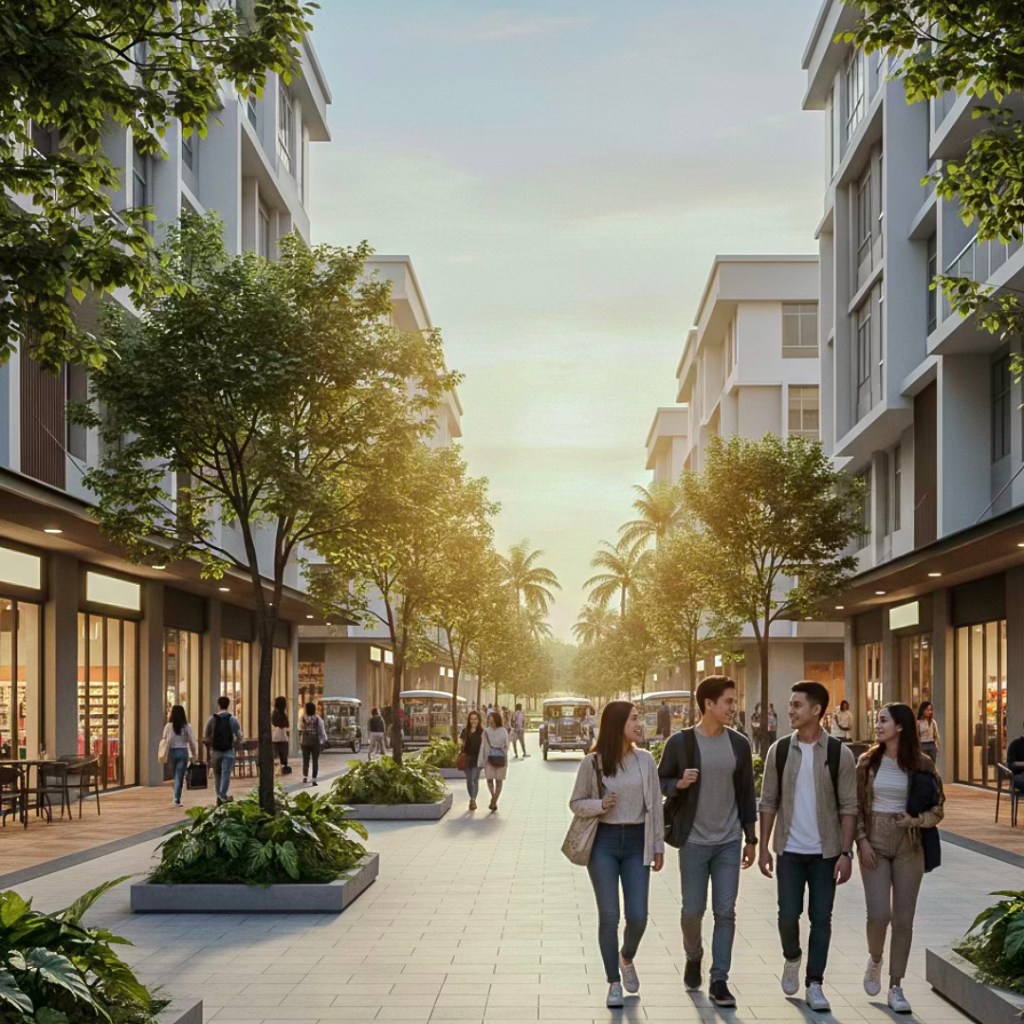
Lifestyle drives real estate value as much as infrastructure, and Dasmariñas delivers a blend that’s hard to replicate: suburban calm, urban convenience, strong community culture, and institutions that anchor long-term desirability.
Family-Friendly Appeal
Dasmariñas has quietly become one of Cavite’s top choices for families upgrading from Metro Manila or seeking a better quality of life without the punishing NCR price tag. The appeal is rooted in a simple formula: space, safety, and access.
Families enjoy:
- quiet, well-established subdivisions with tree-lined streets and secure gated environments
- proximity to high-performing schools, from basic education to top-tier universities
- walkable commercial areas, making daily errands convenient and stress-free
- abundant clinics and hospitals, giving parents quick access to quality healthcare
- a warm, community-oriented culture, where neighborliness and family values remain strong
Children grow up with opportunities that rival NCR’s top educational institutions—minus the congestion, cramped spaces, and premium pricing.
For families, Dasmariñas feels like an upgrade—not a compromise.
Student-Friendly Environment
Dasmariñas didn’t earn the title “University City of Cavite” by accident.
It has one of the largest concentrations of higher education institutions in South Luzon, creating a vibrant, youthful atmosphere that keeps the city dynamic.
This academic energy shapes everyday life:
- Cafés, coworking spots, and study-friendly environments thrive
- Small apartments and dormitories fill quickly
- Public transport adapts to heavy student mobility patterns
- Retail hubs flourish around university zones
Students bring life, movement, and economic activity to the city—making it feel both aspirational and forward-looking.
Healthcare Availability
Access to healthcare is a major livability differentiator, and Dasmariñas stands out here as well.
Residents enjoy multiple tertiary hospitals, specialist clinics, and neighborhood medical centers within a short radius.
In most cases, people are just 5–15 minutes away from:
- leading hospitals
- diagnostic centers
- pharmacies
- wellness clinics
- medical professionals and specialists
This concentration of medical services isn’t just convenient—it pushes long-term residential desirability upward. Families, seniors, professionals, and even investors see healthcare proximity as a non-negotiable advantage.
Health security translates directly to property value.
Shopping, Dining & Leisure
Dasmariñas functions as a commercial hub for surrounding towns, which means residents never feel “far” from anything.
The city offers:
- major malls with full retail ecosystems
- big-box stores for home essentials
- neighborhood dining clusters
- cinemas, fitness gyms, salons, and lifestyle services
- family-centric entertainment centers
Weekends are easy: everything from groceries to dining to leisure is within a short drive—or a short walk, depending on your barangay.
The city provides a suburban pace with urban amenities baked in, giving residents the flexibility to live comfortably without needing to commute to Metro Manila for daily needs.
Community Culture & Safety
Dasmariñas offers the kind of community cohesion that’s increasingly rare in urban areas.
Residents often describe the city as friendly, close-knit, and grounded, with barangays known for:
- active local governance
- well-organized community programs
- responsive barangay officials
- solid coordination during emergencies and public events
Safety varies by barangay (as in any city), but areas around universities, hospitals, and commercial districts benefit from regular police visibility and strong foot traffic, which naturally elevates security.
The city feels lived-in and cared for—an environment where community ties remain strong and people genuinely look out for each other.
Best Neighborhoods in Dasmariñas (By Buyer Type)
Dasmariñas is a city of micro-markets, each with its own personality, pace, and investment profile. Choosing the right neighborhood depends entirely on your lifestyle, goals, and timeline. Below is a curated breakdown—tailored to the distinct needs of different buyer segments.
For Families Wanting Security & Space
Ideal Areas:
- Garden Grove vicinity
- Subdivisions in Salitran, Burol, and San Agustin
These barangays offer a blend of quiet suburban living and essential urban convenience.
Families gravitate toward these neighborhoods because they’re:
- close to reputable schools (both basic ed and higher ed)
- minutes away from hospitals and clinics
- near malls, supermarkets, and retail plazas
- supported by well-established barangay systems
- built around secure, gated communities
If you’re upgrading from Metro Manila or looking for a long-term family home with more room to grow, these neighborhoods deliver a comfortable, stable, and community-centered environment.
For Investors Seeking Rental Income
Optimal Micro-Zones:
- Near DLSU-D
- Nearby De La Salle Medical Center district
- Around Emilio Aguinaldo College
These areas produce some of the highest and most predictable rental absorption rates in Cavite. The tenant pools include:
- college students
- medical interns and residents
- nurses and hospital staff
- young professionals working in nearby commercial hubs
Investors favor these neighborhoods for three reasons:
- Low vacancy risk — thanks to constantly renewing tenant cycles
- Smaller cuts rent easily — especially studios, 1BR units, and compact townhomes
- Recurring yield — student and medical rentals are among the most stable income streams in Luzon
If you want reliable cash flow without overexposure to tourism or seasonal swings, these zones are prime.
For OFWs Focused on Long-Term Appreciation
High-Opportunity Zones:
- Congressional Road corridors
- Future CALAX-adjacent barangays
- Mid-income subdivisions across Salitran, Burol, Paliparan
OFWs typically prioritize long-term upside, low maintenance, and strategic location—and these areas check all boxes.
Why they work well for long-term investors:
- Lower entry prices compared to Bacoor/Imus
- Strong appreciation potential once additional CALAX access points open
- Growing commercial activity and improved road connectivity
- Flexible property types—from lots to mid-income house-and-lots
These neighborhoods are ideal for investors who plan to retain the property for 5–10+ years and benefit from Cavite’s ongoing infrastructure boom.
For Students & Young Professionals
Best Picks:
- Condo units along Aguinaldo Highway
- Apartments and bedspace units near the university belt
- Small townhouses in Salitran and San Agustin
These areas offer:
- walkability to schools and transport lines
- proximity to fast-food strips, cafés, coworking spots, and service centers
- affordable rental options
- strong foot traffic and accessibility
For Retirees Wanting Amenities & Healthcare Access
Recommended Areas:
- Quiet inner subdivisions away from major road noise
- Neighborhoods close to De La Salle Medical Center
- Barangays with manageable density such as Sampaloc and parts of Burol
Retirees choose these communities for:
- easy access to hospitals and medical specialists
- quieter, more residential surroundings
- access to markets, pharmacies, and essential retail
- reliable public transport routes
- lower congestion compared to commercial corridors
These areas deliver comfort, walkability, and access to services—critical factors for senior-friendly urban living.
🎯 Why This Neighborhood Breakdown Matters
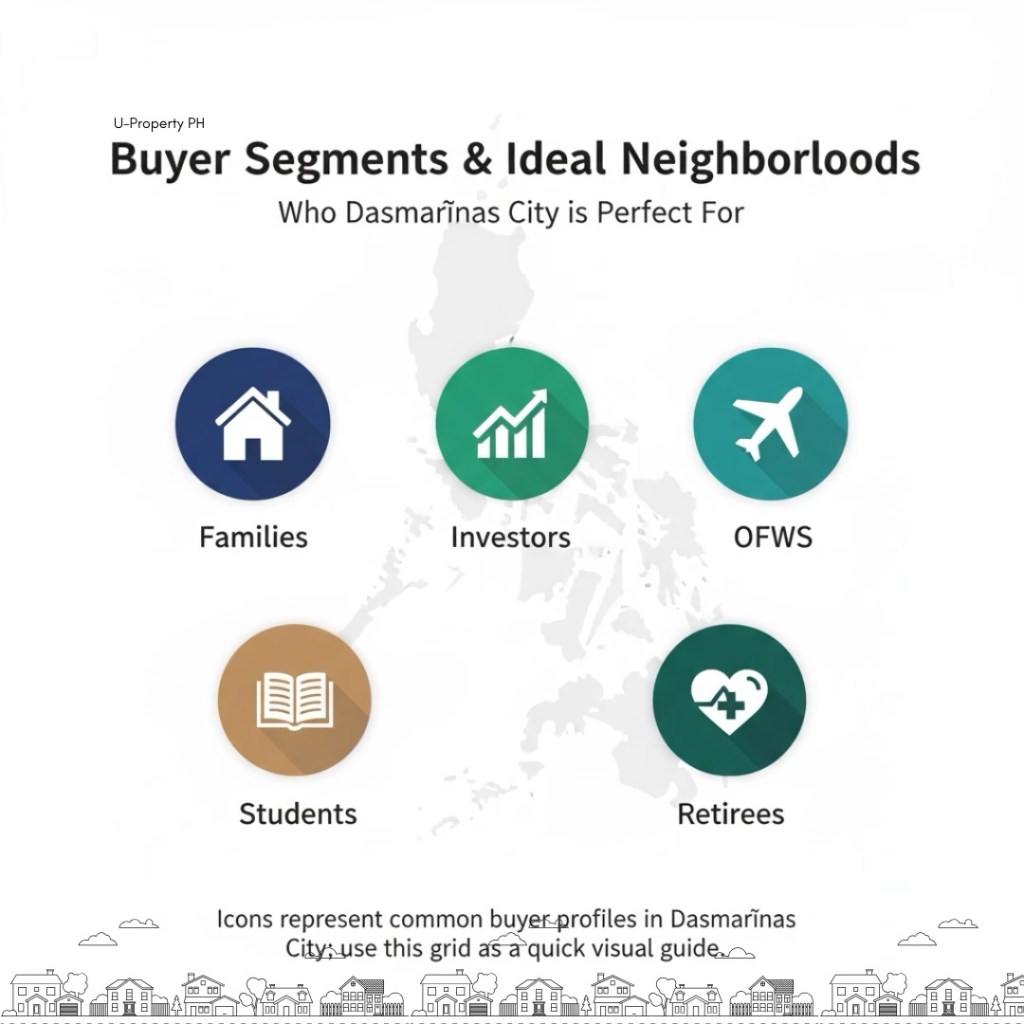
Overview of buyer segments in Dasmariñas City, showcasing ideal neighborhoods for families, investors, OFWs, students, and retirees.
Each area in Dasmariñas serves a specific demographic:
- Families → space + safety
- Investors → yield + stability
- OFWs → appreciation + low maintenance
- Students → walkability + compact rentals
- Retirees → healthcare + comfort
This diversity makes Dasmariñas highly resilient—and ensures every buyer type can find a neighborhood aligned to their goals.
Buying Tips for Dasmariñas: How to Choose the Right Property
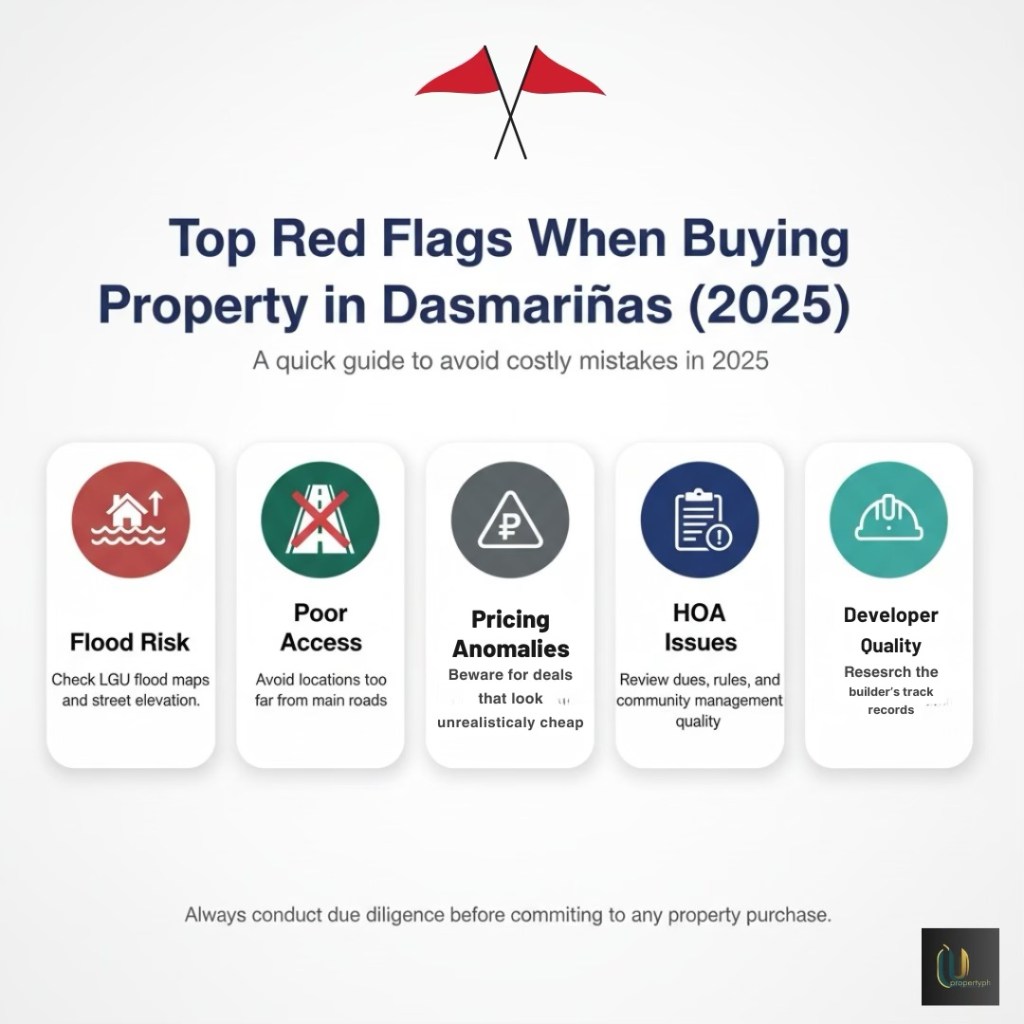
A guide highlighting the top red flags to watch when buying property in Dasmariñas in 2025.
Buying in Dasmariñas—whether for personal use or investment—requires clarity, strategy, and a solid understanding of how each micro-market behaves.
Below are refined, expert-level tips designed to help buyers avoid mistakes and maximize returns.
Red Flags to Watch Out For
Every fast-growing city has pitfalls. Dasmariñas is no exception. When evaluating a property, be cautious of:
1. Units too far from major roads or transport corridors
If it takes multiple tricycle transfers to reach Aguinaldo Highway or key university zones, rental demand can drop significantly.
2. Suspiciously low prices compared to surrounding listings
Ultra-cheap properties often indicate issues with access, flooding, developer quality, or legal documentation.
3. High association dues for small condos
HOA fees that don’t match unit size or rental rate potential can erode long-term yields quickly.
4. Flood-prone or low-lying streets
Always check LGU flood maps and verify with residents—barangay-level risks vary widely.
5. Unrealistic rental guarantees or exaggerated yield claims
Dasmariñas is stable, but it’s not a “get-rich-fast rental market.” If it sounds too good to be true, it usually is.
Smart buyers scrutinize red flags early to avoid costly surprises later.
Essential Due Diligence Steps
Dasmariñas rewards buyers who do their homework.
1. Verify zoning classifications and BIR zonal values
This ensures you’re paying a fair market price and can anticipate future appreciation trends.
2. Check Cavite LGU flood and geohazard maps
An elevated barangay today is better than a discounted unit in a flood-prone pocket tomorrow.
3. Visit the site at multiple times of the day
Peak hours reveal the true traffic, noise, and accessibility conditions that listing photos hide.
4. Compare HOA fees and review community rules
Some subdivisions offer more amenities at lower costs—these have better long-term resale appeal.
5. Validate the developer’s track record
Look for consistent turnover quality, on-time completion, and transparent communication.
Good due diligence turns a “good deal” into a great investment.
Tips for First-Time Homebuyers
Buying your first home in Dasmariñas requires balancing aspiration with practicality. Keep these guiding principles in mind:
1. Prioritize access over aesthetics
A beautifully designed unit loses its value if located in an inconvenient or disconnected area.
2. Align your purchase with long-term needs
Consider family plans, work commute, school proximity, and the lifestyle you want five years from now.
3. Avoid stretching loans beyond comfort
Financial breathing room matters—choose a payment plan that leaves space for emergencies.
4. Check what’s within a 5–10 minute radius
Malls, markets, schools, clinics, and transport stops add huge value for everyday living.
Think long-term: the right property should support your lifestyle today and your stability tomorrow.
Tips for Investors & OFWs
Investors thrive in Dasmariñas when they match location with tenant behavior. To optimize yield and appreciation:
1. Match unit size to tenant type
Students prefer studios and compact 1BRs; families choose townhouses; medical workers prioritize proximity and walkability.
2. Align your purchase with long-term needs
Especially if based abroad—choose developments where property management is reliable, transparent, and responsive.
3. Target high-demand micro-markets
Zones near universities, hospitals, and major transport corridors offer the strongest year-round occupancy.
4. Avoid tourism-driven assumptions
Dasmariñas is a stable rental market—not a tourism hotspot like Tagaytay. Anchor your strategy to actual demand, not wishful projections.
Investors who align their strategy with real-world tenant needs consistently outperform those who buy based on hype.
Common Concerns (and Reality Checks)
Every growing city comes with questions—and Dasmariñas buyers are smart to ask them.
Here are the most common concerns, paired with grounded, data-aware reality checks that separate perception from actual market behavior.
“Traffic is bad along Aguinaldo Highway.”
Yes—Aguinaldo Highway gets congested. It’s the province’s primary backbone, after all.
But the long-term picture looks very different:
- CALAX is steadily absorbing traffic volume.
- New feeder roads and barangay connectors are easing pressure on major choke points.
- MCX and SLEX integration continue to streamline Metro Manila access.
- Planned intersection upgrades and road widening will further improve flow.
Traffic is a challenge today, but infrastructure is actively reshaping mobility—and real estate appreciates ahead of full completion. Investors who understand this cycle typically see stronger returns.
“Isn’t the student market oversaturated?”
Only if you buy in the wrong pocket. Oversupply happens when developments are far from campus, hard to access, or lack essential features like security or reliable transport.
Here’s the reality:
- Units within 1 km of DLSU-D, EAC, or PCU capture the highest demand.
- Well-maintained condos and townhouses outperform bedspaces in older structures.
- Students and parents consistently prefer walkability and safety—not the cheapest option.
- New enrollment cycles replenish demand every year.
The student market isn’t oversaturated—it’s selective.
Choose the right micro-location, and vacancies become the exception, not the rule.
“Flooding?”
Flood risk in Dasmariñas varies widely—and is highly barangay-specific.
Many areas are elevated, well-drained, and dry year-round.
Smart buyers handle this easily:
- Check Cavite LGU flood maps
- Inspect street elevation and drainage
- Ask long-term residents about water movement during heavy rainfall
Flooding is rarely a city-wide issue—it’s a street-level concern.
With proper due diligence, it’s one of the easiest risks to eliminate from your decision-making process.
Future Outlook (2025–2030): Why Dasmariñas Will Keep Rising
The next five years will be pivotal for Dasmariñas.
Infrastructure is accelerating, demand is deepening, and the city’s economic ecosystem is reaching a maturity curve that favors both long-term investors and end-user buyers.
Where Cavite’s growth is heading, Dasmariñas is already positioned at the center.
Market Forecast (2025–2030)
Based on emerging infrastructure, sustained inward migration, and the city’s uniquely diversified demand sources, Dasmariñas is projected to experience:
- 5–8% annual price appreciation, with higher growth in CALAX-adjacent barangays and university/hospital zones
- Rising rental absorption each academic year, fueled by expanding university enrollment and medical staffing needs
- Continuous growth of commercial and retail hubs, encouraging more professionals and families to relocate
- Tightening supply in well-located barangays, pushing value upward as demand concentrates where walkability and transport access are strongest
This is not speculative appreciation—it’s a predictable result of expanding mobility, rising economic activity, and institutional anchors that guarantee consistent foot traffic.
Upcoming Developments Shaping the Market
Current DPWH, LGU, and regional planning updates point to several transformative developments in the pipeline:
- Improved CALAX connectivity — future access points are expected to draw higher-value developments toward the city’s outskirts and emerging barangays.
- Expansion of commercial and lifestyle centers, particularly in Salitran, Burol, and near the Aguinaldo Highway corridor.
- More mid-rise condominium projects, responding to increasing demand from students, medical workers, and young professionals.
- Growing interest from national developers, signaling higher-quality stock, stronger resale potential, and better-managed communities.
These upgrades reinforce Dasmariñas’ evolution from a suburban hub into a full-scale urbanized center—one that serves not just Cavite, but the wider CALABARZON region.
Why Dasmariñas Outpaces Other Cavite Cities
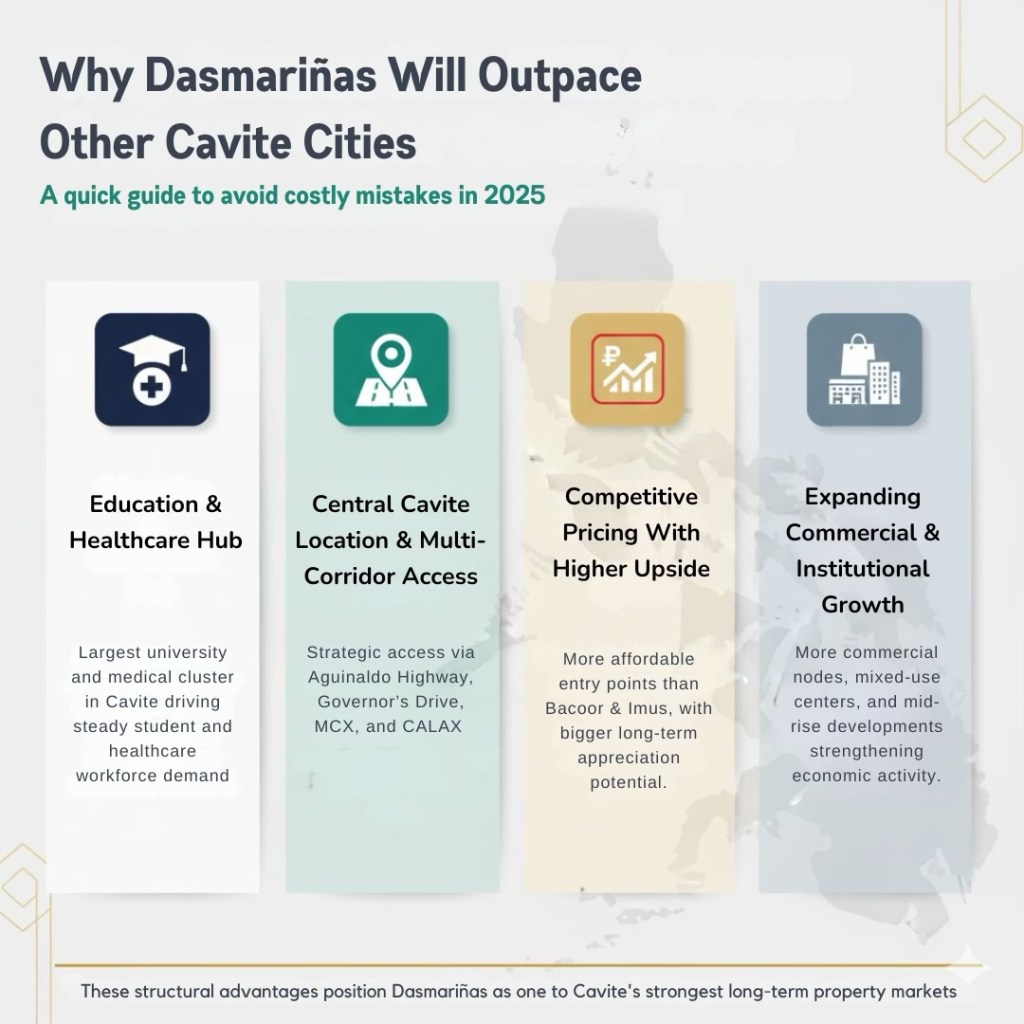
An infographic highlighting the competitive advantages of Dasmariñas over other cities in Cavite for real estate investment in 2025.
The city’s long-term advantage lies in its balance.
Dasmariñas isn’t the most expensive, nor the cheapest. It’s not a tourist city, nor is it a purely industrial one.
Instead, it sits at the intersection of affordability, accessibility, and opportunity—and that blend is rare.
Here’s what sets it apart:
- More schools than Imus → stronger youth population, higher rental turnover
- More hospitals than General Trias → stable medical workforce demand
- Lower entry prices than Bacoor → better affordability and higher yield potential
- Better mid-Cavite positioning than Carmona or Silang → central access to both north and south Cavite nodes
In real estate terms:
- Investors get multiple tenant markets and predictable yields
- Families get stability, space, and access to everyday essentials
- Students get walkability and transport convenience
- OFWs get long-term appreciation without Manila-level prices
Dasmariñas works for every major buyer segment—and markets that serve multiple segments tend to be the most resilient.
The verdict:
Dasmariñas is not just rising; it’s entering a long-term growth cycle shaped by infrastructure, institutions, and population depth.
Those who enter early stand to benefit the most.
Schedule a Viewing or Consultation
Dasmariñas is moving fast.
The best units—especially those near universities, hospitals, and major transport corridors—rarely stay on the market for long.
If you’re serious about securing a property with strong appreciation potential, now is the time to take the next step.
Here’s how I can help you move forward confidently:
schedule a guided tour of top properties in Dasmariñas that match your goals and budget.
👉 Request a personalized shortlist
get a curated list of the best options across subdivisions, condos, and emerging micro-markets.
👉 Explore our full Cavite Real Estate Guide
compare Dasmariñas with nearby cities like Imus, Bacoor, and General Trias to see which one aligns best with your priorities.
👉 Message via WhatsApp or Messenger
get real-time responses, quick clarifications, and on-the-spot recommendations.
Pro tip:
Properties near DLSU-D, De La Salle Medical Center, and major highway access points consistently go first. Don’t wait for prices—or competition—to rise further.


 U-Property PH
Leave a reply to Is Dasmariñas Still Worth the Hype? A Realistic Look at Cavite's Property Powerhouse – RichestPH Cancel reply