

Aerial view of Kawit, Cavite showcasing its residential neighborhoods and proximity to Manila Bay.
TABLE OF CONTENTS
- I. Introduction: Why Kawit Deserves a Second Look
- II. Where Exactly Is Kawit, Cavite?
- III. Kawit’s Historical Identity and Its Impact on Property Values in Cavite
- IV. Accessibility and Daily Connectivity in Kawit, Cavite
- V. Residential Property Landscape in Kawit, Cavite: House Types and Price Direction
- VI. Buying Land in Kawit: Opportunities and Red Flags
- VII. Rental Market and End-User Demand in Kawit, Cavite
- VIII. Local Economy and Commercial Activity in Kawit, Cavite
- IX. Livability, Environment, and Daily Life in Kawit, Cavite
- X. Infrastructure, Utilities, and Risk Considerations in Kawit, Cavite
- XI. Investment Outlook: Where Kawit Fits in Cavite’s Growth Story
- XII. Kawit vs Nearby Cities and Municipalities in Cavite
- XIII. Who Should Consider Buying Property in Kawit
- Frequently Asked Questions About Buying Property in Kawit, Cavite
- XIV. Final CTA: Talk to a Local Cavite Property Specialist
I. Introduction: Why Kawit Deserves a Second Look
Kawit, Cavite rarely tops anyone’s list of Cavite real estate hotspots—and that’s precisely why it’s worth attention. For years, it’s been boxed into a narrow reputation: historical, quiet, residential, done. End of story. Except that story is outdated.
Today’s Kawit is a municipality sitting at an interesting crossroads. It’s close enough to benefit from Bacoor’s urban momentum, yet far enough to avoid its price compression and congestion. It’s coastal, but not speculative beachfront hype. Residential, but not stagnant. In short, Kawit operates under the radar—and serious buyers know that’s often where the best value hides.
What’s changed? Pressure. Pressure from Bacoor and Imus as developable land tightens. Pressure from buyers priced out of first-ring Cavite locations. Pressure from investors who understand that appreciation usually starts before the headlines, not after. Kawit absorbs this pressure quietly, translating it into gradual price normalization rather than volatile spikes. That’s not flashy. It’s stable. And stability compounds.

Geographically, Kawit sits in north-west Cavite, bordered by Bacoor, Noveleta, and Rosario, with Manila Bay shaping its coastal edge. This positioning matters. It places Kawit within commuting distance of major employment centers while keeping land values grounded. Infrastructure upgrades in nearby cities ripple outward, and Kawit is directly in that spillover path—without the speculative premium layered on top.
There’s also a psychological advantage. Kawit doesn’t sell a promise of instant transformation. It offers livability first, upside second. For end-users, that means space, community, and predictability. For investors, it means entry prices that still make sense in a province where many markets no longer do.
Kawit is not where prices double overnight—and that’s the point.
This is a municipality driven by end-user demand, spillover from nearby cities, and controlled growth. Buyers who expect fast flips or dramatic spikes usually leave disappointed. Buyers who value stability, livability, and gradual appreciation tend to stay—and benefit.
This guide breaks down Kawit beyond clichés and postcard history. We’ll look at where it stands today, what’s realistically driving demand, and where it fits within Cavite’s broader growth story—so you can decide, clearly and calmly, if Kawit belongs on your shortlist.
II. Where Exactly Is Kawit, Cavite?
Location is destiny in real estate—and Kawit’s coordinates quietly work in its favor.

Kawit sits in north-west Cavite, occupying a strategic strip between Bacoor to the east, Noveleta to the south, and Rosario to the southwest, with Manila Bay defining its western edge. This placement puts Kawit inside the daily orbit of NCR-linked activity without inheriting the full weight of NCR congestion or Bacoor’s premium pricing. It’s close. Not cramped. Connected, but not chaotic.
Boundaries and Neighboring LGUs
East: Bacoor City
Cavite’s most urbanized gateway to Metro Manila
South: Novelet
a smaller, coastal municipality with similar density patterns
Southwest: Rosario
increasingly relevant due to CAVITEX access
West: Manila Bay
shaping Kawit’s coastal character and land-use rules
This matters because growth pressure doesn’t move randomly. It radiates outward from saturated cities. Kawit sits directly in that spillover path.
Coastal Positioning, Explained
Kawit is coastal, but not in the speculative, resort-driven sense. Its proximity to Manila Bay influences:
- Zoning and setbacks along certain barangays
- Lifestyle—more open air, flatter terrain, fewer vertical developments
- Risk management—buyers must be flood-aware, not flood-fearful
In practical terms, the coast gives Kawit breathing room. It limits overdevelopment and helps preserve its low- to mid-density character—something many buyers now actively seek.
Barangay Layout and Density Patterns
Kawit is composed of 23 barangays, and density varies noticeably:
- Higher-density barangays cluster near main roads and commercial strips
- Lower-density areas sit deeper inside residential pockets and near the coast
- Legacy family compounds and inherited lots are common, shaping irregular but spacious layouts
This barangay-level variation explains why prices and living conditions can change street by street, not just barangay by barangay.
Urban vs Semi-Rural Pockets
Kawit doesn’t present as uniformly urban—and that’s a feature, not a flaw.
- Urban-adjacent pockets: Near Bacoor borders and major roads; ideal for commuters
- Semi-rural residential zones: Quieter interiors with larger lots and fewer developments
- Coastal barangays: More relaxed pace, stricter building considerations
For buyers, this means choice. You can optimize for access, space, or quiet—sometimes two at once, rarely all three.
Quick Context: How Kawit Compares Nearby
| Location | Approx. Land Area | Relative Density | Development Intensity |
|---|---|---|---|
| Kawit | Smaller | Low–Moderate | Gradual, residential |
| Bacoor | Larger | High | Highly urbanized |
| Imus | Larger | Moderate–High | Mixed-use growth |
Kawit’s footprint is smaller, but that constraint supports measured growth, not unchecked sprawl.
Understanding where Kawit sits—physically and functionally—clarifies everything that follows: pricing behavior, livability, and long-term upside. Geography sets the rules. Kawit simply plays them quietly, and well.
III. Kawit’s Historical Identity and Its Impact on Property Values in Cavite
History is often treated as a footnote in real estate listings. In Kawit, it’s a structural advantage.

Kawit is home to the Aguinaldo Shrine, the birthplace of Philippine independence and one of the country’s most important national landmarks. This isn’t just cultural trivia—it shapes land use, buyer behavior, tourism patterns, and long-term value stability in ways that purely residential towns rarely enjoy.
Aguinaldo Shrine and the Heritage Zoning Context
The Aguinaldo Shrine anchors Kawit’s identity as a heritage municipality, not just a bedroom community. Areas surrounding nationally significant landmarks are subject to:
- Stricter zoning and conservation guidelines
- Limitations on intrusive commercial or high-density developments
- Greater scrutiny on alterations, demolitions, and land conversion
For speculative developers, this can feel restrictive. For homeowners and long-term investors, it’s protective. Heritage zoning reduces the risk of sudden, disruptive overdevelopment—one of the fastest ways neighborhoods lose livability and value.
Tourism Foot Traffic: Predictable, Not Chaotic
Kawit experiences seasonal tourism, particularly during:
- Independence Day celebrations
- Educational tours and heritage visits
- National and local commemorative events
This foot traffic is episodic rather than constant, which matters. It supports small businesses, food establishments, and local services without overwhelming daily life. Unlike resort towns or festival-driven locations, Kawit benefits from tourism without being consumed by it.
For property owners, this translates to:
- Stable residential environments
- Selective short-term rental opportunities
- Strong local commerce without volatility
Cultural Pride as a Value Stabilizer
Communities with a strong sense of identity age differently. Kawit residents don’t see their town as interchangeable with the next subdivision-heavy municipality. There’s local pride tied to national history, and that pride influences:
- Property upkeep
- Resistance to incompatible developments
- Long-term residency rather than transient occupancy
In real estate terms, this creates price floors. Values may not spike overnight, but they also don’t collapse easily. Cultural significance doesn’t inflate markets—it stabilizes them.
How Heritage Areas Affect Development Decisions
Buying near heritage zones requires clearer expectations:
- You’re less likely to see high-rise condos or aggressive rezoning
- Commercial growth is controlled and typically small-scale
- Residential character is preserved longer than in fast-urbanizing LGUs
This makes Kawit especially attractive to buyers who prioritize environmental continuity, neighborhood integrity, and long-term livability over rapid transformation.
📌 Heritage Areas: What Buyers Should Know
- Expect conservation rules near landmark-adjacent zones
- Always verify local zoning and building restrictions before purchasing land
- Heritage protection often supports long-term value retention, not short-term flips
- Ideal for end-users, retirees, and conservative investors
Kawit’s history doesn’t freeze it in time. It quietly filters growth—allowing progress that fits, and blocking what doesn’t. In a province where unchecked expansion has diluted character in many areas, that restraint is not a weakness. It’s an asset.
IV. Accessibility and Daily Connectivity in Kawit, Cavite
In Cavite, commute math decides property value. And in Kawit, the math is quietly reasonable—if you understand how the routes actually work.
Kawit isn’t a one-road town. Its accessibility comes from a web of secondary arteries that feed into Cavite’s major corridors, allowing residents to move without being locked into a single choke point.
Key Roads That Keep Kawit Moving
Centennial Road
The main spine linking Kawit to Noveleta, Rosario, and onward to CAVITEX
Tirona Highway
A critical connector toward Bacoor and Imus, especially for daily commerce
Coastal routes
Serving barangays closer to Manila Bay, useful for local circulation and off-peak travel
These roads don’t make Kawit “fast” in the Metro Manila sense—but they make it predictable, which commuters value far more.

Access to CAVITEX and Major Commercial Zones
Kawit residents typically access CAVITEX via:
- Rosario for southbound or coastal routes
- Bacoor for northbound entry toward MOA and Parañaque
This dual access is an advantage. When one entry point is congested, the other often isn’t. From CAVITEX, major destinations become straightforward:
- Mall of Asia complex
- ASEANA and Entertainment City
- NAIA terminals
Daily needs don’t require a Manila run. Bacoor and Imus handle most:
- Major malls and retail centers
- Hospitals and clinics
- Schools and service hubs
Realistic Travel Time Scenarios
Let’s be clear—no Cavite commute is immune to traffic. The difference lies in time predictability.
| Route | Off-Peak | Rush Hour |
|---|---|---|
| Kawit → Bacoor | 15–25 mins | 30–45 mins |
| Kawit → MOA (via CAVITEX) | 35–45 mins | 60–90 mins |
| Kawit → Makati | 60–75 mins | 90+ mins |
Off-peak travel is manageable. Rush hour demands planning. Kawit rewards those with flexible schedules or hybrid work arrangements.
Who Commuting from Kawit Works For
Kawit is well-suited for:
- Hybrid and remote workers with limited weekly NCR travel
- Early-shift professionals who beat peak congestion
- Business owners operating within Cavite or coastal zones
- Families prioritizing space over daily city proximity
Who May Struggle
Kawit is less ideal for:
- Daily peak-hour commuters to Makati or BGC
- Buyers expecting rail-based connectivity in the short term
- Those with zero tolerance for travel variability
This isn’t a flaw. It’s a filter.
Kawit doesn’t promise effortless access. It offers options, redundancy, and realistic commute trade-offs—and for the right buyer profile, that balance makes sense. In a province where single-route dependency is common, having multiple ways in and out is a quiet advantage.
That same logic carries into Kawit’s housing market: buyers who value options, space, and balance tend to gravitate toward homes that reinforce—not undermine—that daily flexibility.
V. Residential Property Landscape in Kawit, Cavite: House Types and Price Direction
Kawit’s residential market isn’t flashy—and that’s its edge. What you get here is clarity: familiar housing types, practical price points, and neighborhoods that behave the way residential areas should. No gimmicks. No vertical overload. Just housing that makes sense for end-users and long-term holders.
In actual buyer walkthroughs, the deciding factor in Kawit is rarely finishes—it’s lot size, street width, and how the neighborhood behaves on a normal weekday.
A. Common Residential Property Types in Kawit
Kawit’s housing stock reflects its roots as a family-oriented municipality with measured growth.
Single-Detached Homes
Best for families prioritizing space and long-term livability.
These dominate many barangays and older subdivisions. Expect:
- Larger lot cuts than newer developments in Bacoor
- Ground-level living, usable yards, and parking
- Incremental renovations rather than cookie-cutter finishes
Ideal for families upgrading from townhouses—or buyers who value space over amenities.
Duplexes and Townhouses
Best for first-time buyers and small families who want predictable pricing, manageable upkeep, and steady resale or rental demand.
Found mainly near main roads and newer pockets, these offer:
- Lower entry prices than single-detached homes
- Practical layouts for young families and first-time buyers
- Predictable maintenance and rental demand
They’re the workhorses of Kawit’s entry-level market.
Family-Owned Legacy Homes
Best for patient, value-focused buyers willing to trade cosmetic updates for larger lots, negotiable pricing, and long-term upside—provided due diligence is done right.
A distinct Kawit feature. These are inherited properties, often:
- Sitting on irregular but generous lots
- Located deep inside barangays
- Priced with flexibility—if title and documentation are clean
For patient buyers, these can offer exceptional value. Due diligence is non-negotiable.
B. Subdivisions vs Barangay Living
Kawit gives buyers a real choice here—and the difference is material.
Gated Subdivisions
- Controlled access and clearer road layouts
- More consistent neighborhood standards
- Higher price per square meter
- Often older, but well-established
Best for buyers prioritizing security, predictability, and resale ease.
Non-Gated Barangay Living
- Lower acquisition cost
- Larger lots in some pockets
- Strong community ties
- More variation in upkeep and road conditions
Best for buyers who value space and affordability—and are comfortable managing variability.
There’s no “better” option. Only better alignment with your priorities.
C. Price Direction (Contextual, Not Speculative)
Kawit’s pricing tells a conservative story—and that’s a compliment.
Typical Directional Ranges (House & Lot):
- Townhouses / Duplexes: Lower-to-mid Cavite price band
- Single-Detached Homes: Mid-range, often below Bacoor equivalents
- Vacant Residential Lots: Still accessible, especially outside main roads
What matters is the relative position, not the absolute number.
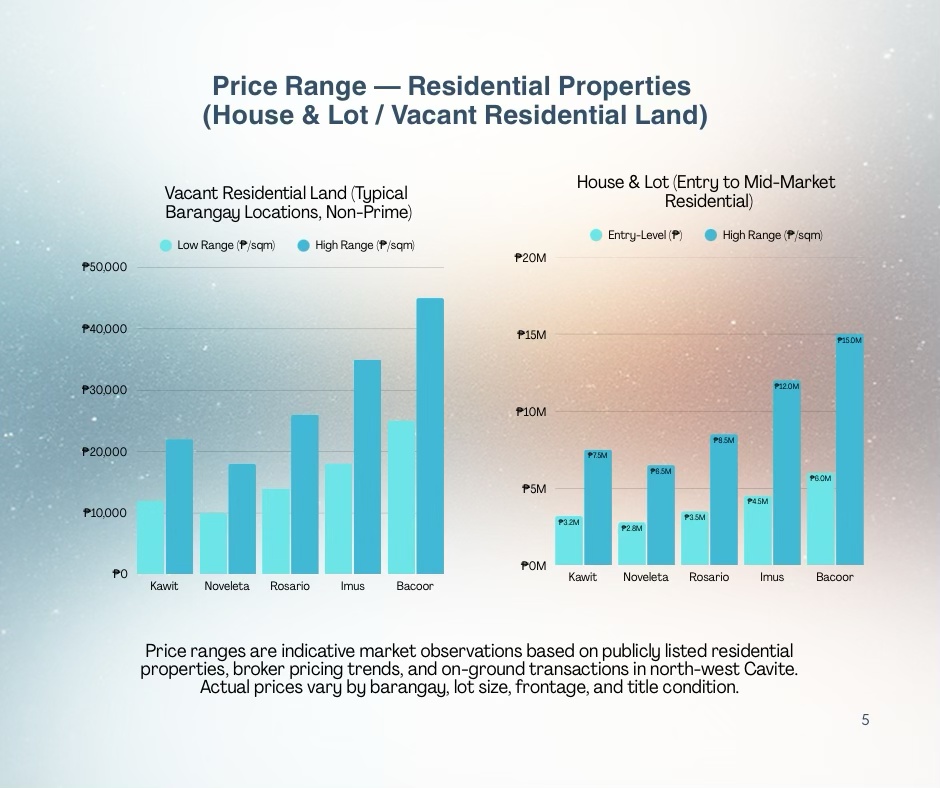
Graph showcasing the price range of residential properties in various locations, including vacant residential land and house & lot options in Cavite.
How Kawit Compares Nearby:
- Versus Bacoor: Noticeably lower entry prices; fewer new launches
- Versus Imus: Comparable in some pockets, but Kawit often offers larger lots
- Versus Noveleta: Slightly higher in established areas; more residential depth
Kawit doesn’t chase price spikes. It absorbs demand gradually, driven by spillover rather than speculation. That’s why appreciation here tends to be steady, not theatrical.
Quick Snapshot: Property Type Comparison
Let’s be clear—no Cavite commute is immune to traffic. The difference lies in time predictability.
| Property Type | Typical Buyer | Price Behavior | Long-Term Appeal |
|---|---|---|---|
| Single-Detached | Growing families | Stable | High |
| Duplex/Townhouse | First-time buyers | Gradual | Moderate–High |
| Legacy Homes | Value-focused buyers | Negotiable | High (with due diligence) |
Kawit’s residential landscape rewards buyers who value livability, lot size, and realistic pricing. It won’t impress you with rooftop pools. It will impress you with space, sanity, and numbers that still add up.
VI. Buying Land in Kawit: Opportunities and Red Flags
Buying vacant lots, coastal land, and titled residential property in Kawit, Cavite requires a different level of due diligence. This is a thinking investor’s market, not a plug-and-play subdivision play. Do it right, and you secure space and value most Cavite buyers no longer can. Do it wrong, and you inherit problems that don’t show up on glossy listings.
Let’s separate opportunity from risk.
Where the Opportunities Are
Vacant Residential Lots
Kawit still has buildable residential lots within established barangays—something that’s increasingly rare in north-west Cavite. These are often:
- Privately held by long-time families
- Moderately sized, sometimes irregular in shape
- Priced below Bacoor and select Imus pockets
For end-users planning custom homes, this is one of Kawit’s strongest advantages.
Infill Lots Inside Communities
Scattered vacant lots within built-up neighborhoods offer:
- Immediate access to utilities
- Established surroundings (no construction guesswork)
- Strong long-term livability
Infill lots tend to appreciate quietly because supply is finite.
Coastal and Near-Bay Considerations (Read Carefully)
Kawit’s Manila Bay frontage attracts interest—but this is not casual land.
Coastal and near-bay lots require:
- Verification of setback requirements
- Awareness of flood-prone barangays
- Compliance with environmental and zoning rules
These properties work best for:
- Long-term land banking
- Low-rise residential use
- Buyers comfortable with regulatory constraints
If a coastal lot looks “too cheap,” it usually is. The reason is almost always regulatory, not negotiable.
The Big Three Title Risks in Kawit
This is where most buyers fail. Kawit has a long settlement history, which means titles can be complicated.
Many of the issues buyers encounter in Kawit don’t appear on listings—they surface only during title review and on-site verification.
⚠️ Heirship Issues
No settled heirs = no enforceable sale.
Many lots are inherited and remain under:
- Undivided estates
- Incomplete extrajudicial settlements
- Multiple heirs across generations
No clean settlement, no clean sale. Period.
⚠️ Fragmented Ownership
If all registered owners don’t sign, the sale is legally invalid—no matter how much you’ve already paid.
Some properties involve:
- Multiple co-owners listed on a single title
- Partial rights being sold informally
- Verbal agreements that don’t survive due diligence
If all owners don’t sign, the deal doesn’t exist.
⚠️ Easements and Right-of-Way Problems
Easements can permanently reduce buildable area and resale value, even when the title is technically clean.
Common in barangay interiors:
- Shared access paths
- Informal road widening claims
- Drainage easements cutting through lots
These affect buildability more than price—and lenders will catch them even if buyers don’t.
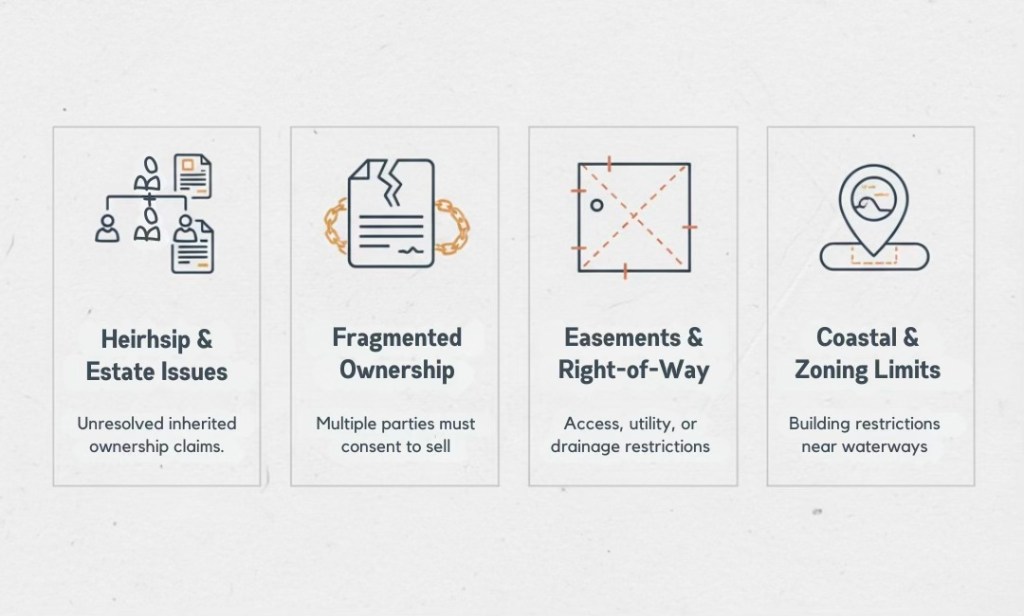
Mini Due Diligence Checklist (Non-Negotiable)
✅ Confirm title type (TCT, not tax declaration)
✅ Verify lot boundaries via survey plan
✅ Check for easements on the title and on-site
✅ Confirm all owners and heirs are accounted for
✅ Validate zoning and setbacks with the LGU
✅ Assess flood history at the barangay level
This checklist reflects the same verification sequence used by banks, appraisers, and risk-averse buyers before approving or funding a transaction.
Skip any one of these, and you’re not investing—you’re gambling.
The Strategic Takeaway
Buying land in Kawit rewards:
- Patient buyers
- Long-term planners
- Investors who respect process
It punishes shortcuts.
The upside? You’re entering a part of Cavite where land still exists, demand is real, and overdevelopment hasn’t erased value. Just make sure the land you buy is legally yours—on paper, in practice, and for the long haul.
Once ownership is secure and demand is confirmed, the next question is performance—specifically how Kawit properties hold tenants, manage vacancy, and generate income over time.
VII. Rental Market and End-User Demand in Kawit, Cavite
Kawit is not a rental hype market—and that’s exactly why it works for the right landlord. This is a use-driven rental economy, not a speculative one. Yields come from consistency, not from chasing the highest peso per square meter.
Who Rents in Kawit
Kawit’s renter base is practical and predictable:
- Local employees working in Bacoor, Rosario, and nearby industrial zones
- Young families transitioning before buying their own homes
- Skilled workers and small business owners who want space without city pricing
- Occasional returning OFWs testing long-term settlement plans
You won’t find a heavy student or tourist population here—and that’s a good thing. It keeps demand grounded and vacancy behavior rational.
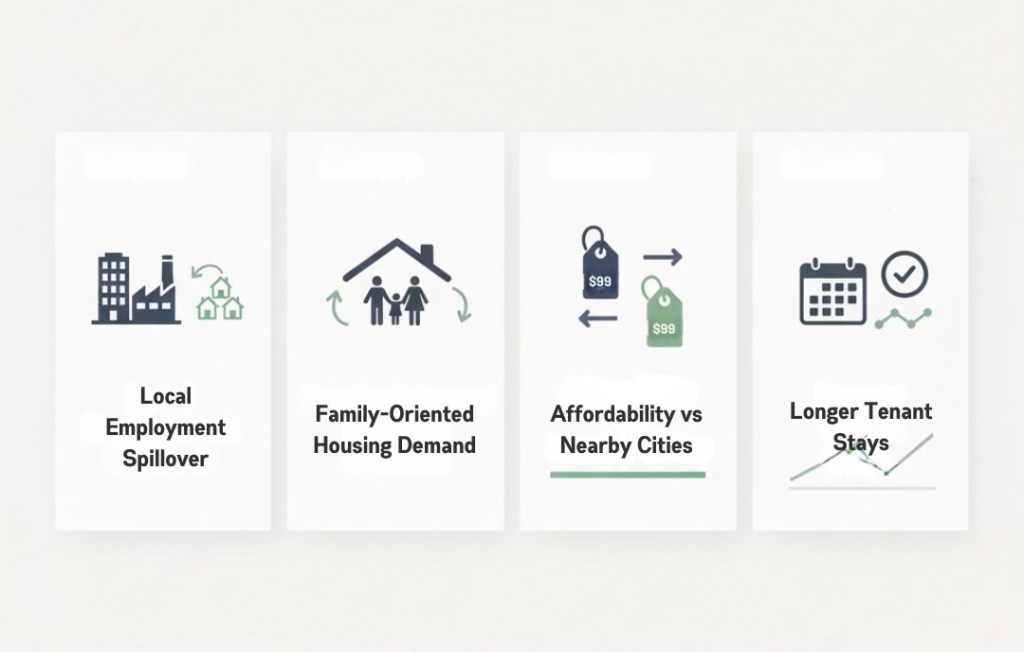
Key factors influencing local housing trends, including employment spillover, family-oriented demand, affordability comparisons, and tenant retention.
Typical Rental Setups
Rental stock in Kawit leans toward whole-unit living, not room-by-room monetization.
Common formats include:
- Townhouse rentals for small families
- Single-detached homes rented long-term
- Duplex units near main roads and subdivisions
Short-term rentals exist but are situational, usually tied to:
- Seasonal heritage tourism
- Temporary relocations
This is a long-stay market. Properties perform best when priced fairly and maintained consistently.
Demand Stability vs Volatility
Kawit’s rental demand is stable, not explosive.
- Tenants stay longer
- Turnover is slower
- Pricing adjustments happen gradually
This favors landlords who value occupancy and tenant retention over aggressive rent jumps.
This stability is reinforced by:
- Limited oversupply of rental-focused developments
- Few speculative condo launches
- A tenant base that values continuity over flexibility
In contrast to fast-urbanizing Cavite cities, Kawit’s rental market behaves more like a utility servicethan a trading instrument.
In Kawit, properties priced correctly tend to retain tenants longer than in faster-turnover Cavite markets, even when newer supply enters nearby cities.
Vacancy Behavior and Pricing Sensitivity
Vacancy in Kawit responds quickly to pricing errors.
- Overpriced units sit.
- Fairly priced homes move.
- Well-maintained properties retain tenants longer.
Tenants here are price-aware but not price-obsessed. Small rent increases are accepted when justified by:
- Space
- Accessibility
- Condition
Large jumps without improvements? Expect resistance.
Investor Reality Check
Kawit favors landlords who:
- Prioritize occupancy over peak rent
- Design for families, not transient tenants
- Understand barangay-level demand nuances
It’s not for aggressive yield maximizers. It’s for investors who appreciate quiet cash flow and minimal drama.

Rental profile overview for Kawit, Cavite highlighting tenant types and market trends.
In Kawit, the rental play is simple: serve real needs, price honestly, and let stability do the work. No fireworks. Just income that shows up when it’s supposed to.
VIII. Local Economy and Commercial Activity in Kawit, Cavite
Kawit’s economy doesn’t shout. It functions. And for residents, that distinction matters more than branding.
This is a daily-needs economy, built around proximity, familiarity, and repetition. People don’t come to Kawit to shop for novelty. They come to live efficiently—and spend locally because it’s convenient, not because it’s curated.
Public Markets and Everyday Retail
At the core of Kawit’s commercial life are:
- Public markets supplying fresh produce, meat, and seafood
- Neighborhood sari-sari stores and mini-marts
- Small eateries, bakeries, repair shops, and service stalls
These businesses thrive on repeat customers, not foot traffic spikes. The result is predictable operating hours, steady pricing, and minimal boom-bust behavior.
For residents, it means:
- Daily needs handled close to home
- Less dependency on weekend mall runs
- Lower cost of living compared to mall-centric towns
Everyday Commerce in Kawit

Everyday commerce in Kawit is built around proximity and repetition—public markets, neighborhood stores, and small service businesses that support daily life without relying on mall-driven retail.
The Absence of Large Malls — Pros and Cons
Kawit has no major mall within its borders—and that’s intentional, not accidental.
The upside:
- Less congestion and traffic clustering
- Fewer speculative commercial developments
- Residential areas remain residential
Kawit preserves residential calm and price discipline by keeping high-intensity commercial activity outside its borders.
The trade-off:
- Limited lifestyle retail within the municipality
- Dependence on nearby cities for cinemas, big-box retail, and specialty stores
Residents rely on nearby Bacoor and Imus for malls and lifestyle retail, trading convenience for quieter daily living.
This balance keeps Kawit livable. It also prevents the kind of over-commercialization that quickly erodes neighborhood value.
📌 Why Kawit Isn’t a Mall City — And Why That’s Okay
Kawit offloads high-intensity retail to Bacoor and Imus, where infrastructure can handle it. In return, residents enjoy quieter streets, lower noise levels, and communities that don’t revolve around parking lots.
Reliance on Bacoor and Imus (By Design)
Major spending and employment spill over into:
- Bacoor for malls, hospitals, and BPO-adjacent services
- Imus for regional retail, schools, and government centers
This proximity allows Kawit to:
- Stay residential-first
- Avoid infrastructure strain
- Benefit economically without absorbing the downsides
Think of Kawit as economically adjacent, not isolated.
Small-Business Viability
Kawit is friendly to:
- Home-based businesses
- Neighborhood service providers
- Food concepts built on loyalty, not novelty
Rents are lower. Competition is manageable. And community recognition matters. Businesses that solve everyday problems tend to last.
What doesn’t work as well:
- High-concept retail
- Trend-driven dining
- Scale-dependent franchises
Kawit rewards function over flash.
The Economic Takeaway
Kawit’s commercial ecosystem is designed to support residents, not impress visitors. That’s why it ages well. For homeowners, it means stability. For small entrepreneurs, it means survivability. And for investors, it means a town that grows quietly—without losing its footing.
IX. Livability, Environment, and Daily Life in Kawit, Cavite
Kawit doesn’t try to impress you on day one. It grows on you—and that’s usually a good sign.
This is a municipality built for daily rhythm, not spectacle. If your idea of livability includes space, familiarity, and predictability, Kawit clears the bar comfortably.
Community Feel: Familiar, Not Anonymous
Kawit still operates on recognition and routine.
- Neighbors know each other
- Local stores know their customers
- Barangay events still matter
This creates a sense of social stability that newer, high-turnover developments struggle to replicate. For families, retirees, and long-term residents, this translates into safety that comes from presence, not patrols.
Traffic and Noise Patterns
Compared to Bacoor and parts of Imus, Kawit feels noticeably calmer.
- Traffic is localized, not city-wide
- Congestion spikes occur near schools, markets, and main roads—but dissipate quickly
- Interior barangays remain quiet, especially at night
You trade some travel speed for peace of mind. For many buyers, that’s a fair exchange.
Flood Context: Barangay-Level Reality
Flooding in Kawit is not uniform—and treating it as such leads to bad decisions.
Key nuances:
- Some coastal and low-lying barangays experience occasional tidal or rain-related flooding
- Interior and elevated pockets remain largely unaffected
- Drainage quality varies significantly by location
Smart buyers don’t ask, “Does Kawit flood?”
They ask, “Which streets and how often?”
In practice, flood assessments in Kawit are most reliable when cross-checked with long-time residents and recent drainage improvements, not just maps.
Barangay-level due diligence matters more here than anywhere else.
Coastal Environment: Benefits and Trade-Offs
Living near Manila Bay brings:
Benefits
- Better airflow
- More open surroundings
- Less vertical congestion
Trade-Offs
- Salt air affecting exterior finishes
- Building and setback considerations
- Heightened awareness of weather patterns
For residents who value openness and natural ventilation, the coast is a plus. For those expecting zero maintenance, it requires adjustment.
Coastal Context

Coastal barangays in Kawit offer more open surroundings and airflow, but also require greater awareness of weather exposure, building guidelines, and long-term maintenance.
Access to Schools, Churches, and Healthcare
Kawit handles essentials locally:
- Public and private elementary and secondary schools
- Prominent churches and chapels embedded in communities
- Basic health centers and clinics
For tertiary hospitals, specialty care, and universities, residents rely on Bacoor and Imus—both within practical driving distance.
Barangay Livability Snapshot
📍 What to Evaluate Before Choosing a Spot in Kawit
- Road width and access
- Flood history of the exact street
- Proximity to markets and schools
- Noise levels during peak hours
- Distance to main exit roads
Livability in Kawit isn’t standardized. It’s granular. Choose well, and you get a daily environment that feels grounded, breathable, and human-scaled—qualities that are becoming harder to find as Cavite urbanizes.
X. Infrastructure, Utilities, and Risk Considerations in Kawit, Cavite
This is where optimism meets reality—and where trust is earned. Kawit performs well when you understand its infrastructure limits, plan around its risks, and read the local governance signals correctly. Nothing here is hidden. But nothing should be assumed either.
Power, Water, and Telco Reliability
Kawit’s core utilities are generally reliable, but performance varies more by barangay than by provider. Buyers should assess conditions at the street level, not rely on municipal averages.
- Electricity: Generally stable for daily residential use, with occasional outages during severe weather. Interior barangays tend to experience fewer disruptions than coastal-facing areas.
- Water: Adequate for households, though pressure can fluctuate during peak hours—especially in older barangays. Storage tanks are a practical upgrade for larger families.
- Telecom and Telco: Major providers operate in Kawit, and fiber coverage is expanding. Availability is not uniform, so street-level confirmation is essential for remote workers.
Bottom line: Kawit supports modern living, but smart buyers verify utility performance per street before committing.
Verify these at the property level—municipal averages are not enough.
| Infrastructure Item | What to Check On-Site | Why It Matters |
|---|---|---|
| Electricity | Frequency of outages, transformer distance | Affects reliability and appliance lifespan |
| Water Supply | Pressure during peak hours, storage tanks | Determines daily usability |
| Internet / Telco | Actual provider availability on the street | Critical for remote work |
| Drainage | Nearby canals, slope, outlet condition | Predicts flood behavior |
| Road Access | Road width, surface, turning clearance | Impacts safety and resale |
| Waste Collection | Schedule and access point | Reflects barangay service quality |
| Emergency Access | Distance to main road / evacuation route | Risk management during events |
Conditions can vary significantly by street and barangay.
This checklist mirrors what experienced buyers and brokers review before finalizing a purchase.
Drainage and Flood History: Context Over Headlines
Flood risk in Kawit is localized, not systemic.
- Low-lying and coastal barangays may experience temporary flooding during heavy rainfall or high tide events.
- Elevated interior areas typically remain dry.
- Drainage improvements have been incremental, not sweeping—progress exists, but expectations must be realistic.
The mistake buyers make is asking general questions. The right approach is hyper-specific: street history, nearby waterways, and actual flood depth—not rumors.
Earthquake and Coastal Exposure (Balanced View)
Kawit, like much of Cavite, sits within a seismically active region. This is not unique—and it’s manageable.
- Low-rise housing stock reduces structural risk compared to high-density vertical developments.
- Proper engineering standards matter more than location alone.
Coastal exposure brings:
- Weather sensitivity during typhoons
- Salt air affecting finishes and metal components
These are maintenance considerations, not deal-breakers. Prepared homeowners plan for them. Unprepared ones complain later.
LGU Governance Signals
Kawit’s local government leans toward conservation and residential stability.
- Controlled land-use approvals
- Slower but steadier infrastructure rollout
- Emphasis on heritage protection and community continuity
This governance style favors long-term residents and conservative investors over fast-flip developers. It limits sudden zoning surprises—an underrated advantage in property ownership.
Infrastructure Reality Check
🧱 What Smart Buyers Verify
- Actual water pressure at the property
- Internet provider availability on the same street
- Drainage outlets and elevation points
- Distance to evacuation routes and main roads
⚠️ Risk vs Mitigation Snapshot
| Risk | Reality | Practical Mitigation |
|---|---|---|
| Flooding | Barangay-specific | Elevation check, drainage review |
| Power outage | Occasional | Backup lighting, surge protection |
| Coastal wear | Gradual | Material choice, maintenance |
| Internet gaps | Area-dependent | Provider confirmation |
Use this table as a reality check: each risk listed is manageable when identified early and paired with the right mitigation step.
The Trust Takeaway
Kawit doesn’t sell perfection. It offers manageability. Infrastructure here rewards buyers who verify, plan, and think long-term. And in real estate, that mindset is often the difference between regret and quiet satisfaction.
XI. Investment Outlook: Where Kawit Fits in Cavite’s Growth Story
Kawit is not the headline act in Cavite’s real estate narrative. It’s the supporting character that quietly benefits when the spotlight moves elsewhere. And in market cycles, that role often ages better.
To understand Kawit’s investment logic, you have to stop asking whether it will “boom” and start asking whether it will normalize.
Bacoor Saturation: The Spillover Effect
Bacoor has done what fast-growing gateway cities always do—it filled up.
- Higher land prices
- Tighter inventory
- Increasing congestion
- Reduced lot sizes
As Bacoor matures, buyers don’t disappear. They shift laterally. Kawit sits directly in that spillover path:
- Close enough to benefit from demand displacement
- Far enough to avoid Bacoor’s price inflation and density strain
This isn’t speculative expansion. It’s demographic pressure relocating in real time.
Price Compression vs Normalization
Kawit’s current pricing reflects under-positioning, not underperformance.
For years, Kawit traded at a discount relative to:
- Its proximity to NCR-access routes
- Its residential stability
- Its limited developable land
What’s happening now is not a spike—it’s compression correcting itself. As surrounding cities push prices upward, Kawit’s values gradually align with its functional reality.
This pattern mirrors what has already happened in earlier-growth Cavite municipalities—quiet normalization first, attention later.
Conceptual Market Positioning (Not a Price Forecast)
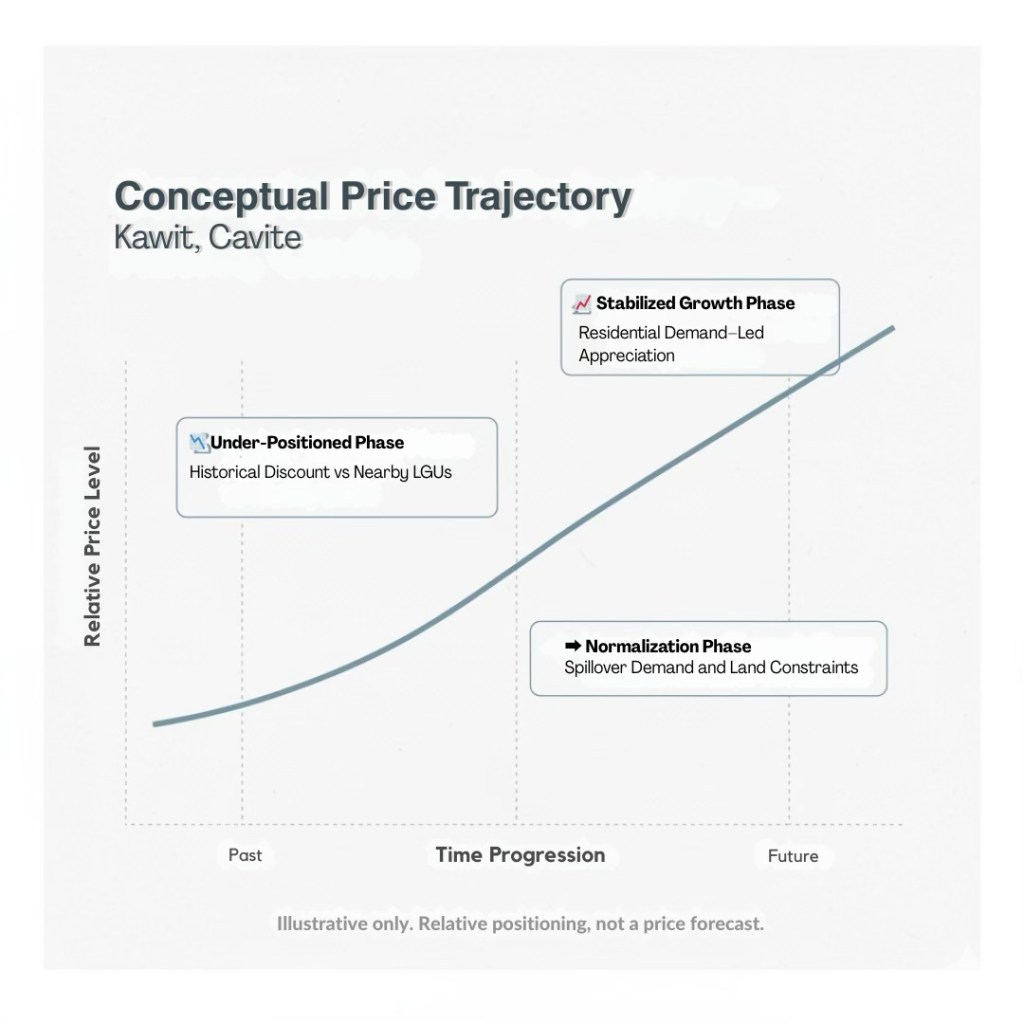
This chart illustrates relative price behavior over time, not projected values. Actual performance varies by location, timing, and property type.
Who Kawit Rewards Long-Term
Kawit’s current pricing reflects under-positioning, not underperformance.
Kawit favors investors who:
- Think in years, not quarters
- Prioritize land and low-rise housing
- Value cash flow stability over headline yields
- Understand barangay-level micro-markets
It’s well-suited for:
- Buy-and-hold land investors
- Rental property owners serving families
- End-users who want appreciation as a bonus—not the only reason to buy
Returns here compound quietly. No drama. No adrenaline.
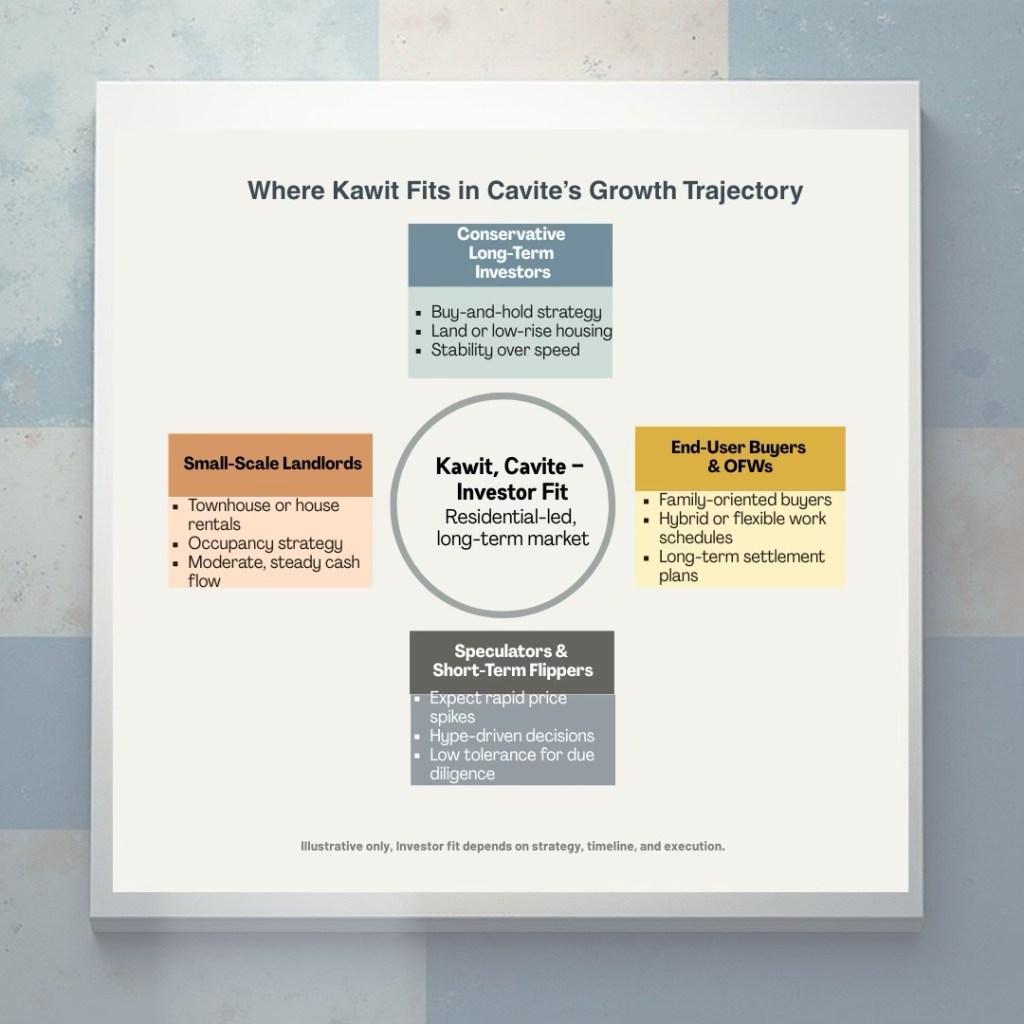
This selector reflects market behavior, not guaranteed outcomes. Fit depends on strategy, timing, and execution.
Who Should Not Invest in Kawit
Let’s be clear—Kawit is not for everyone.
It’s a poor fit if you’re:
- Chasing rapid flips or short-term arbitrage
- Expecting condo-led appreciation
- Dependent on future rail infrastructure for value creation
- Unwilling to conduct deep due diligence
If your strategy requires urgency, Kawit will frustrate you.
Where Kawit Actually Sits in Cavite
Kawit occupies a defensive growth position:
- Protected from overdevelopment
- Supported by neighboring urban centers
- Anchored by heritage and residential demand
That combination doesn’t produce overnight success stories. It produces markets that hold their ground and rise when the province moves as a whole.
XII. Kawit vs Nearby Cities and Municipalities in Cavite
Context sharpens decision-making. Kawit only makes sense when you see it side by side with its neighbors. Each nearby LGU plays a different role in Cavite’s north-west corridor—and choosing the wrong one for your goals is an expensive mistake.
Below is how Kawit actually stacks up.
Kawit vs Bacoor
Bacoor is Cavite’s front door to Metro Manila—and it pays the price for it.
Bacoor:
- Highly urbanized
- Dense subdivisions and vertical developments
- Strong commercial presence
- Higher land and house prices
Kawit:
- Lower density
- Predominantly low-rise residential
- Fewer commercial clusters
- More manageable entry prices
Bottom line:
Choose Bacoor for immediacy and access. Choose Kawit for space, livability, and price discipline.
Kawit vs Imus
Imus functions as Cavite’s administrative and institutional center.
Imus:
- Larger land area
- Regional malls, hospitals, schools
- Mixed-use growth zones
- More active developer presence
Kawit:
- Smaller, more contained
- Residential-first planning
- Fewer large-scale launches
- Slower, steadier appreciation
Bottom line:
Imus rewards buyers who want infrastructure density. Kawit rewards those who want residential calm with nearby access.
Kawit vs Noveleta
Noveleta and Kawit share coastal characteristics—but diverge in depth.
Noveleta:
- Smaller population base
- More limited commercial support
- Lower density overall
Kawit:
- Stronger residential base
- More diversified barangay profiles
- Better access to Bacoor and Rosario routes
Bottom line:
Noveleta suits ultra-quiet living. Kawit offers balance—quiet, but connected.
Kawit vs Rosario
Rosario has become increasingly relevant due to infrastructure.
Rosario:
- Strategic access to CAVITEX
- Rising land values
- Increasing commercial interest
Kawit:
- Less exposed to speculative pricing
- More residential stability
- Indirect but flexible access to CAVITEX
Bottom line:
Rosario attracts infrastructure-driven investors. Kawit attracts lifestyle-driven buyers with long-term patience.
Quick Comparison Matrix
| Location | Entry Price | Density | Lifestyle | Upside Profile |
|---|---|---|---|---|
| Kawit | Moderate | Low–Moderate | Residential, coastal | Gradual, defensive |
| Bacoor | High | High | Urban, commercial | Mature, limited |
| Imus | Mid–High | Moderate–High | Institutional, mixed-use | Structured growth |
| Noveleta | Lower | Low | Quiet, coastal | Limited |
| Rosario | Rising | Moderate | Transit-adjacent | Infrastructure-led |
The Strategic Takeaway
Kawit doesn’t try to outperform its neighbors on speed or scale. It outperforms them on balance. If your goal is immediate access, Bacoor wins. If it’s infrastructure density, Imus takes it. If it’s long-term livability with controlled exposure to growth, Kawit earns its place on the shortlist.
XIII. Who Should Consider Buying Property in Kawit
Kawit is a strong choice—for the right buyer. It rewards clarity of intent and punishes mismatched expectations. This section is your filter. If you see yourself here, Kawit deserves a serious look. If not, better to know now than after the reservation fee.
Ideal Buyer Profiles
End-User Families Seeking Space and Stability
Best for buyers prioritizing livability over commute prestige.
Kawit works exceptionally well for families who want:
- Ground-level homes with usable yards
- Quieter streets and community-oriented barangays
- Predictable daily routines over city stimulation
- Access to Bacoor and Imus without paying their price premium
This is livability-first buying. Appreciation is the bonus, not the bet.

Key characteristics of end-user families, focusing on stability, space, and livability in neighborhoods.
Budget-Conscious NCR Workers with Flexible Schedules
Best for professionals who trade peak-hour convenience for larger living space, lower entry prices, and a calmer home environment.
For professionals who:
- Work hybrid or remote
- Travel off-peak or a few days a week
- Value space more than commute prestige
Kawit offers breathing room that closer-in cities no longer can.
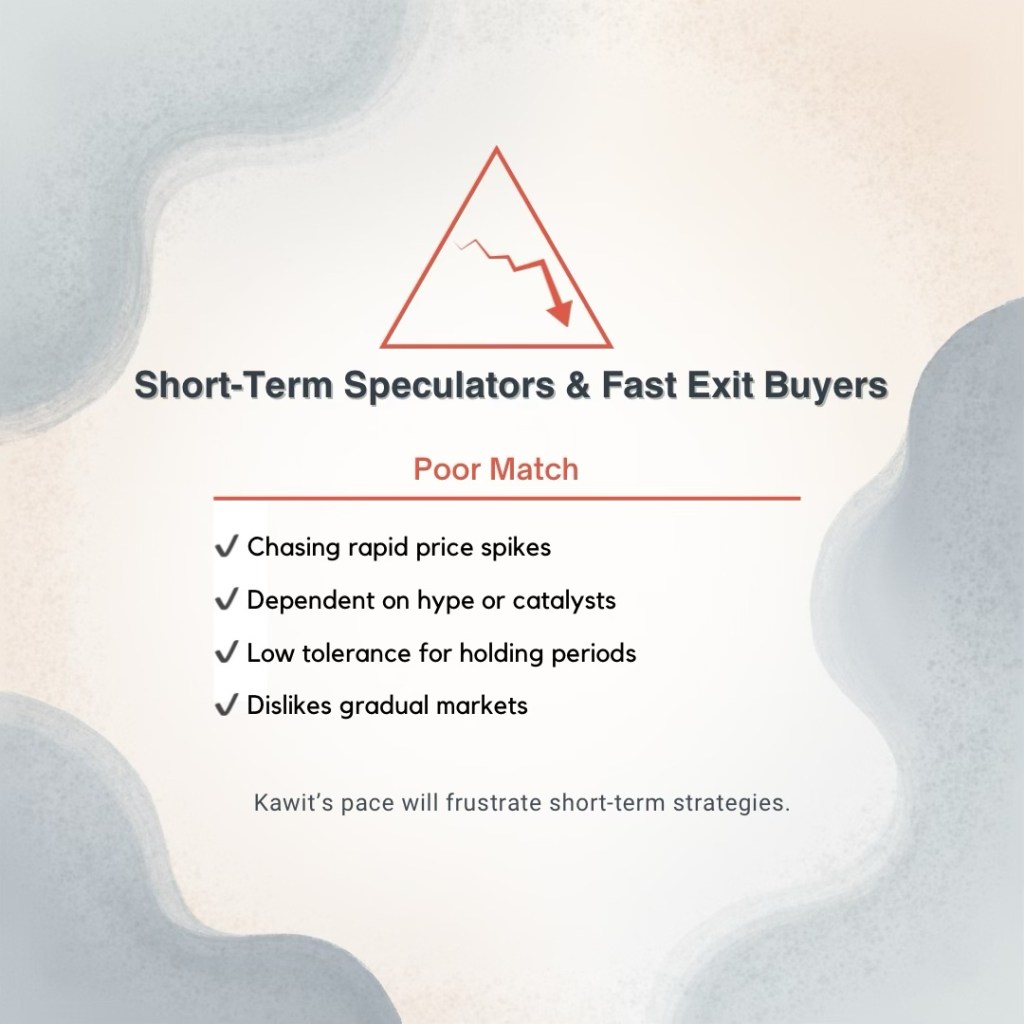
An infographic explaining why short-term speculators and fast exit buyers are a poor match for certain market conditions, highlighting key characteristics such as chasing rapid price spikes and low tolerance for holding periods.
OFWs Planning Long-Term Settlement
Best for overseas Filipinos looking to secure landed property in a stable, family-oriented town before prices fully normalize.
Kawit appeals to OFWs who:
- Prefer landed property over condos
- Want stable neighborhoods for eventual return
- Are comfortable with steady appreciation rather than volatility
It’s a practical re-entry point into Philippine real estate—without the noise.

Key considerations for OFWs planning long-term settlement: preference for landed property, long return horizons, and desire for a stable home base.
Conservative Property Investors
Best for investors focused on capital preservation and steady occupancy rather than rapid flips or speculative yield chasing.
Kawit rewards investors who:
- Favor land and low-rise rentals
- Value occupancy consistency
- Understand barangay-level demand
- Think in holding periods, not exit sprints
This is capital preservation with upside—not speculative exposure.

Guidelines for conservative property investors focusing on stable rental strategies and avoiding speculative markets.
Who Should Avoid Buying in Kawit
Not ideal for buyers whose strategy depends on speed, density, or short-term price acceleration.
Kawit is not for everyone—and that’s healthy.
You should reconsider if you:
- Need daily peak-hour access to Makati or BGC
- Expect condo-driven price acceleration
- Want lifestyle retail and entertainment at your doorstep
- Prefer high-turnover, short-stay rental strategies
- Have zero tolerance for location nuance or due diligence
Kawit doesn’t bend to urgency. It rewards patience.
Matching Goals to Location Reality
Ask yourself:
- Do I value space or speed more?
- Am I buying for daily living or quick exit?
- Is consistency more important than excitement?
If your answers lean toward space, stability, and sustainability, Kawit aligns. If not, neighboring cities may serve you better—and that’s a win too.
🧩 Buyer Fit Summary
- Best fit: Families, OFWs, conservative investors
- Neutral fit: Hybrid workers, small-scale landlords
- Poor fit: Speculators, daily peak-hour commuters
Frequently Asked Questions About Buying Property in Kawit, Cavite
Is Kawit, Cavite a good place to live?
Yes—for the right lifestyle. Kawit is well-suited for families, retirees, OFWs, and buyers who prioritize space, community, and predictability over constant activity. It offers quieter neighborhoods, predominantly low-rise housing, and access to Bacoor and Imus for work, schools, and major retail. If you value livability and long-term stability more than hype, Kawit is a strong fit.
Does Kawit, Cavite flood?
Flooding in Kawit is barangay- and street-specific, not municipality-wide. Some low-lying or coastal areas may experience temporary flooding during heavy rains or high tide events, while many interior and elevated pockets remain largely unaffected. Smart buyers assess flood history at the exact street level, review drainage nearby, and verify elevation—rather than relying on generalized claims.
Is buying land in Kawit safe?
Buying land in Kawit is safe when due diligence is done properly. The most common risks involve inherited properties, fragmented ownership, and easements. Buyers should ensure:
- A clean Transfer Certificate of Title (TCT)
- All heirs and co-owners are accounted for
- Zoning and setbacks are verified with the LGU
- No hidden right-of-way or drainage easements exist
With professional verification, land acquisition in Kawit can be a sound long-term move.
Is Kawit better than Bacoor for families?
It depends on priorities. Kawit is often better for families seeking space, quieter streets, and lower density, while Bacoor suits those needing immediate NCR access and urban amenities. Kawit trades some commute speed for calmer neighborhoods and more residential character—an exchange many families find worthwhile.
Can foreigners or OFWs buy property in Kawit?
- OFWs: Yes. Filipino citizens, including OFWs, can buy land and houses in Kawit without restriction.
- Foreigners: Foreigners may purchase condominium units (subject to foreign ownership limits) but cannot own land directly. Long-term lease arrangements or ownership through a qualified Filipino spouse may apply, subject to legal advice.
XIV. Final CTA: Talk to a Local Cavite Property Specialist
Kawit isn’t a default choice. It’s a deliberate one. And deliberate decisions deserve local perspective—not sales noise.
If you’re considering Kawit, the smartest next step isn’t rushing into a listing. It’s understanding how this municipality fits within your broader Cavite strategy. Whether you’re buying for living, investing, or long-term planning, context matters more than urgency.
A local Cavite property specialist can help you:
- Compare Kawit realistically against Bacoor, Imus, and nearby municipalities
- Identify barangays that match your priorities, not just your budget
- Flag title, zoning, and location nuances before they become problems
- Decide if Kawit is the right move—or if another Cavite market fits you better
No pressure. No push. Just clarity.
📞 Start with a Conversation
If you want a grounded, no-fluff discussion about property options in Kawit and across Cavite, you can:
- Explore the full Cavite Real Estate Guide for market context
- Review our detailed pages on Bacoor City and Imus City for side-by-side comparison
- Request a property consultation or site viewing when you’re ready



 U-Property PH
Leave a comment