
Requirements and Documents Needed to Buy Property in the Philippines
This guide consolidates all documents and requirements involved in a Philippine property transaction, clearly distinguishing what buyers must prepare from what sellers are required to provide. It does not walk through the buying process or timelines—that is covered in our step-by-step buying guide—but focuses strictly on the paperwork that makes or breaks a deal. This matters because missing, incorrect, or late documents are the number one silent deal killer in Philippine real estate. Treat this page as your paperwork control center.
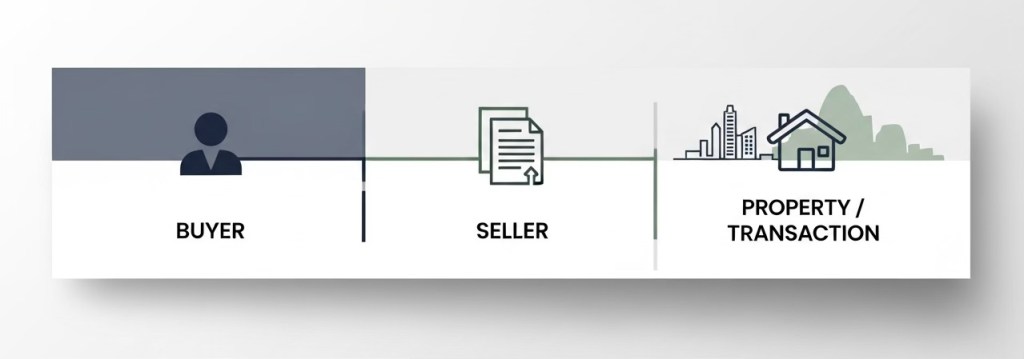
Section 1: Buyer Requirements and Documents (What YOU Must Prepare)
Before engaging sellers or developers, you must have your buyer-side documents in order. This section removes uncertainty early by clarifying exactly what you, as the buyer, are expected to produce and why each document matters.
1.1 Proof of Identity and Legal Capacity
These documents establish who you are and your legal ability to enter into a property transaction.
Government-Issued IDs
Prepare at least two valid government-issued IDs such as PhilID, Passport, UMID, or Driver’s License. These are required for notarization, banking, and registry transactions. Inconsistencies in names or signatures across IDs are a common source of delay, so alignment matters.
Tax Identification Number (TIN)
A TIN is mandatory for all BIR-related transactions. No title transfer or tax payment can proceed without it, even for cash buyers or foreigners.
Marital Status Proof
Depending on your civil status, you may be required to present a Marriage Certificate, CENOMAR, or judicial separation documents. This determines whether spousal consent is required and whether the property is considered conjugal or exclusive.
Special Legal Cases
Additional documents apply if:
- The buyer is a minor (court approval or legal guardianship)
- The buyer is represented by another person (Special Power of Attorney)
- The buyer is a corporation (see 1.3)
1.2 Financial Capacity and Funding Documents
These prove your ability to pay and directly impact financing approval and seller confidence.
Proof of Income
Most banks and developers require a combination of:
- Certificate of Employment (COE)
- Payslips
- Income Tax Returns (ITR)
- Bank statements
These establish both income stability and repayment capacity.
For Self-Employed Buyers
Prepare business permits, Articles of Incorporation (if applicable), and Audited Financial Statements (AFS). Expect stricter scrutiny, as income verification is less standardized.
For OFWs
Commonly required are employment contracts, payslips from overseas employers, and remittance records. These replace local income documents and are essential for loan approvals.
For Cash Buyers
Even without financing, you may still be asked for proof of funds such as bank certificates or statements to comply with anti-money laundering regulations and seller verification.
1.3 Special Buyer Profiles
Certain buyer categories require additional documentation or are subject to specific legal frameworks.
OFWs (Overseas Filipino Workers)
If transacting remotely, prepare:
- Special Power of Attorney (SPA)
- Consularized or apostilled documents
- Valid IDs of both principal and representative
These enable lawful signing and transaction processing in your absence.
Foreign Buyers
Foreigners are subject to ownership restrictions, particularly on land. Most purchases are limited to condominium units or structured through long-term leases or corporate vehicles. Documentation typically includes passport, visa, and proof of legal stay.
Corporate Buyers
Companies must submit:
- SEC registration documents
- Board Resolution authorizing the purchase
- Secretary’s Certificate
- Proof of signatory authority
Without these, even a fully funded deal cannot proceed legally.
Getting your buyer-side documents ready early accelerates approvals, strengthens your negotiating position, and eliminates preventable delays before money ever changes hands. This is the foundation every serious buyer must build before entering the market.
Section 2: Seller Requirements and Documents (What the OTHER SIDE Must Provide)
A buyer who only prepares their own documents but ignores the seller’s paperwork is operating half-blind. This section equips you to verify legitimacy, detect red flags early, and avoid transactions that look attractive but are legally flawed.
2.1 Proof of Ownership
These documents confirm that the seller actually owns the property and has the legal right to sell it.
Original TCT / CCT (Transfer or Condominium Certificate of Title)
Always require a copy of the original title. This is the primary proof of ownership and must be free of adverse annotations such as liens, adverse claims, or court orders. A clean title is non-negotiable.
Tax Declaration
The Tax Declaration reflects how the property is registered with the local assessor’s office. While not proof of ownership by itself, it must be consistent with the title details and location.
Latest Real Property Tax Receipt
This confirms that property taxes are paid up to date. Unpaid taxes can delay title transfer or become the buyer’s problem post-sale if not settled properly.
2.2 Seller Identity and Authority
Ownership alone is not enough—the seller must also have the legal authority to transact.
Valid IDs of the Owner/s
Verify that the name on the title matches the IDs presented. Discrepancies here are a common source of delays and disputes.
Special Power of Attorney (SPA)
If the seller is represented by another person, require an SPA that clearly authorizes the sale of the specific property. Vague or generic SPAs should be treated with caution.
Estate Settlement Documents (If Inherited)
If the property was inherited, require proof of settlement of estate and transfer of ownership to the heirs. A title still under a deceased person’s name is a legal dead end until resolved.
Corporate Seller Documents
When buying from a company rather than an individual, request:
- Secretary’s Certificate
- Board Resolution approving the sale
These confirm that the signatory has authority to bind the corporation legally.
2.3 Developer-Specific Documents (If Buying from a Developer)
For preselling and developer-sold units, regulatory compliance is critical.
License to Sell (LTS)
This proves that the developer is legally authorized to sell the project. No LTS, no deal—regardless of how attractive the project looks.
Certificate of Registration
Issued by the regulatory body, this confirms the project is officially registered and recognized.
HLURB/DHSUD Compliance
Ensure the developer is compliant with the Department of Human Settlements and Urban Development (formerly HLURB). This protects buyers from fly-by-night projects and regulatory violations.
—> Common legal risks when buying property
Knowing what the seller must provide shifts power in your favor. It allows you to verify, question, and walk away when necessary—because the safest deal is the one that never needed rescuing.
Section 3: Property and Transaction Documents (Deal-Critical Paperwork)
These are the documents that do not merely support the transaction—they are the transaction. If these are incorrect, incomplete, or mishandled, ownership cannot legally change hands, regardless of how much money has been paid.
3.1 Contractual Documents
These define the legal relationship between buyer and seller and govern when and how ownership transfers.
Reservation Agreement
This document temporarily secures the property for the buyer, typically in exchange for a reservation fee. It outlines the basic terms and gives you exclusivity for a defined period while final documents are prepared. It is not yet a sale, but it creates binding obligations.
Contract to Sell (CTS)
The CTS governs the transaction while payment is ongoing. It specifies the price, payment schedule, obligations of both parties, and conditions that must be met before ownership is transferred. For developer sales and installment purchases, this is the controlling contract for most of the buyer’s journey.
Deed of Absolute Sale (DOAS)
The DOAS is the final legal instrument that transfers ownership from seller to buyer. It is executed only once full payment has been made or financing conditions are satisfied. Without a valid DOAS, ownership does not legally change—even if the property is already occupied.
3.2 Tax and Transfer Documents
These are required for the government to recognize the sale and authorize the transfer of ownership.
Capital Gains Tax (CGT) / Creditable Withholding Tax (CWT)
Typically paid by the seller, these taxes are triggered by the sale of the property. Which applies depends on whether the seller is an individual or a corporation and the nature of the transaction.
Documentary Stamp Tax (DST)
Imposed on the transfer of real property and required before registration can proceed. This tax validates the transaction in the eyes of the BIR.
Transfer Tax
Paid to the local government unit (LGU) where the property is located, this tax authorizes the local transfer of ownership.
Registration Fees
These are paid to the Registry of Deeds to formally register the property under the buyer’s name. No registration, no enforceable ownership.
3.3 Post-Sale Transfer Documents
These confirm that ownership has been successfully transferred and recorded.
New TCT/CCT Under Buyer’s Name
This is the ultimate proof that the property now legally belongs to you. Always verify the accuracy of name, property description, and annotations.
Updated Tax Declaration
Issued by the local assessor’s office, this reflects the buyer as the new taxpayer responsible for the property moving forward.
Certificate Authorizing Registration (CAR)
Issued by the BIR, the CAR confirms that all required taxes have been paid and authorizes the Registry of Deeds to issue the new title. Without it, title transfer cannot proceed.
—> Title transfer process explained
These documents are not administrative formalities—they are the legal spine of your property purchase. Mastery of this paperwork ensures that what you pay for is what you truly own.
Section 4: Common Document Pitfalls Buyers Must Avoid
Most property problems in the Philippines are not caused by fraud—they are caused by overlooked details that slowly derail otherwise legitimate transactions. The goal here is not to alarm, but to equip you with practical risk filters before small issues become expensive problems.
Incomplete Seller Signatures
Every owner named on the title must sign the sale documents. Missing even one signature renders contracts unenforceable and stalls title transfer indefinitely. Always verify that all registered owners are accounted for.
Expired IDs or Tax Clearances
Outdated identification or expired tax documents invalidate submissions to banks, the BIR, and the Registry of Deeds. These are minor on paper, but major in effect—often forcing reprocessing and weeks of delay.
Titles With Annotations or Encumbrances
Annotations such as mortgages, adverse claims, or lis pendens are not just technical notes—they are legal obstacles. Never assume these will “just be cleared later.” They must be resolved before the sale can safely proceed.
Missing CAR Delaying Title Release
Many buyers believe payment alone guarantees title release. It does not. Without the Certificate Authorizing Registration (CAR) from the BIR, the Registry of Deeds cannot issue a new title. This is one of the most common causes of post-sale frustration.
“To Follow” Documents That Never Follow
Any document promised “later” should be treated as not existing until physically produced. Transactions built on future paperwork are where delays, disputes, and cancellations quietly begin.
—> Early red flags when buying property in the Philippines
Avoiding these pitfalls does not require legal expertise—it requires discipline, verification, and refusing to move forward on incomplete information. That mindset alone protects most buyers from preventable losses.
Section 5: Document Checklist by Buyer Type
Not all buyers face the same documentary requirements. This checklist distills what matters most based on your buyer profile, helping you focus only on what applies to you—and avoid the most common oversights.
This section is designed for clarity and speed. It also lends itself naturally to downloadable checklists and lead magnets.
First-Time Buyer
Required Personal Docs
- Valid government-issued IDs
- TIN
- Proof of income (COE, payslips, ITR or bank statements)
- Marital status documents
Extra Documents Needed
- Bank pre-approval or financing assessment
- Proof of billing or address (for banks and developers)
Common Oversight
Underestimating the number of documents required for bank approval and delaying loan processing as a result.
Investor
Required Personal Docs
- Valid IDs
- TIN
- Proof of income and/or proof of funds
- Bank statements reflecting liquidity
Extra Documents Needed
- Lease agreements (if buying tenanted property)
- Portfolio summary (for multiple acquisitions)
Common Oversight
Failing to align documentation with declared investment purpose, causing issues with banks or sellers during due diligence.
OFW (Overseas Filipino Worker)
Required Personal Docs
- Passport and valid IDs
- TIN
- Overseas employment contract
- Remittance records
Extra Documents Needed
- Special Power of Attorney (SPA)
- Consularized or apostilled documents
- Authorized local representative details
Common Oversight
Late preparation of consularized documents, leading to stalled transactions despite ready funds.
Foreigner
Required Personal Docs
- Passport
- Valid visa or proof of legal stay
- TIN (for tax and title processing)
Extra Documents Needed
- Proof of condominium ownership eligibility
- Lease contracts or corporate structures (if applicable)
- Source of funds documentation
Common Oversight
Attempting to purchase restricted property types without understanding ownership limitations.
Corporate Buyer
Required Personal Docs
- SEC registration documents
- Articles of Incorporation and By-Laws
- Authorized signatory IDs
Extra Documents Needed
- Board Resolution approving the purchase
- Secretary’s Certificate
- Proof of signatory authority
Common Oversight
Assuming any officer can sign documents without formal board authorization.
Section 6: How This Connects to the Buying Process
This guide tells you what documents you need to prepare and verify. For when and where each document comes into play across the buyer journey—from property search to final turnover—refer to our full guide: Step-by-Step Process of Buying Property in the Philippines.
Used together, these two guides give you both the paperwork clarity and the operational sequence needed to move through a Philippine property purchase with control and confidence.
Not sure which documents apply to your situation?
Get a personalized document checklist based on your buyer profile—so you prepare only what matters, avoid unnecessary paperwork, and move forward with clarity instead of guesswork.
 U-Property PH