
Open-plan living rewrites the rules of small-space design. One simple layout shift can make a 28-sqm condo feel twice its size—brighter, lighter, and far more livable. In the Philippine condo market, where compact units dominate and lifestyle demands keep evolving, this design approach does more than upgrade aesthetics. It directly influences how fast a listing gets inquiries, how much rent a unit can command, and how buyers perceive long-term value.
Metro Manila’s urban density fuels a growing appetite for versatile spaces that adapt to modern Filipino living—work-from-home setups, flexible dining arrangements, and seamless entertaining. Buyers and renters gravitate toward homes that flow, breathe, and respond to their daily routines. An open layout delivers exactly that. It transforms a unit from “just enough” to “just right,” elevating comfort while strengthening market appeal.

Why Open-Living Design Matters in Philippine Condos

Condos in the Philippines are getting smaller, and the market is responding with sharper expectations. With many studio and one-bedroom units ranging from 22 to 40 sqm, unit owners are pushed to think more creatively about space. Traditional boxed-in layouts only emphasize limitations, while open plans exploit every square meter, creating an immediate sense of width and freedom that buyers and renters crave.
The pandemic accelerated a lifestyle transition that never reversed. Work-from-home setups became permanent fixtures. Families needed flexible zones that could shift from study areas to workstations to dining spillovers. A layout that once felt “functional enough” suddenly became restrictive, and owners began embracing open configurations to make their homes serve more roles without feeling cluttered.
Demand is strongest among young professionals, expats, and OFWs, all of whom prioritize modern layouts and efficient living. They’re drawn to condos that feel updated, versatile, and ready for evolving routines. For these groups, an open-plan unit signals thoughtful design—and in many cases, a higher-quality home.
Key Benefits of Open Living Spaces for Condo Owners
Better Flow & Interaction
Open-plan layouts transform the way people move and connect inside a condo. Conversations flow without walls interrupting the rhythm, creating a more dynamic and social environment. Even small gatherings feel surprisingly comfortable because guests aren’t squeezed into isolated corners. Family visits become less chaotic, and the space feels more welcoming regardless of its size. With fewer partitioned areas dictating placement, arranging furniture becomes intuitive—you create zones based on lifestyle, not limitations.
More Natural Light & Ventilation
Dense condo towers in Metro Manila often limit daylight penetration, especially in smaller units. Removing unnecessary barriers allows sunlight to travel farther into the home, instantly brightening interiors and reducing reliance on artificial lighting. Improved airflow also means your AC works more efficiently, helping cut utility costs. Beyond the practical benefits, brighter spaces simply feel better—uplifting, refreshing, and more relaxing after a long day in the city.

Expands Visual & Functional Space
For units under 40 sqm, every design decision has impact. Open layouts amplify perceived space by removing visual interruptions, making the condo feel wider and more breathable. This design approach pairs beautifully with the minimalist taste common among Filipino homeowners—clean lines, cool tones, and uncluttered surfaces shine best in open environments. Eliminating small, boxed-in rooms removes visual noise and gives the entire unit a more modern, streamlined appearance.
Layout Flexibility
An open layout adapts to your life instead of forcing your life to adapt to your walls. You can carve out a dedicated work-from-home corner, create a compact study nook, or set up a versatile area that doubles as a guest sleeping spot. Families with children gain more usable floor space, while investors benefit from easier staging options that appeal to renters looking for multifunctional living. It’s a layout that grows with you—and stays relevant as lifestyles evolve.
What to Consider Before Opening Up a Condo Layout
Open-plan living delivers impressive results, but the path to getting there requires careful planning—especially in a Philippine condo where structural limits, building rules, and engineering systems can’t be ignored. A smart renovation respects these boundaries and works within them to achieve the best outcome.
Structural Feasibility
Before touching a single wall, confirm whether it can actually be removed. Many Philippine condos use structural shear walls or reinforced concrete partitions that carry the building’s load. These walls cannot be demolished without compromising safety. Non-load-bearing walls are more flexible, but you still need to understand the unit’s construction.
Most PH condos use a combination of:
- Reinforced concrete walls
- AAC (autoclaved aerated concrete) blocks
- Drywall partitions
Developers also set strict limitations on what can be altered. Some allow partial openings; others prohibit wall removal entirely. A structural engineer or the developer’s in-house technical team should assess the layout to determine what’s possible. Their approval is not optional—it’s your protection against costly mistakes.
Electrical, Plumbing & Mechanical Constraints
Condo systems in the Philippines are compact and interconnected. Opening up a space may require shifting utilities, and this is where things get technical.
- Outlets may need to be relocated, especially if a demolished wall previously held switches or sockets.
- AC units might need new electrical lines or drain rerouting.
- Concealed wiring inside walls or ceilings has to be reconfigured safely.
- Plumbing restrictions can limit where sinks, washing machines, or bathrooms can be moved due to vertical pipe stacks.
- Ceiling works may be required to hide new electrical lines or patch old ones, which can add to labor time and cost.
A licensed electrician, plumber, or mechanical contractor should be involved to ensure compliance and prevent issues like leaks, electrical faults, or poor AC performance.
Building Rules & Condo Corp Approvals
Every Philippine condominium has its own renovation policies. Understanding them early ensures a smooth process.
Expect requirements such as:
- Contractor accreditation
- Renovation bonds or deposits
- Noise restrictions and specific working hours
- Required permits and detailed renovation plans
- Material disposal protocols
Approval timelines can range from a few days to several weeks depending on the developer or management office workload. Prepare all documentation in advance—floor plans, structural assessments, electrical layouts—to avoid delays.
Budget & ROI Expectations
Estimated Metro Manila ranges:
- Wall removal & finishing: ₱25,000–₱80,000
- Lighting upgrades: ₱10,000–₱40,000
- Repainting & ceiling repairs: ₱30,000–₱120,000
- Staging: ₱15,000–₱40,000
These upgrades often translate to stronger buyer interest, higher perceived value, and increased rent. Investors frequently report rental uplifts of ₱2,000–₱5,000/month for well-executed open-plan units.
Choose a contractor with condo renovation experience; high-rises have unique rules, timelines, and technical considerations that inexperienced contractors may mishandle.
📘 Download the “Pre-Renovation Compliance Checklist”
Before you remove a single wall or start any condo renovation, make sure you’re fully compliant with building rules, permits, and technical requirements. This checklist helps you avoid costly mistakes, delays, admin penalties, and renovation shutdowns.
Perfect for:
- Unit owners planning renovations
- Investors upgrading for rental yield
- Sellers preparing units before listing
- First-time condo owners who want a smooth approval process
We’ll only send helpful real estate resources. Zero spam. Unsubscribe anytime.
Design Strategies to Maximize an Open Condo Layout
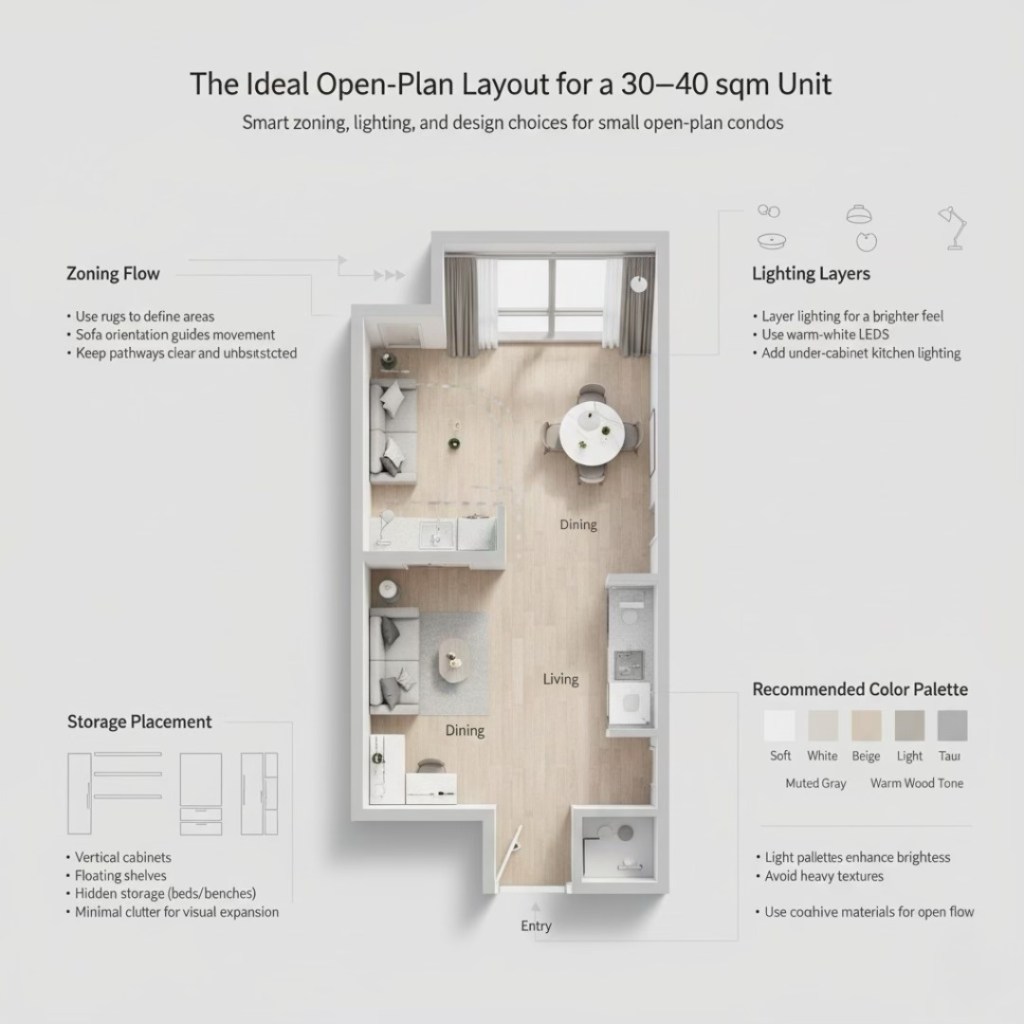
Opening a layout is only the first step. To unlock the full potential of an open-plan condo, every design choice must reinforce flow, function, and visual expansion. These strategies ensure your space looks intentional, cohesive, and comfortably livable—no matter the size.
Zoning Without Walls
A great open layout doesn’t feel like one oversized room; it feels like distinct spaces that work together seamlessly. Clever zoning makes this possible without adding physical barriers.
- Rugs, lighting, and furniture placement instantly define areas. A rug anchors the living zone, pendant lighting marks the dining area, and the direction of your sofa sets movement patterns.
- Floating shelves or glass dividers offer structure without sacrificing light or openness. They subtly break up the space while preserving transparency.
- Best for small units: Keep pathways clear. Avoid tall, bulky furniture near entrances or windows—they shrink the visual field.
- Use visual hierarchy: Larger pieces (sofa, dining table) act as anchors. Smaller accents like stools, side tables, and décor reinforce purpose without cluttering the layout.
Cohesive Color & Material Choices
Consistency is your strongest design ally in an open-plan condo.
- Tropical-friendly materials—like engineered wood, rattan accents, and breathable fabrics—perform well in Manila’s climate while maintaining aesthetic warmth.
- Light palettes such as soft whites, muted taupes, and cool grays bounce natural light, making the space feel more expansive.
- Match flooring transitions to avoid abrupt visual breaks. Seamless flooring visually elongates the room and enhances flow.
- Stay away from heavy textures that weigh down the eye. Large patterns, dark finishes, or overly ornate surfaces can make a small condo feel compressed.
Smart Storage Solutions
Open spaces demand disciplined storage, or clutter will undermine the design.
- Built-in cabinetry maximizes every inch and looks clean, intentional, and polished. Opt for push-to-open panels to maintain a minimalist feel.
- Vertical storage—tall cabinets, wall-mounted shelves, and overhead compartments—keeps floors open and sightlines clear.
- Multi-purpose furniture such as extendable dining tables, foldable desks, or ottoman storage benches doubles functionality without adding bulk.
- Hidden storage techniques, like drawers under the bed or concealed compartments behind headboards, keep essentials accessible but out of view.
Comfort, Acoustics & Energy Efficiency
A well-designed open layout balances beauty and comfort.
- Soundproofing shared walls reduces noise transfer—common in high-rise living—while maintaining a peaceful environment.
- Aircon efficiency becomes more crucial in open spaces. Strategically position vents and ensure airflow reaches all zones without overworking the unit.
- Layer your lighting. Combine ambient ceiling lights, task lamps, and accent lighting to build dimension and eliminate dark corners.
- Upgrade ventilation with ceiling fans or improved window treatments to enhance airflow and reduce heat buildup, especially in west-facing units.
Investment Perspective — Why Open Layouts Improve Resale & Rental Value
Open-plan layouts don’t just elevate aesthetics—they sharpen a unit’s market performance. For investors, this upgrade offers one of the strongest returns relative to cost because it enhances the three factors that matter most in the Philippine condo market: perceived space, livability, and online visibility.
Staged open-plan units consistently command rental premiums of ₱2,000–₱5,000 per month in dense urban markets like BGC, Makati, Ortigas, and QC. Renters—especially professionals working in hybrid or remote setups—value flexible layouts they can personalize. Even older condo buildings become more competitive when the unit flows better and looks brighter in photos.
Young professionals, expats, and OFWs overwhelmingly prefer modern, uncluttered environments. They gravitate toward listings that feel contemporary and adaptable, and open layouts instantly meet that expectation. This translates to stronger listing engagement, more inquiries in the first 24–48 hours, and faster decision-making during viewings.
Another advantage: better photos equal better clicks. Online platforms reward visually appealing listings with more visibility, and an open plan naturally makes the space look larger, cleaner, and easier to furnish. This boosts inquiry volume—often the difference between a unit staying empty and being leased within the week.
Vacancies also shrink because tenants stay longer when their home adapts to changing needs. A unit that can shift from living room to workspace to guest-friendly layout has broader appeal and remains relevant over time.
Compared to full renovations, opening up a space is a low-complexity, high-impact project. It avoids plumbing relocations, heavy carpentry, and major mechanical works while still delivering a noticeable transformation. For many investors, this is the sweet spot: a renovation that doesn’t break the bank but dramatically improves both rentability and resale potential.
Renovation Costs vs. Potential Rental/Resale Gain
| Renovation Scope | Typical Cost Range* | Market Context / Source | Potential Benefit | Assumption & Notes |
|---|---|---|---|---|
| Basic refresh (paint, flooring, minor works in a 30–40 sqm unit) | ₱450,000 – ₱800,000 (≈ ₱15,000–₱20,000 / sqm) | Mid-level condo renovation rate in PH: “mid‐level projects … Php 15,000-20,000 per square metre.” | Improved livability, faster rental lease-up, better listing photo appeal | Assumes simple materials, minimal structural work |
| Moderate upgrade (wall removal/partition change, lighting, built-in storage) | ₱800,000 – ₱1,200,000 (for a 30–40 sqm, ~₱25,000-30,000 / sqm) | Traditional data: wall removal for PH condos ~ ₱10,000-15,000/partition work; renovation surveys show ₱25 k/ sqm ballpark. | Open-plan layout, higher perceived size, better rental premium | Requires approvals, structural & MEP coordination |
| Premium overhaul (top finishes, integrated design, staging) | ₱1,200,000 – ₱1,800,000+ | Higher-end projects referenced at ₱30,000/ sqm+ for 50 sqm units. | Move-in ready unit, strong resale potential, competitive differentiation | Best for investor/seller strategy rather than basic tenant rental only |
| Market average gross rental yield (post-upgrade) | ~5%–6%+ gross yield in Metro Manila for studio/1-BR condos. | Indicates how rental income relates to purchase price | Better layout might push toward the higher end of this range | Gross yield only, excluding costs, vacancy, maintenance |
| Vacancy risk mitigation & value uplift | Yield for optimised unit could exceed market average by ~0.5%–1% | Upgrades reduce vacancy, increase occupancy and appeal | Enhanced returns via lower downtime and higher rent | Uplift depends heavily on location and execution |
Case Study — Open Living Success in a Manila Condo
A young professional owned a 32-sqm one-bedroom unit in Makati, tucked inside a well-located but older building. The layout was typical of many mid-2000s condos—tight kitchen, narrow living area, and a bulky divider that chopped the space into awkward zones. Despite its location, the unit struggled to stand out in a crowded rental market filled with newer, better-lit options.
The owner decided to embrace an open-plan redesign. The kitchen wall separating it from the living area was removed, instantly expanding the sightline from the entryway to the windows. A lighter color palette replaced the original cream walls, and a new pendant light distinguished the dining area from the rest of the space. A slim console table acted as a subtle zone divider without interrupting flow. With thoughtful furniture placement and cohesive décor, the unit looked brighter, wider, and more contemporary.
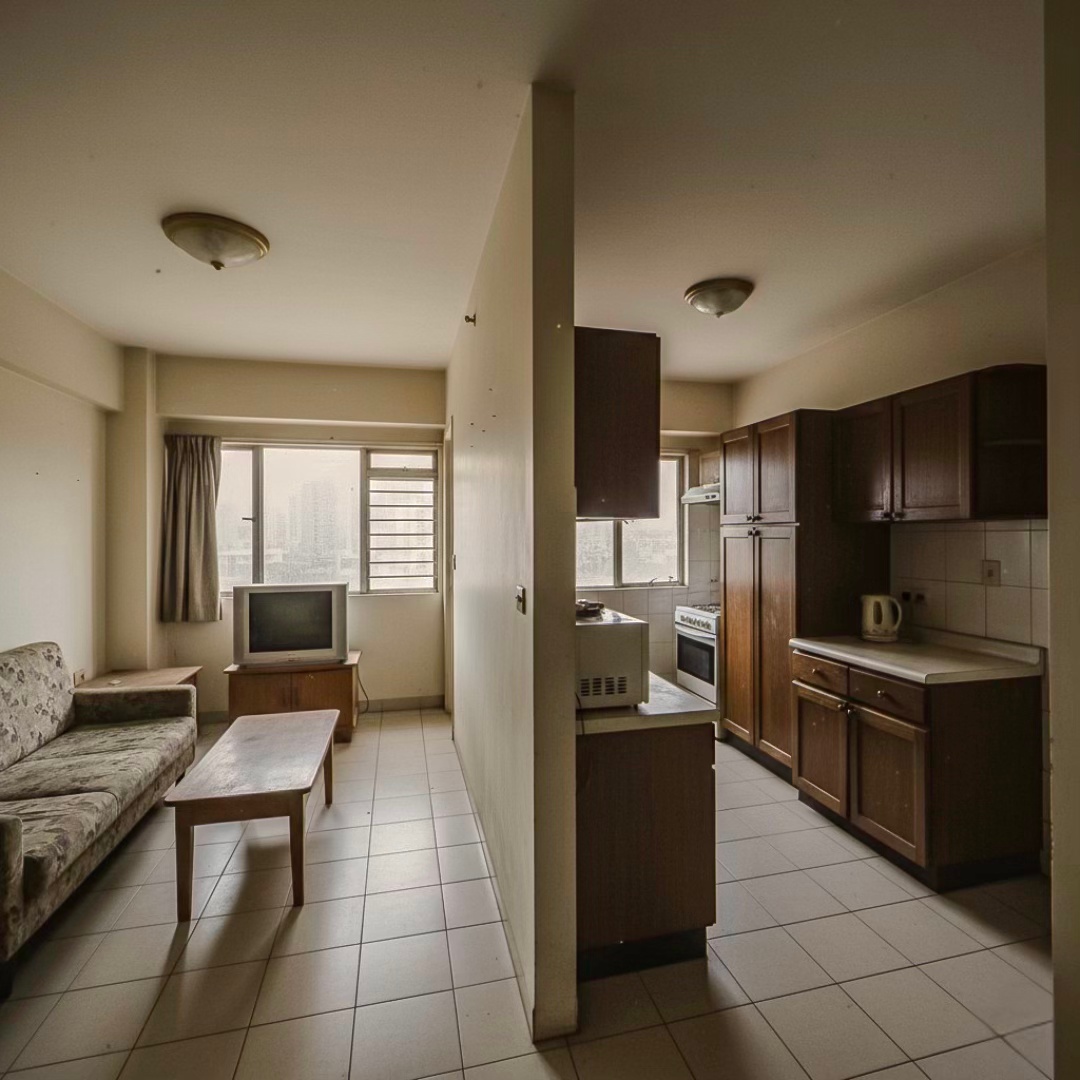
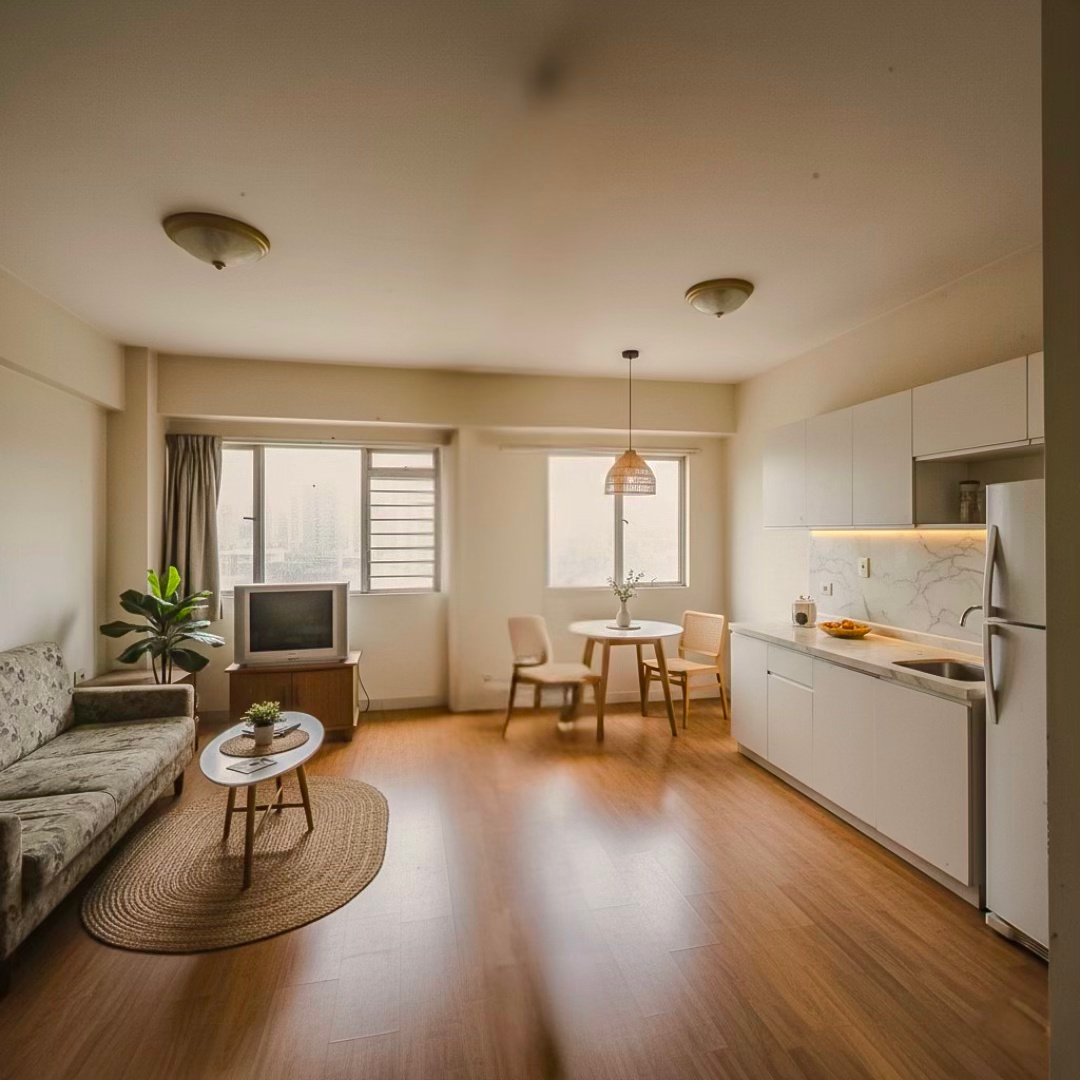
Before/after photo collage showing a wall removal, improved lighting, and more unified design.
The market response was immediate.
Within three days of relisting, inquiries doubled. Renters specifically commented on how “spacious and modern” the unit felt, even though the actual size didn’t change. The owner raised the rent by ₱3,000/month, and the unit was leased to a remote-working tenant who had viewed several condos but chose this one because the open layout made the home feel more comfortable for daily use. The tenant ended up staying long-term, reducing turnover and vacancy periods.
The key lesson for condo owners is simple: space isn’t just physical—it’s perceptual. A well-executed open layout can outperform newer units simply by offering better flow, better light, and better usability. When designed strategically, even modest spaces in older buildings can command premium interest and strong rental performance.
Open-Living Renovation Checklist for Condo Owners
A successful open-plan transformation depends on clear planning and disciplined execution. This quick-action guide helps condo owners navigate the process with confidence, avoid common pitfalls, and ensure a smooth renovation from start to finish.
Structural Checks
- Confirm which walls are load-bearing and cannot be demolished.
- Request a structural assessment from the developer or a licensed engineer.
- Identify electrical, plumbing, and mechanical lines within affected walls.
- Clarify ceiling height limitations before planning lighting or bulkhead designs.
Developer Approvals
- Secure renovation guidelines from the condo’s admin office.
- Prepare required documents: layout plan, scope of work, contractor accreditation forms.
- Settle renovation bonds or deposits as required.
- Schedule works within permitted hours to avoid rule violations or penalties.
Budget Planning
- Allocate funds for wall removal, patching, electrical, and finishing work.
- Set a contingency buffer of 10–20% for unexpected structural or utility adjustments.
- Factor in design, staging, and furniture upgrades for maximum visual impact.
- Compare quotes from multiple contractors to establish a realistic range.
Contractor Selection
- Choose contractors experienced in condo renovations, not general home construction.
- Verify licenses, project portfolios, and client feedback.
- Ensure they understand building rules, noise limits, and delivery schedules.
- Require a detailed timeline with milestones and payment terms.
Design & Staging Steps
- Finalize color schemes, zoning strategies, and furniture layout before construction starts.
- Incorporate layered lighting and functional décor to define spaces.
- Add multi-purpose furniture pieces to maximize adaptability.
- Stage the unit professionally (or with guided styling) before listing or renting.
Transform Your Condo and Maximize Its Potential
An open layout elevates everything—from daily comfort to long-term returns. By removing barriers and embracing open, breathable design, your condo becomes a brighter, more versatile space that stands out in the Philippine market.
If you’re selling, modernizing your layout before listing gives you a dramatic market advantage.
If you’re buying, prioritize units with layouts that can be opened up for greater long-term value.
If you’re investing, this upgrade boosts rent, shortens vacancy, and strengthens the property’s competitive edge.
When you’re ready, I can help you evaluate your unit, plan a transformation, stage the property, or position it for maximum resale or rental success. Your next breakthrough—whether a higher offer or a better tenant—starts with a smarter layout.
Ready to Upgrade Your Condo or Find a High-Value Unit?
Whether you’re planning a renovation, preparing your condo for sale, or searching for a high-performing investment unit, I’m here to help you make the best move. Get expert guidance on layout improvements, staging, pricing, and property selection—so your next real estate decision delivers maximum results.
Let’s talk about your goals and map out your next steps with clarity and confidence.


 U-Property PH
Leave a comment