

Once known for its tranquil coastal charm and historic roots, Bacoor, Cavite has evolved into one of Metro South’s fastest-growing cities—a vibrant urban hub bridging Metro Manila and the heart of Cavite.
Just a decade ago, Bacoor was a residential suburb where families sought peace away from the metro. Today, it rivals Alabang and Las Piñas in growth, boasting expressway interconnections, commercial centers, and modern condo communities that have reshaped its skyline.
Did you know that Bacoor’s population has surged past 600,000, with property values rising steadily thanks to major infrastructure projects like CAVITEX, MCX, and the LRT-1 Cavite Extension? This rapid transformation positions Bacoor not only as a livable suburban city but also as a strategic investment destination for homebuyers and investors looking for accessibility and long-term appreciation.
In this article, you’ll discover why Bacoor is considered the Gateway to Cavite—where modern infrastructure meets coastal heritage, and where everyday living connects seamlessly to the economic pulse of Metro Manila.
Overview: Location, Geography, and Demographics
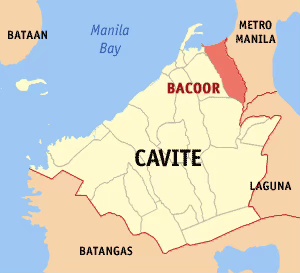
Strategically located at the northwestern tip of Cavite, Bacoor City serves as the province’s primary gateway to Metro Manila. Bordered by Las Piñas and Parañaque to the north, Kawit and Imus to the south, and Manila Bay to the west, Bacoor is ideally positioned for both residential convenienceand economic expansion. This prime location allows residents to enjoy the best of both worlds — proximity to the metro’s business centers and the suburban comfort of Cavite living.
Geographic Location and Proximity to Metro Manila
Bacoor is just 15 to 20 kilometers from Makati and the Ninoy Aquino International Airport (NAIA), accessible through major road networks like CAVITEX, MCX, and Aguinaldo Highway. The LRT-1 Cavite Extension, currently underway, will further shorten travel time between Bacoor and Metro Manila, transforming daily commutes into short, predictable trips. This connectivity has made Bacoor a favored choice for professionals working in the metro and families seeking accessible suburban homes.
Barangays and Key Districts
The city is composed of 73 barangays, with key growth clusters such as Molino, Niog, Talaba, and Zapote emerging as economic and residential centers.
- Molino – Known for its master-planned communities, shopping centers, and schools; home to SM Molino and several mid- to upscale subdivisions.
- Niog and Talaba – Major entry points from Metro Manila, featuring mixed-use developments and commercial growth zones.
- Zapote – Bacoor’s historical and business core, where the Zapote River and heritage landmarks meet modern commerce.
Each district has its own urban character—ranging from coastal communities along Manila Bay to inland residential enclaves surrounded by malls, schools, and business parks.
Population Data and Urban Density
According to the 2020 Philippine Census, Bacoor has a population of approximately 664,625 residents, making it Cavite’s most populous city. Its annual growth rate of around 3.5% reflects both organic expansion and migration from Metro Manila. This steady influx of new residents fuels demand for housing, retail spaces, and transport infrastructure, driving continuous real estate development across the city.
Urban Classification and Governance
Bacoor is classified as a first-class component city and serves as the de facto commercial capital of Cavite’s northern corridor. Since its cityhood in 2012, the local government of Bacoor (LGU) has implemented forward-looking programs focused on urban renewal, flood mitigation, and sustainable development. Through the “Urbanized Bacoor 2030 Vision,” the city aims to transform into a smart, resilient, and investor-friendly metropolis, balancing growth with livability.
Accessibility and Transportation
If there’s one thing that makes Bacoor, Cavite stand out in the southern real estate landscape, it’s connectivity. The city’s strategic location—just minutes from Metro Manila—has transformed it into a transportation hub and commuter-friendly city, ideal for homebuyers who value accessibility and investors looking for growth anchored on infrastructure.
Cavitex, MCX, and CALAX: The Road Networks That Power Bacoor’s Growth
The Manila–Cavite Expressway (CAVITEX) remains Bacoor’s lifeline to Metro Manila, connecting the city directly to Parañaque and Roxas Boulevard in as little as 20 to 30 minutes during off-peak hours. This has dramatically reduced travel time for residents who work in the metro but prefer to live in Cavite’s calmer suburban setting.
Meanwhile, the Muntinlupa–Cavite Expressway (MCX) links Bacoor to Alabang and Muntinlupa, creating a seamless route for South Metro professionals. The Cavite–Laguna Expressway (CALAX), currently under phased construction, is set to complete a high-speed corridor linking Kawit to Laguna, further enhancing Bacoor’s role as a gateway city for both northbound and southbound travel.
These expressways have not only improved mobility but also stimulated land development, with residential, commercial, and industrial zones emerging along these major corridors.
The LRT-1 Cavite Extension: Game-Changer for Commuters
The Light Rail Transit Line 1 (LRT-1) Cavite Extension Project is one of Bacoor’s most transformative infrastructure upgrades. Once completed, the line will extend from Baclaran to Niog in Bacoor, cutting average travel time from Cavite to central Manila by over 50%.
Key stations—such as Niog, Zapote, and Dr. Santos—will open new corridors of growth and increase nearby property values, especially for condominiums and townhouses within walking distance. This development cements Bacoor’s position as a true metro-adjacent city, blending the convenience of rail connectivity with suburban living.
Travel Times to Metro Manila’s Key Destinations
Thanks to improved infrastructure, Bacoor residents enjoy shorter commutes and more predictable travel times compared to other Cavite cities.
| Destination | Average Travel Time (Peak Hours) | Average Travel Time (Off-Peak) |
|---|---|---|
| Makati CBD | 45–60 minutes via CAVITEX | 25–35 minutes |
| Alabang | 25–35 minutes via MCX | 15–20 minutes |
| NAIA Airport | 35–45 minutes via CAVITEX | 20–25 minutes |
| Mall of Asia | 30–40 minutes via CAVITEX | 20–25 minutes |
These travel efficiencies have made Bacoor a preferred address for urban professionals, OFWs, and investors seeking a balance between convenience and value.
Public Transportation and Connectivity
Bacoor’s transport system is well-integrated with Metro Manila routes. Modernized PUVs, jeepneys, and UV Express shuttles operate across Molino Boulevard, Aguinaldo Highway, and Zapote Road. The city’s proximity to Parañaque Integrated Terminal Exchange (PITX) also offers easy interconnectivity to provincial and city-bound routes, strengthening Bacoor’s role as a southern transit hub.
To further enhance connectivity, the Bacoor LGU is planning transport modernization initiatives, including improved road lighting, pedestrian access, and feeder routes to upcoming LRT stations—ensuring the city’s growth remains commuter-centric and sustainable.
Economic and Infrastructure Development
Bacoor’s transformation from a quiet suburb into a dynamic economic hub is anchored on a decade-long wave of infrastructure investments and mixed-use developments. This growth trajectory continues to attract property developers, investors, and business locators, positioning Bacoor as one of Cavite’s most progressive and investment-ready cities.
Ongoing and Upcoming Government Projects
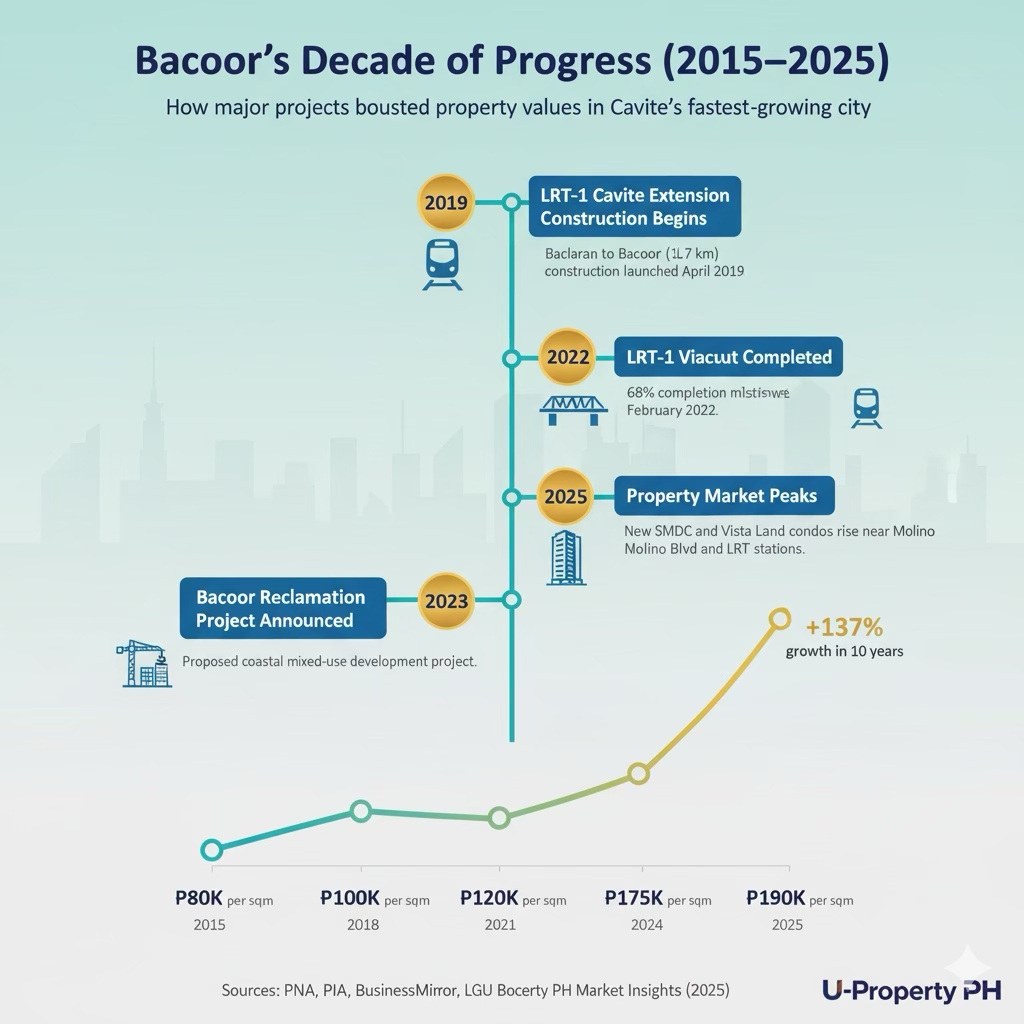
The Bacoor Reclamation and Development Project stands as one of the city’s most ambitious undertakings — a 420-hectare coastal reclamation initiative aimed at creating a new urban districtcomplete with business centers, residential zones, and eco-tourism areas. Once completed, it is projected to generate thousands of jobs and increase Bacoor’s local revenue through commercial investments and new economic activity.
Complementing this, the LRT-1 Cavite Extension, CAVITEX flyover expansion, and Bacoor Flood Management projects are being pursued to boost connectivity and resilience. These infrastructure upgrades enhance mobility, flood mitigation, and investor confidence, making Bacoor a key player in the “Build Better More” national development agenda.
Rise of Commercial and Lifestyle Hubs
Bacoor’s urban landscape is now defined by modern retail and lifestyle centers catering to its growing middle-class population.
Evia Lifestyle Center
A premier integrated lifestyle complex along Daang Hari that brings together retail, dining, and entertainment within a master-planned setting.
SOMO – A Vista Mall
A rising leisure and shopping destination within Molino that supports local entrepreneurs and larger retail anchors.
The Tent at Vista Global South
A flexible event and expo venue attracting regional conventions, trade fairs, and cultural events.
These commercial anchors not only improve local quality of life but also drive real estate appreciationin nearby subdivisions, condos, and business parks.
Growth of IT Parks and Mixed-Use Developments
Bacoor is seeing a surge in IT-BPO investments and mixed-use township projects, capitalizing on its proximity to Metro Manila and growing skilled workforce.
- Vista Global South and SMDC District Bacoor are examples of integrated communities combining residential, retail, and office spaces.
- The city’s proposed IT park accreditation under PEZA aims to attract outsourcing firms and technology-driven enterprises seeking lower operational costs outside the NCR core.
These initiatives diversify Bacoor’s economy from traditional retail and manufacturing toward knowledge-based and digital services, supporting high-value employment and continuous urban renewal.
Local Government Initiatives Promoting Investment
Under the leadership of the Bacoor City Government, the city has strengthened its business climate through investor-friendly programs. The Bacoor Business-One-Stop-Shop (BOSS) has streamlined permits and registrations, while incentives under the Investment Code of Bacoor promote developments in tourism, housing, and information technology.
The city’s “Urbanized Bacoor 2030 Vision” outlines clear priorities:
- Sustainable urban expansion
- Transport-oriented development (TOD)
- Green and resilient city planning
- Investment in digital infrastructure and smart governance
Together, these programs showcase Bacoor as a city that balances rapid progress with livability, offering a stable and thriving environment for residents and investors alike.
Real Estate Market Overview: Why Bacoor Is a Rising Investment Destination
Bacoor’s real estate market has evolved from suburban housing clusters into a diversified investment hub, attracting both end-users and property investors looking for strong value appreciation, convenient access to Metro Manila, and dynamic community growth. With its strategic location, improving infrastructure, and affordable property prices relative to NCR, Bacoor has become one of Cavite’s most investable cities.
Residential Property Types: Options for Every Lifestyle
Bacoor offers a wide spectrum of residential developments, catering to varied buyer profiles—from first-time homeowners to OFW investors and growing families.
Condominiums
Mid-rise and high-rise condos have surged along Aguinaldo Highway, Molino Boulevard, and Daang Hari. Notable projects include SMDC Gold Residences, Camella Condo Homes Bacoor, and Amaia Steps Bacoor. These developments appeal to young professionals and investors seeking rental income potential near the LRT-1 extension corridor.
Townhouses
Popular among starter families, townhouse projects like Lancaster New City’s Bacoor clustersand Camella Bacoor offer a blend of suburban living and city accessibility.
Subdivisions and House-and-Lot Communities
Established neighborhoods such as Ponticelli Gardens, Carmel Subdivision, and Springvilleprovide secure, well-developed environments with leisure amenities. These are highly sought after by families upgrading from Metro Manila apartments.
Together, these options reflect Bacoor’s transition into a mixed-use urban district where vertical and horizontal developments coexist harmoniously.
Price Trends and Average Price per Square Meter
Despite steady appreciation, Bacoor remains competitively priced compared to nearby southern cities.
| Property Type | Average Price per sqm (2024) | Annual Appreciation (Est.) |
|---|---|---|
| Condominium | ₱150,000 – ₱200,000 | 5–7% |
| Townhouse | ₱80,000 – ₱120,000 | 4–6% |
| House & Lot | ₱70,000 – ₱110,000 | 6–8% |
These figures show steady year-on-year appreciation, fueled by infrastructure projects and land scarcity near the metro boundary. Investors who bought properties in Bacoor in 2015 have already seen 20–30% capital gains, with rental yields averaging 5–6% for condos and 7–8% for houses.
Comparison vs. Neighboring Areas
When compared with nearby real estate markets, Bacoor offers the best balance of accessibility, affordability, and growth potential.
| City | Average Condo Price/sqm | Average House & Lot Price/sqm | Key Advantage |
|---|---|---|---|
| Bacoor | ₱150K–₱200K | ₱70K–₱110K | Closest Cavite city to Metro Manila; LRT-1 extension |
| Las Piñas | ₱180K–₱250K | ₱100K–₱140K | Established city but limited land availability |
| Imus | ₱120K–₱160K | ₱60K–₱90K | Growing market, slightly farther from Metro Manila |
| Dasmariñas | ₱100K–₱140K | ₱55K–₱80K | More affordable but longer commute |
This data underscores Bacoor’s sweet spot: near-Metro accessibility without the Metro Manila price tag.
Top Developers and Notable Projects
Several of the country’s most prominent developers have launched projects in Bacoor, signaling strong market confidence:
- SMDC – Gold Residences, Spring Residences, and upcoming District Bacoor mixed-use township near Niog Station.
- Vista Land / Camella – Ponticelli Gardens and Crown Asia Communities, offering Italian-inspired homes along Daang Hari.
- Amaia Land (Ayala Land Subsidiary) – Amaia Steps Bacoor, targeting young professionals and first-time homebuyers.
- Filinvest Land – South Peak and Princeton Heights, mid- to upscale subdivisions along Molino.
- DMCI Homes – Future vertical developments along the LRT-1 corridor, tapping the growing condo demand.
These projects collectively reinforce Bacoor’s position as a preferred location for both established brands and new developers, ensuring continued quality, innovation, and value growth in its real estate market.
Lifestyle and Community in Bacoor: A City Built for Modern Living
Bacoor isn’t just a place to live — it’s a city where community, convenience, and culture blend seamlessly. As one of Cavite’s most urbanized cities, Bacoor offers the comforts of modern life while preserving the warmth and familiarity of a close-knit community.
Shopping, Dining, and Entertainment
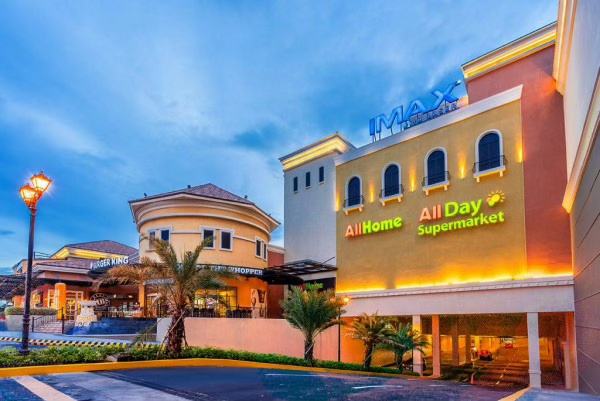
From SM City Bacoor to Evia Lifestyle Center, SOMO – A Vista Mall, and Vista Mall NOMO, Bacoor residents enjoy a variety of retail and dining experiences without crossing city borders. Weekend markets, coffee shops, and family restaurants along Aguinaldo Highway and Molino Boulevard add to the city’s lively local scene. For leisure, Cinemas, indoor playgrounds, and fitness clubs provide entertainment for every lifestyle — from young professionals to growing families.
Schools, Healthcare, and Worship
Bacoor is a hub for quality education, home to schools like St. Dominic College of Asia, University of Perpetual Help – Molino, and Elizabeth Seton School. Healthcare access is equally strong with top medical institutions such as Metro South Medical Center and St. Dominic Medical Center.
The city also fosters spiritual growth, with notable places of worship like the St. Michael the Archangel Parish Church, a historic site that dates back to the Spanish era, and several community churches that serve diverse faiths.
Coastal Heritage and Cultural Pride
Rooted in its coastal identity, Bacoor continues to honor its past as a fishing and trade communityalong Bacoor Bay. The Bakood Festival, celebrated annually, showcases colorful street parades, music, and local delicacies — a tribute to the city’s resilience and unity. These cultural traditions connect residents to Bacoor’s rich heritage while celebrating its modern evolution.
Safety, Cleanliness, and Community Services
Bacoor City takes pride in being one of Cavite’s cleanest and most organized urban centers. The local government actively enforces waste segregation, traffic management, and disaster preparedness programs. Regular patrols by Barangay Public Safety Officers (BPSO) and community CCTV systems contribute to a growing sense of security among residents.
Community centers, parks, and family-friendly public spaces reflect Bacoor’s vision of sustainable, people-first urban growth — a city designed not just to thrive, but to care.
Why Invest in Bacoor, Cavite
Bacoor’s rapid evolution from a quiet residential town to a thriving urban center makes it one of Cavite’s strongest property investment hotspots. Strategic infrastructure projects, affordability, and livability all combine to create a city where both capital appreciation and rental returns are on the rise. Here’s why Bacoor deserves serious attention from investors and homebuyers alike:
1. Proximity Advantage: Metro Manila Access at Lower Prices
Located just 15 to 30 minutes from Pasay or Alabang, Bacoor offers city-level convenience at a fraction of Metro Manila’s cost. Property prices here are typically 20–40% lower than comparable developments in Las Piñas or Parañaque, giving investors a wider entry margin for appreciation.
For daily commuters, Bacoor’s seamless connectivity via CAVITEX, MCX, and Daang Hari makes it one of the most accessible locations in Cavite. As Metro Manila expands southward, Bacoor sits perfectly between urban convenience and suburban value — an ideal mix for long-term growth.
2. Infrastructure Growth: Transport Projects Driving Value
The LRT-1 Cavite Extension, set to reach Bacoor soon, is already transforming property demand. Once operational, it will cut travel time from Bacoor to Baclaran to just 25–30 minutes, positioning the city as a prime commuter hub.
In addition, ongoing projects like the Cavite-Laguna Expressway (CALAX) and the CAVITEX C5 Linkwill further enhance regional mobility, opening Bacoor to more business, logistics, and residential developments. Historically, areas within proximity to major transport corridors in the Philippines have seen land values increase by 10–20% within 3–5 years of project completion — a promising indicator for Bacoor investors.
3. Rental Demand: Preferred by Commuters and Young Professionals
Bacoor’s growing condo market, particularly near Molino Boulevard and Niog, attracts tenants who work in Makati, Pasay, and Alabang but prefer more affordable living options.
Typical studio and 1-bedroom units in Bacoor rent for ₱15,000–₱22,000/month, offering steady yields of 5–7% annually — a competitive figure in the southern property market.
The city’s mix of universities, BPO offices, and lifestyle centers also drives short- to mid-term leasing opportunities, especially for young professionals, OFWs, and small families seeking flexibility and convenience.
4. Balanced Urbanization: Growth Without Losing Its Calm
Unlike denser city centers, Bacoor’s development remains measured and livable. Its new townships, such as those developed by Vista Land and SMDC, integrate open spaces, lifestyle hubs, and green corridors — reflecting a balanced approach to urbanization.
Residents enjoy the perks of city living — malls, schools, hospitals — while still benefiting from wider roads, cleaner air, and quieter neighborhoods. This combination of progress and comfort continues to attract long-term settlers and repeat investors looking for sustainable property value appreciation.
Property Hotspots in Bacoor, Cavite
Bacoor’s dynamic real estate landscape features several micro-markets—each catering to distinct buyer profiles, investment goals, and lifestyles. From high-end subdivisions to mixed-use corridors, understanding these property hotspots helps investors and homebuyers identify where the best opportunities lie.
Molino and Niog: Upscale Residential and Emerging Condo Districts
The Molino–Niog corridor is Bacoor’s most desirable residential zone, hosting mid- to high-end subdivisions such as Ponticelli by Crown Asia, Camella Bacoor, and Vermosa by Ayala Land(nearby in Imus). This area attracts upwardly mobile families seeking security, spacious homes, and proximity to schools and malls.
Recently, vertical living options have emerged — SMDC’s Coast Residences Bacoor, Vista Land’s Bria and Camella condos, and Amaia Steps Bacoor — catering to professionals and OFWs looking for income-generating properties. Land prices here have appreciated steadily, with residential lots now ranging between ₱40,000–₱70,000 per sqm, depending on proximity to main roads and developer reputation.
✅ Investor Tip: Molino and Niog developments benefit directly from the upcoming CAVITEX C5 Linkand LRT-1 Cavite Extension, ensuring sustained value appreciation over the next 3–5 years.
Talaba and Zapote: Mixed Commercial-Residential Growth Hubs
Strategically located along Aguinaldo Highway, Talaba and Zapote serve as Bacoor’s economic and commercial engines. These barangays have seen a surge in low-rise apartments, townhouses, and shophouse-style developments catering to business owners and local entrepreneurs.
Talaba is known for its seafood markets and logistics activity, while Zapote—bordering Las Piñas—hosts mixed-use properties ideal for both retail and residential use. This dual-use potential gives properties in this zone strong cash flow resilience, especially for investors seeking rental diversification (commercial + residential).
💡 Example: A 120 sqm mixed-use property along Zapote Road can command ₱35,000–₱50,000/month in rental income when configured for a storefront plus residential space.
Coastal Road Area: Upcoming Mixed-Use and Waterfront Projects
The area near CAVITEX and the Coastal Bay City expansion is Bacoor’s next frontier. As reclamation and infrastructure projects advance, expect the emergence of modern mixed-use developments blending residential towers, commercial complexes, and leisure zones.
Developers are already eyeing the area for bay-view condominiums and business parks, targeting future professionals working in Metro Manila but preferring shorter commutes and waterfront living. Early investors here can expect above-average capital growth, especially once the Coastal Link and LRT-1 stations become operational.
Major Condo Clusters: Affordable to Premium Living Options
Bacoor’s vertical housing market is expanding rapidly, led by national developers:
- SMDC – Gold Residences (near NAIA), Spring Residences, Hope Residences (near Molino)
- Vista Land – Camella Condo Homes Bacoor, Avant at Molino
- Amaia Land – Amaia Steps Bacoor
- Profriends and Stateland – Lancaster and Bellefort Estates extensions
These projects appeal to young professionals, OFWs, and investors due to strong rental demand, low entry prices, and professional property management. Pre-selling units in these developments often start around ₱3.5M–₱4.5M, making them accessible for first-time investors.
Who Should Consider Living or Investing in Bacoor, Cavite
Bacoor’s unique blend of urban accessibility and suburban charm attracts a diverse mix of homeowners and investors. Whether you’re a first-time buyer, returning OFW, or long-term investor, the city offers strong financial and lifestyle advantages that align with your goals.
1. First-Time Homebuyers: Affordable Entry Near Metro Manila
If you’ve been priced out of the Metro Manila housing market, Bacoor offers an ideal starting point. Many pre-selling condos and townhouses here are priced between ₱3M–₱6M, often with developer-backed payment schemes that make ownership more attainable.
You’ll enjoy:
- Quick access to Metro Manila via CAVITEX, Daang Hari, and LRT-1 Extension
- Complete amenities—malls, schools, and hospitals within a 5–10 km radius
- Growing value appreciation, ensuring your first home is also a smart investment
Example: A young professional working in Makati can own a condo in Molino and commute daily within 45 minutes—saving on rent while building long-term equity.
2. OFWs and Balikbayans: Long-Term Stability and Passive Income
For OFWs and Balikbayans seeking secure and income-generating investments, Bacoor’s rental demand and strategic growth make it a top choice. Condos near Niog and Zapote are popular for short- to medium-term leasing, often managed by property management services or Airbnb-style operators.
Why it’s ideal:
- Strong rental yields (averaging 5–7% annually)
- High liquidity with strong resale demand
- Close proximity to NAIA and Metro Manila—ideal for visiting families or returnees
Many OFWs choose to buy pre-selling units during their contract years, letting them grow in value until they’re ready to return home or retire.
3. Real Estate Investors: Proven Growth and Diversified Opportunities
Bacoor has evolved into a prime investment corridor, thanks to major infrastructure upgrades and urban expansion from nearby cities. Investors can explore a range of property types — from affordable condos to mixed-use lots — with the confidence that demand will remain high due to migration from Metro Manila.
Investment highlights:
- Capital appreciation from ongoing transport projects (LRT-1, CALAX, CAVITEX C5 Link)
- Consistent rental demand from commuters and professionals
- Future commercial potential as Bacoor transforms into a city-center extension
Insight: Investors who entered Bacoor’s market in 2018–2019 have already seen 10–20% value appreciation as new developments and infrastructure progress.
4. Families and Retirees: Suburban Comfort with Urban Convenience
Bacoor’s livability makes it one of Cavite’s most family-friendly and retirement-ready cities. Its cleaner environment, gated communities, and modern healthcare facilities offer peace of mind while staying close to Metro Manila conveniences.
Benefits include:
- Quiet, family-oriented neighborhoods with parks and schools
- Reliable healthcare (Metro South Medical Center, St. Dominic Hospital)
- Lifestyle balance—close to beaches, leisure hubs, and business centers
Families often settle in areas like Molino and Niog, while retirees prefer peaceful subdivisions near Daang Hari or Talaba, where space and tranquility meet accessibility.
Challenges and Considerations: What Buyers Should Know Before Investing in Bacoor
Even with Bacoor’s strong growth trajectory, smart investors recognize that every opportunity comes with key considerations. Understanding these early helps you make informed, risk-mitigated decisions and ensures that your investment remains both profitable and sustainable in the long term.

1. Traffic Congestion During Rush Hours
Bacoor’s proximity to Metro Manila is a double-edged sword. While it’s convenient for commuters, rush-hour traffic along Aguinaldo Highway and Molino Boulevard can be challenging, especially during weekdays.
What’s being done:
- The CAVITEX C5 Link Expressway and LRT-1 Cavite Extension aim to ease congestion by offering alternate routes.
- The Bacoor Traffic Management System is implementing synchronized traffic light control and one-way schemes in key areas.
Pro Tip: When buying, consider developments with secondary access roads (e.g., via Daang Hari or Molino–Paliparan) to reduce commute time.
2. Flood-Prone Zones and Ongoing Mitigation Efforts
Parts of Bacoor, particularly low-lying barangays near the coast or rivers, are historically prone to flooding. However, the local government and DPWH have implemented major flood control projects, including drainage upgrades and coastal embankment rehabilitation.
Buyer Tip: Always check the Flood Hazard Map from the DENR or LGU Planning Office before purchase. Developers in flood-prone areas are now required to integrate elevated structures and retention ponds, improving long-term resilience.
3. Zoning and Land Use Restrictions
As Bacoor transitions from residential to mixed-use zoning, land classification plays a vital role in determining what can be built on a property. Some zones are reserved for light industry or commercial use, while others remain residential-only.
Why it matters: Buying land without understanding its zoning classification can limit your development or resale plans.
Best Practice: Always request a Zoning Certification from the City Planning and Development Office before closing a deal to ensure the land aligns with your intended use.
4. Importance of Title Verification and Due Diligence
With the city’s rapid urbanization, Bacoor has seen isolated cases of overlapping claims and fraudulent transactions—often involving unverified titles or informal resales.
How to protect yourself:
- Verify property ownership directly with the Registry of Deeds (LRA).
- Conduct a title trace and confirm tax declarations match the title number.
- Work only with licensed brokers or accredited developers for transparency and compliance.
This extra diligence prevents future disputes and ensures your investment is legally sound.
Future Outlook: Bacoor 2030 – The City on the Rise
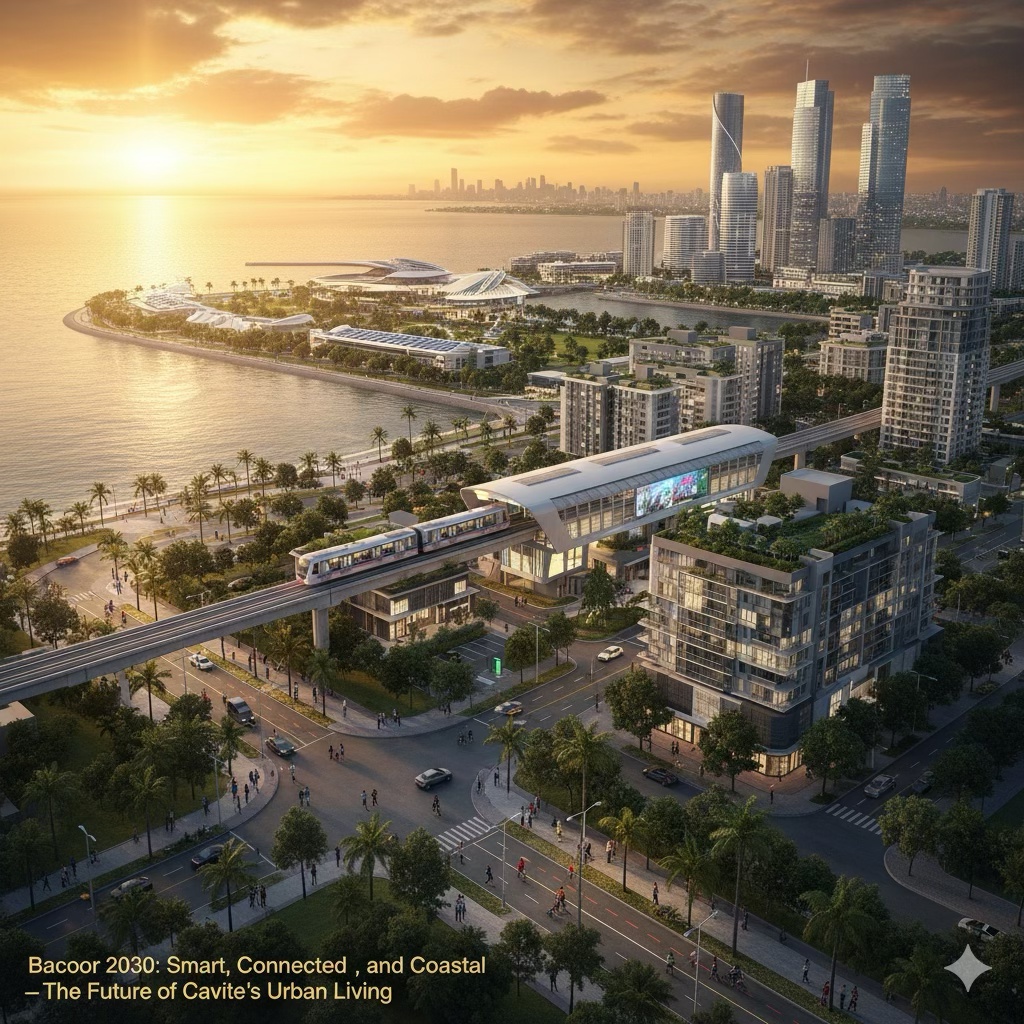
Bacoor’s transformation over the next decade positions it as Cavite’s most strategic growth corridor— a city balancing livability, innovation, and sustainable development. As infrastructure projects near completion and new master-planned communities take shape, Bacoor is evolving into a modern urban hub integrated with the broader Metro Cavite economy.
1. Smart City Initiatives and Digital Transformation
By 2030, Bacoor aims to be among the first smart-enabled cities in Cavite, integrating technology into governance, mobility, and safety. The local government has started implementing the Bacoor Digital Transformation Roadmap, which includes:
- Smart traffic systems to manage congestion and improve road efficiency.
- Digitized business permits and land records for faster, more transparent transactions.
- Community Wi-Fi zones and public information systems for improved citizen engagement.
These efforts align with the Department of Information and Communications Technology (DICT)’s national Smart City framework, ensuring Bacoor’s infrastructure supports both residential convenience and investor confidence.
2. Expected Property Appreciation and Investment Momentum
With the LRT-1 Cavite Extension, CAVITEX C5 Link, and CALAX nearing completion, Bacoor’s property values are expected to see steady appreciation between 7% and 10% annually over the next five years.
- Condo projects near transport corridors (Niog, Zapote, Molino) are projected to experience the highest capital gains.
- House-and-lot communities within gated developments will benefit from suburban migration trends among Metro Manila workers seeking space and affordability.
Investors entering the market now are well-positioned to capture compounded long-term growth, similar to how Alabang and Parañaque expanded in the early 2000s.
3. Planned Reclamation and Eco-Tourism Projects
Bacoor’s coastal district will undergo major transformation through reclamation and sustainable waterfront development projects, designed to stimulate tourism and generate jobs. The Bacoor Reclamation and Development Project, once approved by DENR and PRA, will create a new mixed-use coastal township with commercial zones, parks, and eco-tourism attractions.
Complementary to this are initiatives to revive the Bacoor Bay coastline, turning it into a family-friendly leisure area with bike paths, promenades, and cultural hubs celebrating the city’s heritage as the “Gateway to Cavite.”
4. Integration with the Cavite Economic and Industrial Zone
Bacoor is strategically positioned to serve as the northern urban gateway to Cavite’s industrial belt, connecting to Imus, General Trias, and Dasmariñas — all key areas of the Cavite Economic Zone (CEZ). This integration brings major benefits:
- Job generation and business expansion, with professionals choosing to live in Bacoor while working in nearby industrial hubs.
- Support services growth—from logistics to retail and hospitality—driven by increased economic activity.
- Improved regional planning, as Bacoor aligns with Cavite’s broader urban development masterplan under the CALABARZON Growth Corridor initiative.
Looking Ahead
By 2030, Bacoor will no longer be viewed as merely a suburb of Metro Manila — it will stand as a self-sustaining, smart, and livable city that bridges the best of both worlds: urban access and suburban quality of life.
Early investors who recognize Bacoor’s long-term vision today are poised to benefit from the city’s ongoing transformation into a modern, connected, and economically vibrant community.
Conclusion & Key Takeaways
Once known for its quiet coastal life, Bacoor has evolved into a dynamic urban gateway—a city where Metro Manila convenience meets Cavite charm. Its rapid transformation, fueled by infrastructure growth, mixed-use developments, and smart city initiatives, positions it as one of Southern Luzon’s most promising real estate frontiers.
Key Takeaways for Homebuyers and Investors
- Strategic Location Advantage: Bacoor offers direct access to major business districts through CAVITEX, CALAX, and LRT-1, making it a prime choice for commuters and investors alike.
- Sustained Property Growth: With annual appreciation rates projected between 7%–10%, Bacoor’s property values are expected to rise steadily through 2030.
- Balanced Lifestyle: The city perfectly blends urban accessibility (malls, schools, hospitals) with suburban tranquility, making it ideal for families and retirees.
- Investment Versatility: From condos and townhouses to mixed-use lots, Bacoor caters to every investor profile—from first-time buyers to long-term portfolio builders.
- Smart and Sustainable Future: Bacoor’s focus on digital governance, flood control, and coastal renewal ensures its long-term livability and investment resilience.
The Bottom Line
Bacoor is no longer just Cavite’s entry point—it’s the next lifestyle and investment capital rising at the edge of Metro Manila. Whether you’re seeking a home to grow in or an investment that appreciates with time, Bacoor offers a balanced, future-ready environment built for modern living.
Ready to make Bacoor your next home or investment?
Discover the best condos, house-and-lot communities, and preselling developments in Bacoor — from strategic locations near Metro Manila to serene neighborhoods ideal for families.




 U-Property PH
Leave a comment