
Published April 2026 · Sources: PEZA, Manila Times, BusinessWorld
Investment
Revenue Target
(Phase 1)
Direct Jobs
Footprint
A Signal Worth Reading
Not every foreign investment makes headlines for the right reasons. But the announcement that Singapore-based Total Advanced Future Technology Pte. Ltd. (TAFT) is committing ₱3.6 billion to a manufacturing facility in Batangas deserves close attention — not just for its headline figure, but for what it reveals about where the Philippines is heading as an investment destination.
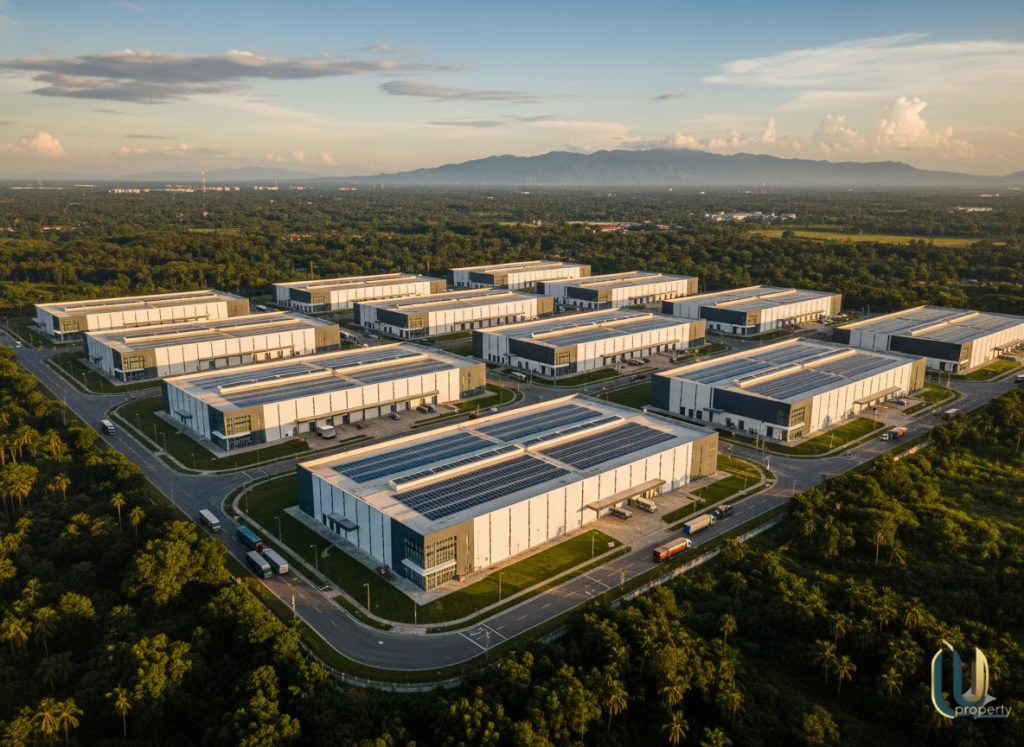
TAFT will establish operations at Light Industry and Science Park IV (LISP IV) in Malvar, Batangas, under the Philippine Economic Zone Authority (PEZA). The company’s focus is distinctive: it will specialize in high-tech, climate-resilient houses for the Japanese market, and will also handle the packaging and export of complete housing products, including components, parts, and accessories.
The facility is projected to generate approximately $120 million — roughly ₱7.29 billion — in annual export revenues. That figure alone reframes the investment: this is not just a factory, but a dedicated export platform targeting one of Asia’s most demanding and highest-value markets.
For real estate investors watching Southern Luzon, the question is not whether this matters. It is how much — and across which property segments.
“With the presidential proclamation, the LISP IV expansion will serve as a catalyst for innovation, employment, and competitiveness, reinforcing the Philippines’ potential as a strategic hub for forward-looking investments.”
PEZA Director General Tereso O. Panga
Why Batangas, and Why Now
Batangas has earned its reputation as one of CALABARZON’s most productive industrial corridors through a combination of geography, infrastructure, and policy alignment — not through hype. Four structural advantages make it a rational choice for export-oriented manufacturers.
Location Advantage
The province sits at the southern edge of Metro Manila’s economic gravity, with direct access via the South Luzon Expressway (SLEX) and STAR Tollway. Manufacturers can move goods efficiently between production facilities, the Port of Batangas, and the country’s largest consumer base.
Port Infrastructure
The Port of Batangas is a functioning gateway for domestic and international cargo — not a future promise, but an existing operational advantage that manufacturers weigh when choosing sites. For a facility exporting finished housing products to Japan, reliable port access is non-negotiable.
Established Industrial Ecosystem
Batangas is already home to major economic zones including First Philippine Industrial Park (FPIP) and the Light Industry and Science Park complex. Phase 1 of TAFT’s project will cover 13 hectares at LISP IV — expanding an already active zone with a credible, export focused anchor tenant.
PEZA Alignment
PEZA’s regulatory backing provides fiscal incentives that make investments like TAFT’s viable and replicable. With PEZA targeting 30 new ecozone proclamations in 2026, continued momentum for industrial expansion across the region is a reasonable expectation, not wishful thinking.
What Makes TAFT’s Investment Particularly Interesting
The nature of TAFT’s business — manufactured housing for Japan — is worth unpacking, because it shapes the downstream effects on Batangas differently than a typical electronics or automotive parts plant.
Modular and prefabricated housing manufacturing is a precision-intensive industry. It requires skilled fabricators, quality-control technicians, logistics specialists, and engineers who understand Japanese construction standards. The workforce profile skews toward mid-skilled to skilled labor — which translates to stronger purchasing power in the surrounding residential market compared to lower-wage assembly operations.
Japan’s modular housing sector is also a stable, growing export market driven by demographic and regulatory factors that are unlikely to reverse quickly. That stability matters for property investors because it reduces the risk of a facility closing in three years and deflating local housing demand. This is a long-horizon tenant, not a transient one.
How Many Jobs Are We Actually Talking About?
One question the official announcements leave unanswered is how many people TAFT’s facility will actually employ. PEZA has not yet published a formal employment target — a figure typically disclosed at or after the registration agreement signing, which remains pending the presidential proclamation. However, a defensible estimate can be constructed from two converging reference points.
The Investment-to-Employment Benchmark
PEZA’s manufacturing ecozone projects historically generate roughly one direct job for every ₱1 to ₱2 million in capital invested — a broad but serviceable industry ratio. Applied to TAFT’s ₱3.6-billion commitment, that benchmark suggests a direct workforce of between 1,800 and 3,600 employees at full Phase 1 capacity.
The Comparable Facility Cross-Check
A ceramic capacitor manufacturer operating within the broader LISP complex in Tanauan employs close to 1,900 workers across a site roughly twice the size of TAFT’s planned 13 hectare footprint. Modular housing manufacturing, however, is inherently more labor-intensive per square meter than electronics assembly — involving structural fabrication, carpentry, joinery, panel fitting, quality inspection, and finishing work that resists full automation. That characteristic pushes the estimate toward the upper end of the range.
Accounting for the precision requirements of the Japanese export market — where construction tolerances and quality standards are among the strictest in the world — a trained, mid-skilled workforce is not optional. It is a structural feature of the business model. A working estimate of 2,000 to 3,500 direct employees at full Phase 1 operational capacity appears defensible, with the important caveat that this remains analytical until PEZA publishes verified projections.
Employees
Multiplier
Footprint
Beyond direct hires, manufacturing facilities of this type typically generate an indirect employment multiplier of two to three times through the supplier and services ecosystem that clusters around anchor plants. The total economic footprint on surrounding communities could therefore represent 6,000 to 10,000 additional livelihoods across component suppliers, logistics operators, and local service businesses. That number has direct and measurable implications for property demand across Batangas.
The Real Estate Ripple: Residential
A workforce of 2,000 to 3,500 people does not appear in a vacuum. They need somewhere to live — and the geography of LISP IV in Malvar positions several established residential centers directly in the path of that demand.
Cities within practical commuting distance — Lipa City, Tanauan City, and Sto. Tomas — have already absorbed the residential overflow from existing LISP and FPIP tenants. TAFT’s entry adds another layer of sustained demand onto a market already experiencing upward pressure on rents and land values.
What makes this workforce particularly significant for property investors is its composition. Manufacturing climate-resilient homes to Japanese export standards requires structural fabricators, quality technicians, engineers, and logistics supervisors — a workforce that skews toward mid-skilled to skilled labor rather than purely entry-level assembly workers. That profile translates to stronger and more stable purchasing power in the surrounding residential market
The employment demand builds in two waves. The first is TAFT’s direct workforce, which typically scales over 18 to 36 months post groundbreaking. The second is the indirect workforce — those 6,000 to 10,000 additional livelihoods across the supplier and services ecosystem — many of whom will also seek housing nearby. Together, they represent a compounding demand signal across multiple residential segments.
Three Residential Segments to Watch
- Rental income (near-term): The bulk of incoming workers — particularly those relocating from outside Batangas — will enter the rental market before considering home ownership. Ready-for-occupancy (RFO) units near transport corridors connecting Malvar to Lipa and Tanauan are positioned to absorb this demand most directly. Investors holding RFO stock in these corridors may see occupancy rates and achievable rents firm up as TAFT’s operations ramp.
- Mid-market house-and-lot (medium-term): Engineers, supervisors, and senior technicians represent genuine demand for mid-income house and-lot and townhouse products. Developers targeting the ₱2–5 million price bracket in Lipa and Tanauan are building into a market where underlying demand is meaningfully strengthening.
- Pre-selling appreciation (longer horizon): For investors with a 3–5 year window, pre selling developments currently being launched in Malvar-adjacent corridors offer entry ahead of the full operational ramp. Employment — and by extension housing demand — grows progressively rather than arriving all at once, rewarding those who position early.
The Real Estate Ripple: Commercial and Retail
A growing industrial workforce does not just need housing. It creates demand for the full range of everyday services — grocery stores, pharmacies, banks, food establishments, clinics, and retail convenience. A combined workforce and economic footprint of 6,000 to 10,000 represents the kind of sustained population base that attracts branded retail chains and anchors mixed-use commercial developments.
This demand typically lags the initial investment announcement by 18 to 36 months, but investors who position commercial assets early tend to capture the highest appreciation. Strip malls, mixed-use developments, and service centers near residential growth corridors in Malvar and surrounding municipalities are worth evaluating ahead of that curve.
The Real Estate Ripple: Industrial and Logistics
Large manufacturers rarely operate in isolation. TAFT’s facility will generate secondary demand for industrial real estate through the supplier ecosystem it attracts:
- Component and material suppliers — likely to establish nearby operations to reduce logistics costs and meet just-in-time delivery requirements
- Packaging and third-party warehousing — TAFT will operate an on-site warehouse, but logistics providers routinely cluster near anchor plants
- Maintenance and technical services — firms supporting specialized manufacturing equipment tend to locate within quick reach of the facilities they serve
This ecosystem creates secondary demand for industrial land, warehouses, and distribution centers — assets that have historically appreciated steadily in active PEZA-adjacent zones across CALABARZON. For investors interested in industrial real estate specifically, land near LISP IV and the broader Malvar–Sto. Tomas corridor merits evaluation before this secondary wave materializes.
Investor Opportunity Matrix
The table below summarizes the primary real estate investment pathways emerging from TAFT’s Batangas entry, organized by property type, key locations, investor profile, time horizon, and risk level.
| Property Type | Key Locations | Investor Profile | Horizon | Risk Level |
|---|---|---|---|---|
| RFO Rental Units Condo / Townhouse |
Lipa City, Tanauan, Sto. Tomas | Income-focused, passive landlord | Immediate – 3 yrs | Low–Medium |
| Pre-Selling Residential | Malvar-adjacent corridors | Capital appreciation, longer horizon | 3–5 years | Medium |
| Mid-Market House & Lot | Lipa City, Tanauan City | Developer or end-user investor | 2–5 years | Medium |
| Industrial Land / Warehouse | Malvar, LISP IV vicinity | Institutional or high-net-worth | 5–10 years | Medium–High |
| Commercial Strip / Mixed-Use | Malvar, Sto. Tomas, Tanauan | Retail / commercial specialist | 3–6 years | Medium |
Infrastructure: The Underlying Foundation
Infrastructure investment is often the most durable driver of long-term property appreciation — and Batangas has a credible foundation rather than a speculative pipeline. The SLEX–STAR Tollway corridor is operational. The Port of Batangas is active. PEZA’s stated goal of proclaiming 30 new ecozones in 2026 suggests continued regulatory momentum for industrial expansion across the region.
That said, rapid industrial growth can strain local roads, utilities, and public services before infrastructure catches up. Investors should assess specific micro- locations — not just broad proximity to industrial parks — and factor in access to reliable utilities as a due-diligence criterion rather than an assumption.
Risks Investors Should Weigh Honestly
Balanced analysis requires acknowledging the limits of any investment thesis. Four risks merit explicit attention before committing capital.
Market Competition Is Intensifying
As Batangas gains recognition among developers and investors, competition for prime locations is increasing. Entry prices today reflect considerably more awareness of the province’s potential than they did five years ago. Investors should be disciplined about valuation, not just optimistic about growth.
Demand Projections Are Downstream of Operations
TAFT’s registration agreement is set to be signed upon issuance of the presidential proclamation. Until operations are confirmed and hiring begins, downstream residential and commercial demand remains speculative rather than confirmed. The employment estimates in this article are analytical — investors should treat them as directional, not guaranteed.
Environmental Stewardship Matters
Industrial expansion in a province with significant coastal and natural resources requires responsible environmental management. Zones with poor environmental records can face regulatory delays or community resistance that affect property values and investor sentiment.
Export Market and Currency Risk
TAFT’s revenues are tied to the Japanese market. While this is a stable export destination, peso-dollar-yen dynamics can affect the facility’s long-term profitability and expansion plans — factors beyond a property investor’s direct control, but worth monitoring as part of ongoing due diligence.
The Investor’s Takeaway
The ₱3.6-billion TAFT investment at LISP IV is a credible, PEZA-backed development with a differentiated product offering, a concrete export revenue target, and an employment profile that positions it as a durable rather than transient industrial tenant. It fits a broader pattern of Batangas strengthening its position as one of Southern Luzon’s most reliable industrial destinations.
Batangas is not a speculative frontier market. It is a maturing industrial province with verified infrastructure, active economic zones, and a growing track record of attracting export-oriented foreign investment. An estimated 2,000 to 3,500 direct jobs — and up to 10,000 total livelihoods across the economic footprint — represent a meaningful and sustained demand signal across residential, commercial, and industrial property sectors.
An estimated 2,000–3,500 direct jobs and up to 10,000 total livelihoods — all anchored in a 13-hectare PEZA ecozone in Malvar, Batangas.
The employment and real estate case, in one sentence.
Three Near-Term Priorities for Investors
- Residential rental properties in Lipa, Tanauan, and Sto. Tomas, targeting themid-skilled workforce profile TAFT’s operations will attract
- Industrial land and warehouse assets near LISP IV, ahead of the supplier ecosystem that typically follows anchor manufacturers into active PEZA zones
- Pre-selling residential developments in Malvar-adjacent corridors for investors with a 3–5 year horizon, entering ahead of the full employment ramp
Sources: Philippine Economic Zone Authority (PEZA) official announcements, March 2026; Manila Times, 31 March 2026; BusinessWorld, 30 March 2026. Employment figures are analytical estimates based on PEZA investment-to-employment benchmarks and comparable LISP-area facilities; official PEZA employment projections for TAFT are pending post-proclamation disclosure. This article is for informational purposes only and does not constitute financial, legal, or investment advice. Independent due diligence is advised before any investment decision.



 U-Property PH
Leave a comment