Annotations on a Philippine Property Title: What Each One Means — and Which Ones Should Stop a Sale
The back of a title carries the full legal history of a property. Most buyers skip it. This guide explains every annotation type — and how to tell the routine ones from the transactional blockers.
The front of a Philippine property title tells you who owns it. The back tells you whether that ownership is actually clean. Most buyers spend their due diligence time on the front — verifying the name, the lot number, the title type — and treat the back as a formality. It is not. Annotations recorded on the dorsal side of a title are legally binding entries that can encumber, restrict, freeze, or entirely block a property transfer. A buyer who signs without reading them is legally presumed to have known about them anyway. Under Philippine law, ignorance of an annotation is not a legal defense — it is a risk the buyer assumes.
What an Annotation Is — and Where to Find It
An annotation is an official entry made by the Registry of Deeds on a property title. It records a legal fact — a lien, an encumbrance, a court order, a government restriction, or the completion of a prior transaction — that affects the property beyond the basic question of who holds title. Annotations are sometimes referred to as encumbrances on a title. They do not replace the title. They layer on top of it, and they travel with the property when it changes hands.
Physically, annotations appear on the dorsal side — the back — of the Owner’s Duplicate Certificate of Title. The Registry of Deeds maintains its own copy, which carries the same entries. Only the Registry can make an annotation. No broker notation, developer stamp, or handwritten remark on the title document constitutes a legal annotation. If it was not entered by the Registry of Deeds, it does not have annotation-level legal force.
This matters for one critical practical reason: the owner’s duplicate copy you receive from a seller may not reflect every annotation. If the seller withheld the duplicate from the Registry at any point, the Registry’s copy may carry more recent entries. For due diligence purposes, the owner’s duplicate alone is insufficient. You must obtain a Certified True Copy issued directly by the Registry of Deeds.
The legal framework governing all of this is Presidential Decree No. 1529, the Property Registration Decree — the statute that governs the Torrens system of title registration in the Philippines. Under PD 1529, registration is the operative legal act. The principle is simple but consequential: once an instrument is annotated, it becomes a matter of public record, and all subsequent parties — including buyers — are deemed to have notice of it. This is called constructive notice. The practical implication is straightforward: conduct your annotation due diligence before you sign anything — not after discovering a problem you are now legally bound by.
A practical note on annotation entries: each annotation carries a standard set of fields — an entry number, the nature of the instrument being recorded, the names of the parties, the date the instrument was signed, and the date it was registered with the Registry. The legally operative date is the date of registration, not the date the deed or order was signed. When you are assessing whether an annotation is current or historical, look at the registration date.
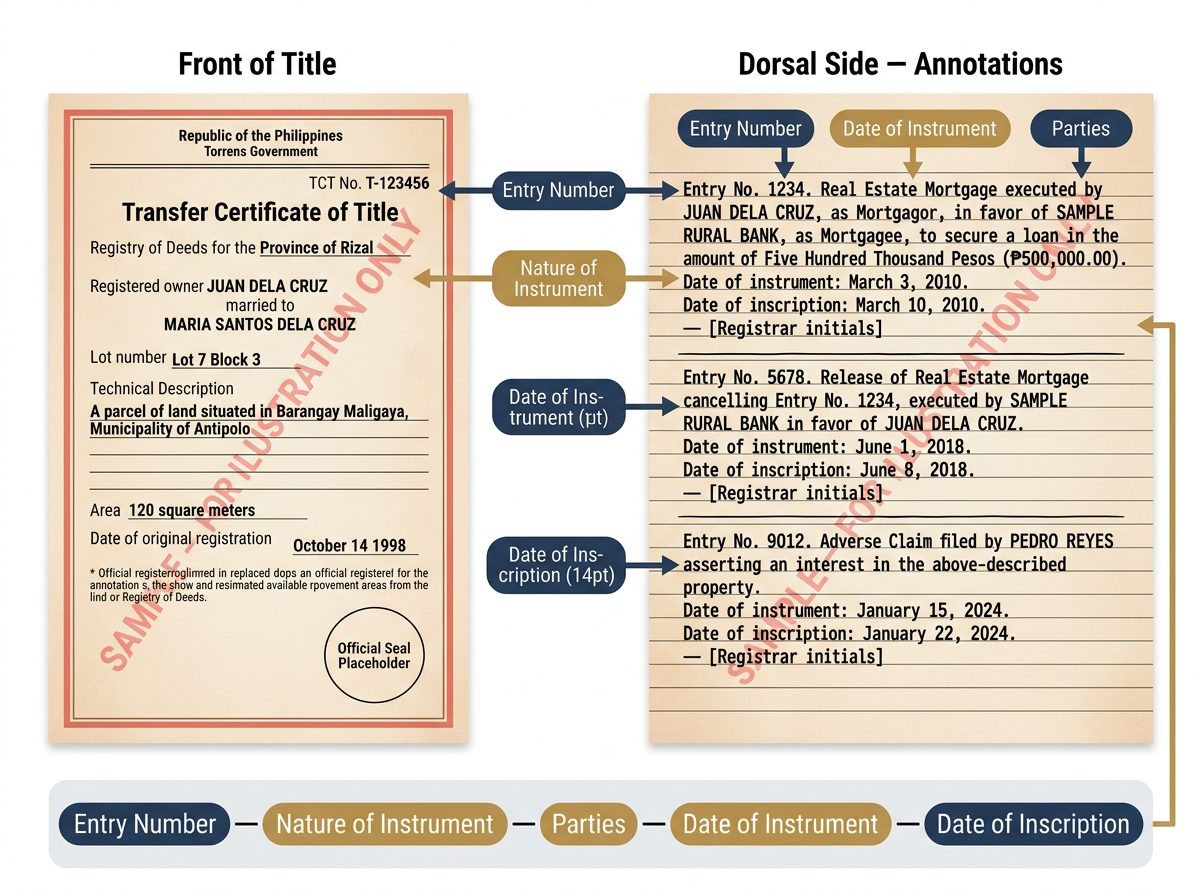
A buyer who purchases a property with an active annotation takes it subject to that annotation — regardless of whether they read it. Under the Torrens system, registration constitutes notice to the entire world. Claiming you did not see an annotation on a title you purchased is not a legal defense. It is a risk you accepted.
Category 1 — Liens and Encumbrances
Liens and encumbrances are annotations that attach a financial or possessory claim to the property. They are the most common annotation type a buyer will encounter, and the most varied. Some are entirely routine and manageable. Others require careful structuring before a sale can proceed.
Real Estate Mortgage
A real estate mortgage annotation records that the property has been pledged as collateral for a loan — typically a bank housing loan, but sometimes a private lending arrangement. The mortgagee (the bank or lender) registers the mortgage with the Registry of Deeds, and it is annotated on the title. The annotation remains in place until the loan is fully repaid and the bank executes a Release of Real Estate Mortgage, which is then separately annotated as a cancellation.
A mortgage annotation is not automatically a red flag. Many sellers are paying down a bank loan and intend to settle it from the sale proceeds. This is a standard transaction structure. What makes it manageable or dangerous is the seller’s ability to document it properly. Before you proceed on a mortgaged property, require a bank-issued Statement of Account confirming the outstanding balance and the account status. Confirm that the payoff will be handled directly at closing — with proceeds going to the bank before the balance goes to the seller. Do not release funds based on verbal assurances that the loan “will be paid” after closing.
The red flag version of a mortgage annotation is one where the seller cannot produce a current Statement of Account, the loan appears to be in arrears, or the mortgage is with a private lender rather than a regulated bank — particularly where the terms are not documented or the lender is not readily identifiable.
Pacto de Retro Sale
A pacto de retro sale is a sale with a right of repurchase. The seller sells the property to a buyer but retains the right to buy it back within a specified period. The annotation records both the sale and the repurchase right. If the redemption period has not expired, the seller can reclaim the property by paying back the purchase price — meaning a third-party buyer who acquires the property during the redemption window is buying into an unresolved right of redemption. Check whether the annotation specifies an expiry date. If the period has lapsed and no redemption occurred, look for a consolidation of ownership annotation confirming the repurchase right has expired.
If the annotation specifies an expiry date that has passed but no consolidation of ownership has been annotated, do not assume the right of repurchase has been extinguished. Require the seller to execute and register the consolidation before or at closing. An unregistered consolidation does not formally discharge the prior buyer’s repurchase right.
Usufruct
A usufruct grants a third party — the usufructuary — the right to use and enjoy the property for a defined period or for the duration of their lifetime, without holding ownership. A registered usufruct survives a sale. If you buy a property with an annotated usufruct in favor of a living person, that person retains the right to use the property until the usufruct expires or they pass away. This directly affects possession, occupancy, and the ability to rent out the property. Verify the identity of the usufructuary, the term of the usufruct, and whether it has expired before agreeing to a purchase price that reflects the right being in place.
Registered Lease
Leases exceeding one year in duration may be registered with the Registry of Deeds and annotated on the title. A registered lease is binding on subsequent owners. If you purchase a property with an annotated lease, you inherit the tenant and the lease terms. This is not inherently a dealbreaker, but it must be factored into the purchase price and the buyer’s intended use. A buyer planning to occupy the property immediately cannot do so if an annotated lease grants a tenant possession for another two years.
| Annotation Type | What It Records | Survives Sale? | Dischargeable Before Closing? | What to Require |
|---|---|---|---|---|
| Real Estate Mortgage | Loan secured against the property | Yes, until released | Yes — via Release of REM + cancellation annotation | Bank Statement of Account; direct payoff at closing |
| Pacto de Retro Sale | Sale with seller’s right of repurchase | Yes, until period lapses or consolidation is annotated | Depends on redemption period status | Confirm expiry date; check for consolidation annotation; require registration of consolidation if period has lapsed |
| Usufruct | Third-party right to use and enjoy | Yes, for the usufruct term | Only if usufruct has expired or usufructuary consents | Identity of usufructuary; term and expiry date |
| Registered Lease | Long-term lease binding on all owners | Yes, for lease term | Only if lease has expired or tenant consents to early termination | Lease terms; tenant identity; remaining term |
Category 2 — Government and Regulatory Restrictions
Government annotations are imposed by agencies exercising regulatory authority over the property — not by private parties with financial claims. They tend to be less common than mortgage annotations, but significantly harder to discharge, and in some cases they make a sale legally impossible without prior clearance.
DAR Annotations
Properties that have passed through the agrarian reform program carry annotations from the Department of Agrarian Reform. The most consequential is the CLOA annotation — a Certificate of Land Ownership Award, which is the title issued to agrarian reform beneficiaries under Republic Act 6657. A CLOA carries a statutory ten-year restriction on transfer from the date of award. During this period, the beneficiary cannot sell, lease, or transfer the property without DAR clearance. A sale executed without that clearance is void — not merely voidable.
Even for properties that are no longer under formal agrarian reform coverage, a DAR clearance requirement annotation may appear, indicating that the property’s agricultural history requires DAR sign-off before a transfer can be registered. This is a procedural blocker, not a substantive one — but it must be resolved before closing.
A CLOA title carries a 10-year restriction on transfer under RA 6657. If the restriction period has not lapsed, a sale executed without DAR clearance is legally void — not merely irregular. Verify the CLOA award date, calculate whether the restriction period has expired, and confirm that a DAR clearance certificate is in hand before any money changes hands.
HLURB / DHSUD Annotations
For subdivision lots and condominium units, annotations from the Housing and Land Use Regulatory Board — now the Department of Human Settlements and Urban Development — may appear on the title. These typically reflect development approval conditions, open space reservations, or restrictions tied to the developer’s License to Sell under Presidential Decree 957. The presence of a License to Sell annotation on the master title confirms the developer was authorized to sell units from that project. Its absence is a red flag indicating the developer may have sold without regulatory authority. If you are buying a pre-selling unit or a subdivision lot, verify the License to Sell number before paying a reservation fee — not after.
Easements
Legal easements — rights of way, drainage easements, easements of light and view — may be annotated on a title when they are formally established by court order or government directive. An easement grants a third party or the public a defined right over a portion of the property. It does not transfer ownership, but it restricts what the owner can do with the affected area. Easements are particularly relevant for lots near national roads, rivers, shorelines, power line corridors, or adjacent to public infrastructure. The area covered by an easement cannot be built on, enclosed, or used in a way that obstructs the easement right.
Eminent Domain and Expropriation Notices
When the government initiates proceedings to acquire a property — for road widening, infrastructure, or public use — a notice of expropriation may be annotated on the title. This is immediately material to any purchase decision. The scope of the expropriation (partial vs. full), the stage of the proceedings, and the compensation offered or awarded all need to be verified. A government expropriation claim does not require the owner’s cooperation to proceed. Buying into an active expropriation means the property’s disposition may no longer be fully in the seller’s hands.
Category 3 — Court-Ordered and Litigation Annotations
Litigation annotations are the category that causes the most post-sale loss. A buyer who purchases a property with an unresolved court annotation does not buy free and clear — they buy into the outcome of a legal proceeding they had no part in starting. These annotations must be treated as hard stops until a legal opinion confirms otherwise.
Lis Pendens
Lis pendens — Latin for “suit pending” — is annotated when a property is the subject of active litigation. The case may concern ownership rights, boundary disputes, fraudulent transfers, inheritance contests, or any claim that puts the title itself in question. The annotation puts all subsequent parties on notice that the title is contested.
A buyer who purchases a property with an annotated lis pendens takes it subject to the court’s eventual decision. If the court rules against the current owner, the buyer’s title may be nullified or the property may be ordered transferred to a third party. The fact that you paid fair market value and transacted in good faith does not automatically protect you — particularly if the lis pendens was on record at the time of sale.
Before proceeding on a property with an active lis pendens, obtain a certified true copy of the case records from the court, determine the current status and the nature of the claim, and get an independent legal opinion on the likely outcome and the realistic timeline for resolution. Do not accept the seller’s characterization of the case as minor or certain to be dismissed.
A detailed look at how lis pendens annotations work, what types of cases trigger them, and the steps buyers must take before proceeding on an affected property.
Notice of Levy on Attachment
A notice of levy on attachment records that a creditor has obtained a court order attaching the property as security for a debt owed by the owner — before a final judgment has been rendered. The property is effectively frozen. It cannot be transferred with clean title while the levy is in place. If the creditor ultimately wins the case, the levy may convert into an execution. Discharging a levy on attachment requires the underlying legal dispute to be resolved and the court order to be lifted, after which a cancellation must be annotated.
Notice of Levy on Execution
A levy on execution is a more advanced and more dangerous annotation than attachment. It records that a court has rendered a final judgment against the owner and that the property has been levied to satisfy that judgment. At this stage, enforcement has already begun. The property may be subject to public auction to pay the judgment creditor. A buyer who purchases under these conditions risks the property being auctioned out from under them, or acquiring a title that will be challenged by the judgment creditor.
Adverse Claim
An adverse claim is filed by a person asserting an interest in the property that has not yet been resolved through formal litigation. Under Section 70 of PD 1529, an adverse claim is effective for thirty days from the date of annotation. If no action is taken within that period — either through a court case or a cancellation proceeding — it must be re-annotated to remain effective. An adverse claim that appears on a title you are evaluating requires immediate investigation: who filed it, on what basis, and whether they have since initiated a court case that would be annotated separately as a lis pendens.
If an adverse claim annotation appears to have expired — the registration date is more than 30 days old and no re-annotation or follow-on lis pendens is visible — it does not automatically mean the claim has been abandoned. The claimant may have filed a case without annotating it, or may re-annotate at any time. Treat an expired adverse claim as a dormant risk, not a resolved one, and investigate the claimant’s current intentions before proceeding.
| Annotation Type | Stage of Legal Process | Can Property Transfer Clean? | What Buyer Must Do |
|---|---|---|---|
| Lis Pendens | Active court case filed; title contested | No — buyer takes subject to court outcome | Obtain case records; get independent legal opinion before proceeding |
| Levy on Attachment | Court order issued; judgment not yet final | No — property frozen pending case resolution | Verify case status; do not proceed until levy is cancelled |
| Levy on Execution | Final judgment rendered; enforcement active | No — property may be auctioned | Treat as a hard stop; legal intervention required |
| Adverse Claim | Interest asserted; no case filed yet | Technically yes, but with significant risk | Identify the claimant and basis; assess likelihood of a follow-on case; treat expired claims as dormant risk, not resolved |
Category 4 — Annotations That Record a Completed Event
Not every annotation signals an active problem. Some record transactions or legal events that have already concluded. These are generally benign — but they still require verification to confirm the event is genuinely complete.
Annotated Deed of Absolute Sale — Title Not Yet Transferred
When a deed of sale is executed and registered but the title has not yet been transferred into the buyer’s name, the deed is annotated on the existing title. This is a normal intermediate step in a transfer — but it has a red flag version. If the deed was annotated in favor of a prior buyer, and the current seller is presenting themselves as the owner without having updated the title into their own name, you need to understand why. Was the prior sale rescinded? Was there a resale of an untransferred right? A gap between an annotated deed and a title that still reads in an earlier owner’s name is a chain-of-title issue that requires legal clarification before you proceed.
Cancellation Annotation
A cancellation annotation records that a prior annotation has been formally discharged — a mortgage released, a lis pendens dismissed, an adverse claim cancelled. This is good news when you see it. But confirm that the cancellation is complete: the annotation should specify the entry number being cancelled, and the Registry’s copy should reflect no residual claim. A cancellation that has been executed but not yet registered with the Registry of Deeds has no legal effect — the encumbrance is still live on the title. Do not release funds or sign a deed of sale on the basis of an unregistered cancellation.
Consolidation of Ownership
In a pacto de retro sale where the seller failed to exercise their right of repurchase within the agreed period, ownership consolidates with the buyer — the person who purchased under the pacto de retro arrangement. The consolidation is annotated on the title. When you see a consolidation annotation in a property’s history, it signals that the title passed through a redemption-sale structure at some point. This is not inherently a problem, but it is worth understanding the timeline to confirm the consolidation was properly executed and that no residual redemption right remains.
Before You Sign: A Six-Step Annotation Review
Reading annotations is not a task to delegate entirely to your broker. A broker can help you understand what an annotation means in the context of a transaction. The due diligence itself — obtaining the Registry copy and reviewing each entry — is something a buyer must oversee directly or confirm has been done properly by a lawyer.
Before releasing any funds at closing, require written confirmation for every annotation that will be cancelled and verify that the cancellation annotation has been registered with the Registry of Deeds. An executed Release of Mortgage sitting in a desk drawer is not a registered cancellation.
- Obtain a Certified True Copy of the title directly from the Registry of Deeds where the property is located. Do not use the seller’s photocopy. Do not rely on the owner’s duplicate alone. The CTC is the only document that reflects the Registry’s current record.
- Read the dorsal side in full. List every annotation entry by entry number, in sequence. Do not skip entries marked as cancelled — verify the cancellation is complete.
- Categorize each annotation — if you are uncertain what an annotation means, the category framework in this guide is the starting point. Determine whether it falls under: lien or encumbrance, government restriction, court order, or record of a completed transaction.
- For each active annotation, determine whether it is dischargeable before or at closing, or whether it survives a sale. Mortgages and registered leases are generally manageable with proper structuring. Litigation annotations and government restrictions are harder and may require you to walk away.
- For any court-related annotation — lis pendens, levy on attachment, levy on execution, or adverse claim — obtain an independent legal opinion before making any purchase decision. Do not rely on the seller’s lawyer for this assessment. The seller’s lawyer represents the seller’s interest in completing the transaction — not your interest in understanding the risk.
- Before releasing any funds at closing, require written confirmation for every annotation that will be cancelled, and verify that the cancellation annotation has been registered with the Registry of Deeds. An executed Release of Mortgage sitting in someone’s desk drawer is not a cancelled annotation.
Annotations are one layer of title verification — this guide covers the full authentication process for confirming a title is genuine before you commit to a purchase.
Not sure which title type you’re looking at? Understanding the difference between a TCT, CCT, and OCT is the first step before reading what’s annotated on it.
Cross-check annotations with the full document authentication process that protects you from fraudulent titles.
Understand the title type before interpreting the annotations recorded on it.
A deeper look at the most consequential litigation annotation a buyer will encounter, and the steps required before proceeding.
Have a title in front of you and not sure what you’re looking at?
We’ve worked through title annotations across transactions in Metro Manila and the provinces — mortgaged properties, lots with DAR history, units with active adverse claims. If you want a straight read on what an annotation means for your deal, reach out.
Request a Title ReviewNot sure your title is clean?
Verifying a title before you buy? We check TCT/CCT status and annotations as part of every transaction.
Free Checklist
Want This as a Printable Checklist?
Get the full Property Title Verification Checklist — Registry of Deeds steps, annotation red flags, and the questions to ask before you sign. Enter your name and email and we’ll send it over.
Verifying a title before you buy?
We check TCT/CCT status and annotations as part of every transaction.

Leave a Reply