
Two units in a Mandaluyong condo became vacant in the same week, both 24-square-meter studios with identical layouts, views, and asking rents of ₱18,500. The first owner invested ₱11,000 to fix the air conditioner and repaint a wall, leasing the unit in nine days at the full price. The second owner left their unit unchanged, expecting a desperate tenant would take it. Three weeks later, without any interest, they reduced the rent to ₱15,800 to attract tenants. This resulted in a monthly difference of ₱2,700 for the same building and floor, which the first owner recouped within two weeks due to their repairs.
That gap is the main point of this guide. Not all repairs are worth the cost, and many landlords waste money on unnecessary fixes or upgrades that don’t increase rent. This guide explains which repairs and upgrades can help increase rental income in the Philippine market, which ones just maintain current rent, and which are simply wasted expenses.
Key Takeaways
- Some repairs create a genuine rent premium; others simply stop you from losing rent to a longer vacancy or a lower offer — the math differs for each, and both matter.
- A repair is generally worth doing if it pays for itself within 12 months of the rent difference it creates. Past 24 months, reconsider.
- The highest-ROI repairs right now are the boring ones — a working aircon, reliable hot water, and fresh paint — not designer finishes.
- A full gut renovation almost never pays back on a rental-only unit; targeted repairs consistently beat renovation-level spending.
- Metro Manila condo vacancy is running near 25% heading into the back half of 2026 (Colliers), so a unit that shows better is doing real competitive work, not just looking nice.
Why Repair ROI Is the Question Most Landlords Skip
Most landlords approach repairs in one of two ways: they either fix everything that’s broken and hope for the best, or they fix nothing and let the rent cover the costs. Neither option is a true strategy; it’s just a default choice.
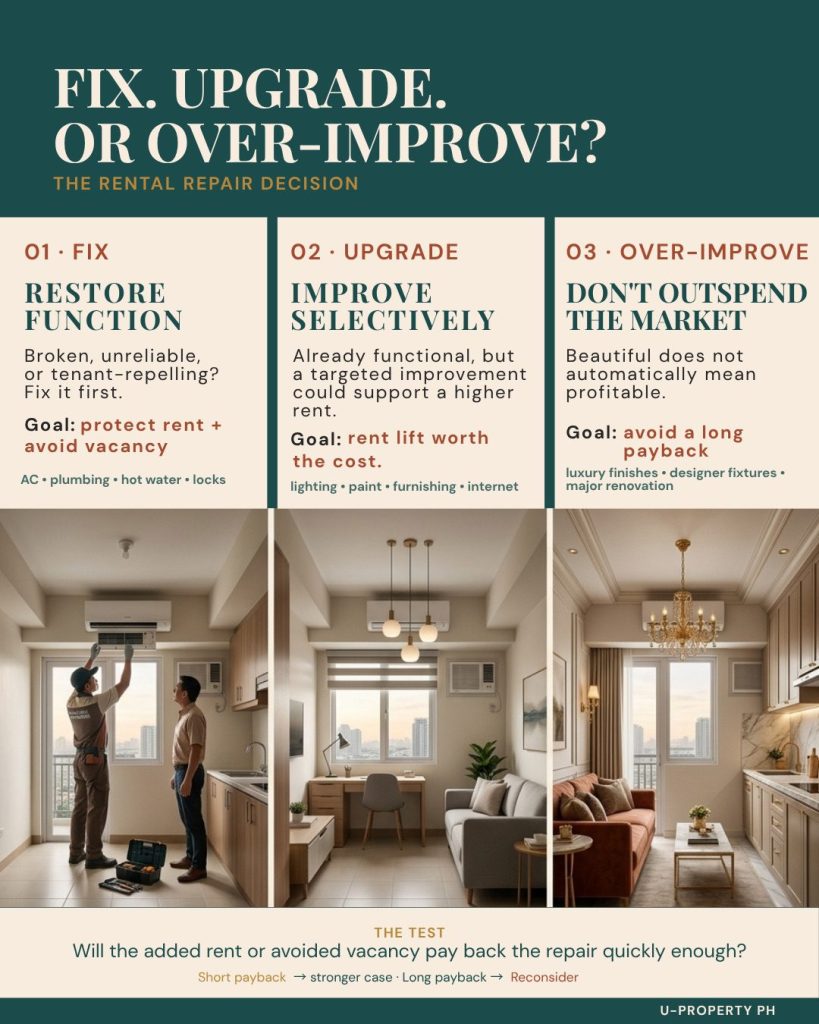
The key question for any repair or upgrade is: will this fix help you charge more, lease faster, or keep a good tenant? And is that benefit worth the cost? It’s a return-on-investment question that all investors consider. Many landlords skip the calculations because they see repairs as maintenance rather than investment choices.
The current market situation makes it more urgent than before. Metro Manila’s condo market has a high vacancy rate, estimated at 24.7% by the end of 2025, with further declines expected in 2026 as more units become available. In such a market, tenants looking at several similar units have real power, making presentation crucial. It’s one of the few aspects landlords can fully manage, along with pricing.
The Simple Math: How to Know If a Repair Pays for Itself
To find the payback period in months, calculate the monthly rent difference from a repair, multiply by 12, and then divide by the repair cost.
A repair that pays for itself in under 12 months is almost always worth it since you’ll recover the cost in a year, and everything after that is profit for as long as the improvement lasts. Repairs taking 12 to 24 months need more consideration based on how long you plan to keep the unit; if you intend to lease it for years, it might still be worthwhile. For repairs taking more than 24 months, it’s usually better to save that money for future vacancies instead.
One point to consider: not every repair increases rent. Some are just to stop rent loss—like a broken air conditioner or lack of hot water won’t allow a unit to rent for more than a similar one, but it will drive away potential tenants or require lowering the rent. For these cases, it’s better to calculate against the avoided discounts or extra vacancy time, not an upgrade premium. Both calculations are important; they just address different questions.
Here’s how it works with a real unit. For example, a 24-square-meter studio in a mid-market Quezon City building rents for ₱16,000 a month but has been vacant for five weeks due to tenant concerns over a ceiling stain and a slow aircon. A ₱9,500 repair bill for fixing the ceiling and servicing the aircon removes these issues.
If the unit leases in the first week afterward rather than another month, the landlord recoups more than the repair cost through avoided vacancy, even before factoring in any potential rent increase. Many landlords overlook this calculation: the return on investment for repairs is not just about raising rents, but often about how quickly the unit can be rented out.
Worth doing
- Payback under 12 months
- Fixes something actively disqualifying the unit during viewings
- Addresses a repeat complaint from past tenants
Think twice
- Payback beyond 24 months
- Upgrades the unit past what comparable listings in the building command
- A cosmetic preference with no evidence it affects viewings
| Repair | Cost | Rent Effect | Payback |
|---|---|---|---|
| Aircon repair (capacitor + clean) | ₱2,300 | Prevents a ₱2,000–3,000/mo discount tenants ask for a non-working unit | Recovered on the first lease |
| Full repaint (studio unit) | ₱12,000 | +₱800/mo vs. an unpainted comparable | ~15 months |
| Furnishing upgrade (semi → full) | ₱150,000 | +₱5,000/mo in an OFW-heavy building | ~30 months — reconsider unless holding long-term |
High-ROI Repairs That Actually Move the Needle
This core list shows price ranges based on current Philippine repair and service costs, which can vary by unit condition, location, and contractor. Make sure to compare these ranges with your own quotes before deciding.
| Repair / Upgrade | Typical Cost | Achievable Rent Lift | Payback |
|---|---|---|---|
| Aircon service & minor repair | ₱800–3,500 | Prevents a 10–20% discount request | Immediate |
| Plumbing fixes (leaks, low pressure, clogs) | ₱1,500–8,000 | Prevents disqualification, not a premium | Immediate |
| Internet-ready wiring / fiber port | ₱1,500–5,000 | ₱500–1,000/mo | 3–6 months |
| Instant water heater (unit + install) | ₱4,000–10,000 | ₱1,000–2,000/mo | 3–6 months |
| Security upgrade (lock, grill, doorbell cam) | ₱2,000–10,000 | ₱500–1,500/mo | 4–10 months |
| Fresh paint (spot to full repaint) | ₱6,000–18,000 | ₱500–1,500/mo | 6–12 months |
| Kitchen functional repair (not a remodel) | ₱5,000–25,000 | ₱500–1,500/mo | 6–15 months |
| Lighting fixture upgrade | ₱2,000–8,000 | ₱300–800/mo | 6–12 months |
| Flooring spot repair | ₱3,000–15,000 | ₱500–1,000/mo | 6–18 months |
| Furnishing upgrade (semi → fully furnished) | ₱80,000–250,000+ | ₱3,000–8,000+/mo | 12–24+ months |
Some of these points need extra context. Air conditioning reliability is crucial because the heat in the Philippines is constant; a faulty unit can quickly ruin a daytime viewing. Similarly, reliable hot water is essential for families and couples who see it as a basic requirement rather than an extra. Additionally, internet-ready wiring has shifted from optional to almost essential since remote work has become common among Metro Manila tenants—units without a usable fiber port now struggle to compete with those that do, even if they are priced the same.

Where Landlords Waste Money: Upgrades to Skip
The other side of the ROI question is important too. These upgrades seem useful but often don’t increase the rent a similar unit can achieve.
Usually Not Worth It on a Rental Unit
- Branded fixtures and premium appliances priced above what comparable units in the building charge — tenants shopping mid-market rarely pay extra for a brand name they can’t monetize.
- Structural changes — knocking down walls, reconfiguring layout — on a unit you plan to keep renting rather than occupy or sell.
- Smart home tech (smart locks, voice assistants, automated blinds) in mass-market and mid-market segments, where most tenants won’t pay extra for it and some find it a hassle.
- Bold, highly personalized finishes — unusual tile, saturated accent walls, statement lighting — that narrow rather than widen your pool of interested tenants.
- A full gut renovation on a unit you’re only renting out. Renovation-level spending commonly runs ₱15,000–₱60,000+ per square meter, and that math essentially never pays back through rental income alone — it only works if you’re also planning to sell.
Does It Matter What Kind of Rental You Own?
Priority repairs vary by type of property. What is important in a BGC studio may not be as important in a suburban family home.
Young professional, OFW-family
Family tenants
Premium segment
₱10,000/mo or below (NCR)
Furnished vs. Unfurnished: Where the Biggest Premium Sits
Furnishing level is the most important upgrade affecting rental prices in Metro Manila condos, especially in buildings popular with OFWs, expats, or short-term corporate tenants who typically don’t have furniture and prefer the ease of moving in with just their luggage.
There’s no exact dataset for rental premiums, so consider this a general range: property managers in Metro Manila’s buildings with many OFWs and expats report that fully furnished units usually rent for 15% to 30% more than bare units. The higher premium tends to be in buildings with short-term tenants, while the lower premium is found where tenants typically sign longer leases.
That premium should be compared to furnishing costs. A moderate-quality furnishing package for a studio or 1BR condo typically costs ₱80,000 to ₱250,000+, which has a much longer payback period than a ₱12,000 repaint. Furnishing is more beneficial when targeting short-term tenants, but less so for long-term families who prefer to bring their own furniture and save money.
Run the numbers before you commit: a ₱150,000 furnishing package that costs an extra ₱5,000 a month in a building with strong short-term demand pays back in about 30 months — a good investment if you plan to keep and rent the unit for years, but not ideal if you want to sell within a year or two. In a building where most tenants are long-term families who prefer their own furniture, that ₱150,000 may not increase the rent significantly, showing that furnishing is a specific strategy rather than a general improvement.
| Furnishing Level | Typically Includes | Where the Premium Shows Up Most |
|---|---|---|
| Unfurnished | Fixtures, cabinetry, aircon only | Long-term family and local tenants |
| Semi-furnished | + major appliances (fridge, washing machine, water heater) | The broadest tenant pool — most common ask |
| Fully furnished | + beds, sofa, dining set, curtains, kitchenware | Short-term corporate, OFW-family, expat tenants |
Baseline Maintenance vs. Repairs Worth Scheduling Around
Some repairs are essential for every turnover, regardless of their impact on rent, as they ensure the unit meets basic standards.
- Test and service the aircon before every new tenant moves in
- Check water pressure and look for active leaks under sinks and around the water heater
- Touch up or repaint walls with visible marks, stains, or scuffs
- Replace burnt-out bulbs and confirm every fixture actually works
- Test all locks and confirm door and window seals are intact
- Do a final deep clean, including aircon filters and exhaust fans
Beyond the basics, there are two important times to plan for. The first is lease renewal — if you’re raising the rent for a tenant, doing it alongside a noticeable repair or upgrade makes it feel justified rather than random. The second is seasonal: fixing plumbing and leaks is cheaper and easier before the rainy season, and air conditioning service gets more expensive and busy before the peak heat months from March to May, so it’s better to schedule it during the January–February slow season.
Repairs, Rent Increases, and a Tenant Already in Place
A repair or upgrade alone doesn’t allow for a rent increase during the lease; the lease agreement controls what you can charge and when. In most Philippine rentals, rent increases occur at renewal, not during the lease term.
For units under the Rent Control Act (RA 9653) — usually ₱10,000/month or less in Metro Manila and larger cities, or ₱5,000 or less elsewhere — rent increases at renewal are limited to 7% each year. For units beyond this amount, often condos and upscale apartments, rent increases depend on negotiations and the local market. In any case, it’s best to mention any genuine improvements you’ve made during the renewal discussion, instead of just increasing the rent without a reason.
Protecting Yourself at the Next Move-Out
Repairs are connected to discussions about your security deposit, even if they seem like different topics. The key difference is between necessary maintenance, which the landlord must handle due to normal use, and optional upgrades the landlord chooses to make for raising rent or attracting tenants. Only damage caused by the tenant beyond normal wear and tear can be deducted from the deposit; a repair that the landlord was already responsible for doesn’t become chargeable to the outgoing tenant just because it was finally completed.
Documenting the unit’s condition when you move in—using photos and a signed condition report—protects you as it does tenants. This evidence can help you defend against deductions and may influence a barangay mediator’s decision.
Common Mistakes Landlords Make With Repairs and Rent
Common Mistakes
- Cutting the rent instead of fixing what’s actually suppressing demand — a discount is a permanent monthly cost; a repair is a one-time one.
- Making the repair but never adjusting the rent to reflect the unit’s new condition, leaving money on the table for the rest of the tenancy.
- DIY work done poorly on anything involving plumbing or electrical, which tends to create a bigger, more expensive problem — and a bigger dispute — later.
- Assuming every unit in a building needs the same fix, without checking what comparable active listings in that specific building are actually offering.
When to Let a Property Manager Make the Call
Not every landlord can spend time calculating costs for each unit, especially if they own multiple properties. A property manager justifies their fee by using real leasing data—not by guessing which repairs are important, but by identifying the specific fixes that help leases close faster and those that tenants no longer request.
Let Someone Who Leases These Units Daily Make the Call
KeyStudio, U-Property PH’s studio condo leasing and management arm, handles tenant matching, rental marketing, and turnover — prioritized off what’s actually converting in the buildings they work in.
See KeyStudio’s ServicesWhy This Matters More in 2026
Two main factors are pushing Philippine landlords to think more carefully about repairs this year. First, the oversupply of condos in Metro Manila means tenants have many similar choices, making the appearance of units a key factor in attracting renters. Second, rising financing costs, due to the Bangko Sentral ng Pilipinas increasing its policy rate to 5% in August 2026, make borrowing more expensive for landlords.
As a result, landlords should aim for repairs that pay back quickly: a repair that recovers costs in six months is better than one that takes two years, especially since vacancy now costs more than before. Landlords who focus on repairs as a calculation of return will be better able to keep their units occupied and competitively priced.
Frequently Asked Questions
Can I raise the rent right after making repairs on a tenant who’s already in place?
No, you can’t raise it immediately or on your own. The increase must follow your lease agreement and the 7% yearly limit for units under RA 9653 at renewal. Repairs support your case when discussing renewal, but they don’t give you the right to raise rent during the lease.
What should a pre-listing repair budget look like?
For a basic turnover refresh—like air conditioning service, touch-up paint, and minor repairs—plan for 3% to 8% of one year’s rent. If a unit has been neglected over several tenancies, aim for 10–15% to restore it to a competitive level.
Should I repair before listing, or after I find a tenant?
Any issues that impact how the unit looks in photos or in person — like paint, damage, or a broken air conditioner — should be fixed before listing; a bad first impression can cost you viewings. Less visible problems can sometimes be discussed with a tenant as part of the move-in conditions.
Are repair costs tax-deductible against rental income?
Yes, if you’re on graduated income tax rates — repairs and maintenance can be deducted, or you can choose the simpler 40% Optional Standard Deduction. If you selected the 8% flat tax option, no deductions apply beyond the first ₱250,000 relief, including repairs.
Does the repair-ROI math change if I use a property manager instead of handling it myself?
The math doesn’t change, but the accuracy of your inputs does. A landlord managing one unit estimates rent lift from a few comparable listings, while a manager overseeing many units has real leasing data to rely on, leading to a more accurate estimate of a specific repair’s value before spending on it.
| Security Deposit Rules in the Philippines: 2026 Guide What’s a legitimate deduction at move-out, and how fast the deposit has to come back. | → |
| How to Calculate Rental Yield in the Philippines See how a repair-driven rent lift actually moves your gross and net yield. | → |
| How to Price Your Rental Unit in the Philippines (2026) Comparables, yield calculations, and location factors for setting the ask. | → |
| Landlord Rights and Responsibilities in the Philippines RA 9653 rent caps, eviction rules, repair obligations, and tax duties for 2026. | → |
Not Sure Which Repairs Are Worth It for Your Unit?
KeyStudio can walk through your specific unit and tell you which fixes are actually converting in your building right now.
See KeyStudio’s Services Talk to Us- Colliers Philippines, Property Market Report — Q1 2026 Residential.
- Philippine Daily Inquirer (Business), “BSP raises policy rate to 5%; peso sinks to new low,” Aug 28, 2026. business.inquirer.net
- Aircon.ph, “Aircon Cleaning Price Guide Philippines 2025.” aircon.ph
- Aircon.ph, “Aircon Repair Cost Guide Philippines 2025.” aircon.ph
- ToolsPH, “Shower Heater Price List Philippines, Updated 2026.” toolsph.com
- Nillasca Construction, “Painting Cost per Square Meter Philippines (2026).” nillascaconstruction.com
- Mainline Power Philippines, “Condo Renovation Budget: What Filipino Condo Owners Actually Spend.” mainlinepowerph.com
- Bamboo Routes, “Updated Rents in Manila (2026).” bambooroutes.com
- TaxCalculator.com.ph, “Rental Income Tax Philippines 2026: Rates, VAT and Deductions.” taxcalculator.com.ph
- REN.PH Academy, “Rent Increase Cap Philippines: 7% Annual Limit (RA 9653).” ren.ph
This article is for general informational purposes only and does not constitute legal, financial, or professional advice. Laws, regulations, and government fees change. Always consult a licensed real estate broker, lawyer, or tax professional for advice specific to your situation.

Leave a Reply